
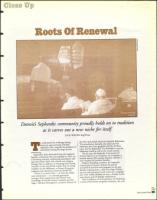

Roots Of Renewal
Detroit's Sephardic community proudly holds on to tradition
as it carves out a new niche for itself.
JULIE WIENER Staff Writer
o understand the challenges facing
America's approximately 250,000
Sephardic Jews, magnify the problems of
assimilation facing the larger Jewish
community.
Sephardim, Jews descended from the medieval
Spanish community that was expelled in 1492, are
a shrinking minority confronting assimilation and
ignorance about their rich cultural and religious
heritage. But in addition to worrying about losing
members to the non-Jewish world, they are losing
members to the Ashkenazi, or Eastern European,
traditions that dominate American Jewish life.
"There is a concern that — as with the Ashke-
nazi community — as a second generation
emerges, that's a generation that doesn't have
knowledge of the old country's customs and her-
itage," said Jane Rosengarten, executive director of
T
the New York-based American Sephardi Federation.
"It's assimilation, basically, the same kind the
Ashkenazi Jews have grappled with for all these
years, but for Sephardim, it's assimilation into the
Ashkenazi world as well as the overall society."
The 81-year-old Sephardic Community of
Greater Detroit is no exception. In its heyday, it
boasted almost 200 member families, whereas it
now numbers 66 member families.
Despite dwindling numbers, the Sephardic
Community of Greater Detroit has greatly
increased its activities and programs in the past
decade, evolving from a club with High Holiday
services and occasional social events to a congrega-
tion with weekly Shabbat services, a Sunday morn-
ing minyan and full holiday celebrations.
And in defiance of its long history of inhabiting
a series of borrowed, temporary locations, the corn-
9/4
1998
Detroit Jewish News
69