

munity recently purchased_ an acre for
ing point will be when the congrega-
a synagogue on the northviest corner
tion starts offering a religious school,
of Walnut Lake and Orchardd-Lake
something she wants in place by the
roads. It has enough money saved to
year 2000.
begin construction; letders hope to
lost;*-lotolpeople because
have the synagogue completed by the
we didn't provide any programs for
fall of 1999. For the first time ever,
children," she said. "Even when we
the community is actively searching
started to do regular Shabbat services,
for a rabbi and members are talking
there was no place for the children to
about eventually starting up children's
go. A lot of the people who wanted
programs and a religious school.
thejr kids to have an education had
Things won't be easy in the short
run, however. Sasson Natan, the chaz-
z.an who helped orchestrate the con-
gregation's revival, moved to Chicago
two months ago. And Sephardic rab-
bis — particularly ones capable of
dealing with the diversity of Detroit's
Sephardic community -- aren't so
easy to find.
"The pot is smaller [than for
Ashkenazi rabbis], so we have to bring
in people from far away," said Kadima
Ben-Ezra, who grew up in the
Sephardic Community of Greater
Detroit and is its recording secretary.
The congregation is trying to woo one
local Sephardic rabbi, former Yeshiva
Beth Yehudah Principal Rabbi Avra-
ham Cohen, but so far with no suc-
cess.
"I'm of course very flattered and I
have a strong relationship with the
community, but I don't see how I
could do it; what with them moving
to West Bloomfield," said Cohen,
who teaches a Wednesday night class
for the Sephardic community and
advises members on spiritual matters.
"I feel like Oak Park is where I need
to be right now."
In addition to being without a spir-
itual leader, the congregation must
find another way-station because its
temporary home, Congregation Beth -
Achim, is making way for Akiva
Hebrew Day School as Beth Achim
merges with Adat Shalom Synagogue.
Nonetheless, leaders are optimistic.
"By next year, we'll have our syna-
gogue and rabbi, and
hopefully other families
-
will join then," said Eli
Shalom, who is vice-presi-
dent of the congregation.
He estimates that there 9
t
are 150-170 Sephardic
families in the Detroit
area, many of which
already turn out for High
Holiday services. He
hopes that within five
years, most will become
members of the congrega-
tion.
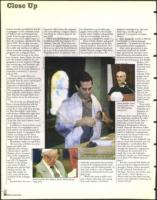
Board member Sam Pape at Sasson Natan going-
For Ben-Ezra, the turn- away party.
.
9/4
1998
70 Detroit Jewish News
no choice but to go to other syna-
gogues. Now we have a lot of older
people whose children and grandchil-
dren are not members, and we're
going to try to bring them back"-
Many of these children and grand-
children are descendants of the first
wave of members. Founded in 1917,
when Turkish immigrants Jacob and
Judith Chicorel arranged High Holi-
day services in their home, the
Sephardic community then primarily
consisted of immigrants from south-
ern Europe and the Mediterranean. At
that time, Ladino, a mix of Spanish
and Hebrew, dominated services and
gatherings.'
"When your parents didn't want
you to know what they were saying,
they spoke Ladino," said Susan
Alspector, whose parents, Sam and
Pearl Papo, met through the
Sephardic Community of Greater
Detroit.
Mow sepice,s are mostly in Hebrew,
and- Ladin8
a dying language
worldwide — is spoken by only about
20 members of the congregation.
More recent generations to join
come from Israel and the Middle
East. Jacob David, who grew up in
the community and remains active,
estimates that the community is now
an even mix of European and Middle
Eastern, with
Middle Eastern
becoming more
dominant.
However, a
melange of lan-
guages can be
heard at all
functions, and
with members
from Greece,
Turkey, Israel,
Egypt, Tunisia,
Iran and else-
where, the com-
munity is a ver-
itable United
Nations.
Board member Jacob
Many active
David speaks at Sas- members of the
son Natan's going-
Sephardic con-
away party.
gregation are
married to
Ashkenazi Jews, something which is
not religiously a problem for either
group. Jacob David's wife, Pam, is
Ashkenazi, and the family also
belongs to Congregation Shaarey
Zedek. Alspector married an Ashke-
nazi man and for years was active pri-
marily in Ashkenazi congregations,
but recently has become more active
in the Sephardic community.
"There are very few Sephardic cou-
ples in which both husband and wife
are Sephardic," said Kadima Ben-
Ezra, who met her husband, Isaac,
through the Sephardic congregation.
"It's because the community is so
small. But even with Sephardic-
Ashkenazi couples, we could attract a
lot of them if we offered more pro-
grams."
Ben-Ezra is herself half Ashkenazi
and received her religious education
through a Hebrew school sponsored
by the Lubavitch Foundation of
Michigan. However, her mother, Lau-
rette Lavadi —from Morocco —
always made sure the family was also
active in the Sephardic Community of
Greater Detroit.