
S. 9 55 5U u . S
Allk Adik A AML Ailk Aulk
V --O-o 0
0 0 0
1 0 0 a
w
0 0
COVERSTORY
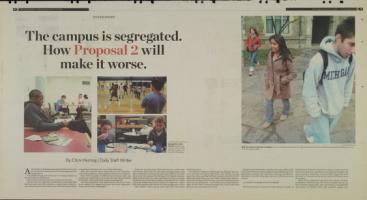
The campus is segregated.
HowP swill
make it worse.
Wednesday, Novernber 15, 2006 - The Michigan Daily
PHOTOS BY BEN SIMON/Daily
Segregation is wide-
spread throughout the
campus: in dorm cafete-
rias, study lounges, and
recreational buildings.
With the amount of diversity on campus, there are countless opportunities for integration between students of different backgrounds that often go unno-
ticed and unappreciated.
By Chris Herring Daily Staff Writer
A tlast Friday's chemicalengineering230 lecture in room
1013 of the Dow Building, much of what happened was
commonplace.
Prof. Phillip Savage started lecture by writing formulas on
the old-fashioned blackboard.
Instruction started precisely 40 minutes past the hour.
And just like most Mondays, Wednesdays and Fridays that
the class meets, the white students occupied most of the lec-
ture hall duringthe class, while nearly all of the black students
sat together in the front two rows of the auditorium.
This class, and the many others like it at the University,
raise larger questions concerning the school's race relations.
How well do people of different races interact with one
another on campus? How can we get the educational benefits
of diversity when much of the campus is segregated?
And most important, how much harder will it be to inte-
grate students on campus now that race-based affirmative
action can't be used at Michigan?
Many see the disconnect between races as a social issue
that must be dealt with. But, the task of getting people of dif-
ferent ethnicities to interact became more difficult last week
when state voters passed the Michigan Civil Rights Initiative.
Eight hundred thirteen underrepresented minority students
enrolled in the University's freshman class this fall. Bt if the
University follows the trend of schools in California - hit in
1996 by Proposition 209, which also banned affirmative action
- that number could drop by more than half with future
incoming classes.
Out of all the California schools that saw dramatic decreas-
es in minority enrollment after Prop. 209, UCLA's was the
most dire. After enrolling 289 black students in the fall of 1995
before the proposition, just more than a decade after affirma-
tive action was banned in the state, UCLA enrolled 96 blacks in
this year's incoming class --20 of whom were scholarship ath-
letes. Of the 4,800 incoming freshmen the school welcomed
this fall, only 2.9 percent were black.
Many fear that Proposal 2 could have the same effect at the
University. What some tend to forget is that aside from just los-
ing minority students, the school also stands to lose whatever
interaction currently takes place between different races on
campus.
DIVERSITY IS MORE THAN NUMBERS
Phillip Bowman is director of the National Center of
Institutional Diversity, located on campus in the School of
Education. Bowman, a professor specializing in higher and
post-secondary education, is particularly concerned with
the level of interaction between people of different races
on campus.
"Most of the emphasis is placed on the school's diversity
in numbers," Bowman said. "It's almost assumed that, if you
have diversity numerically, that everything is accomplished
and people of different races will naturally engage each
Scanned image of the page. Keyboard directions: use + to zoom in, - to zoom out, arrow keys to pan inside the viewer.
November 15, 2006 (vol. 117, iss. 49) - Image 16
- Resource type:
- Text
- Publication:
- The Michigan Daily, 2006-11-15
Disclaimer: Computer generated plain text may have errors. Read more about this.