
w .0
0 0W
0 0pw
I . TeMchgn" enedyONvmer 20
Wednesday, November 15, 2006 - The Michigan Daily SB
Progress for the fallen giants
ZACK MEISNER/Daily
Many students of the same background decide to live together.
Perhaps the American automak-
ers have taken a lesson from their
Japanese counterparts.
Just a few days after Fox News
host Neil Cavuto made headlines
in Detroit newspapers for his opti-
mism regarding the future of the
American automakers, several top
executives from the Big Three took
an important step in righting the
ship yesterday.
The chief executives from Ford,
General Motors and Daimler
Chrysler met with President Bush
in the oval office, discussing some
of the issues that are most pressing
for the automakers.
This meeting was a rare display
of the foresight that the Ameri-
can manufacturers so often lack
- the same foresight gave Toyota
and other foreign automakers the
competitive advantage that they
have eagerly taken advantage of in
recent years.
It should be undisputed that
gas prices and climate change
have necessitated improved fuel
efficiency and the use of alterna-
tive fuels. As the realization that
changes in efficiency were neces-
sary spread across the nation, the
Japanese automakers were abli o
seize the moment. They became the
first to perfect hybrid technologies
and to produce trendy vehicles like
the Toyota Prius, which consumers
are still lining up to buy.
This was just one example of
how foresight has led to Toyota's
recent success. Having seen the
need for changing manufacturing
processes and technologies, Toyota
and its Asian counterparts were
able to streamline their production
cycles, allowing them to develop
these new technologies quicker
than the Big Three, one of many
reasons that the Motor City has
been drowning.
Consideringthis, one of the more
compelling topics addressed by the
president and his guests was energy
policy and how the industry might
be affected by changes in the com-
ing years. The fears of potentially
debilitating legislation have been
magnified by last week's elections,
as many congressional Democrats,
backed by environmental groups
like the Sierra Club, have recently
supported an increase in corporate
average fuel economy for SUVs and
pickup trucks.
Simply raising CAFE standards
would not achieve its goal effi-
ciently. Using conventional tech-
nologies to achieve a more efficient
output is an expensive proposition,
making the discourse between the
executives of the industry and the
nation, which focused on promot-
ing alternative fuels, particularly
intriguing.
The proposition for alterna-
tive legislation centered around
an agreement from last summer,
where the automakers agreed to
double the production of flexible
fuelvehiclesbycthe year2010. These
vehicles, which can run on biofuels
like ethanol, have become increas-
ingly popular among consumers.
But these vehicles remain tough to
fuel because ethanol pumps have
yet to pervade traditional filling
stations.
Having shown their willing-
ness to develop these vehicles and
knowing that the sale of flexible
fuel alternatives could help them
regain some of their lost market
share, the American executives
encouraged the president to sup-
port policies that would aid the
industry as it tries to pull its head
back above the water.
The resultof a bill that was signed
into law simply raising CAFE stan-
dards would be that the automakers
would be forced to pay fines for not
meeting the given level. Rather than
havingthe desired effect of creating
a disincentive for not meeting the
standard, the new standard would
likely justserve as an obstacle on the
way to new technologies.
Instead, Washington should
take advantage of the Big Three's
excitement regarding the develop-
ment of flexible and alternative fuel
technologies. The policies support-
ed by the industry executives were
surprisingly aggressive, and this
readiness to submit to lofty goals
displays a confidence that these
industry leaders have been lack-
ing in recent years. According to
The Detroit News, General Motors
chief Rick Wagoner even went as
far as to say that the proper incen-
tives could drive the manufactur-
ers to make biofuel vehicles half of
their total productiono by 2010.
Finally, the American automakers
have found something they believe
they can compete in, and with the
right congressional encouragement,
the Americans have a chance to cor-
ner a market much like the Japanese
have with hybrids.
Instead of supporting disincen-
other. But that certainly tends not to be the case.
It's not just a problem at Michigan, though. The
problem is nationwide."
Self-segregation can be seen every day on the
Diag, at campus parties and in dorm cafeterias.
Some say students' backgrounds influence who
they choose to spend the most time with once they
start college.
"I think a lot of it has to do with the person's
upbringing," said LSA sophomore Kate Mul-
rooney, who is white. "When I was brought up, I
was around a lot of different races. But if you are a
white student (who) hasn't had a lot of interaction
with minorities before, it could be more difficult."
Many students do come from largely segregated
areas, where they have had little contact with peo-
ple of other races. A significant portion of the Uni-
versity's black students come from Detroit, where
83 percent of the population is black, making it the
most segregated major city in America.
"If one looks at the challenge and why we have
this problem, they'll find that it's because of the way
society is structured," Bowman said. "It shouldn't
be a surprise - when students of different races
come to Michigan, they don't integrate well. The
number of integrated high schools pales in com-
parison to the number of completely segregated
high schools."
Although taking courses on race and ethnicity
may not be of pressing importance to some, many
feel education on the issue is just as necessary as
classes in other subjects, if not more so.
John Matlock, the University's associate vice
provost and director of the office of Academic
Multicultural Initiatives, feels that gaining knowl-
edge about other people's different backgrounds is
a type of education that is often overlooked but yet
Many students do
come from largely
segregated areas,
where they have had
little contact with
people of other races.
very important.
"To me, the best way to solve the diversity prob-
lem is to create opportunities for students to learn
about each other," Matlock said. "That opportunity
has to be there in order to make progress."
THE SCHOOL'S EFFORT
According to Bowman, Michigan is creating
more opportunities for people of different eth-
nic backgrounds to talk to each other than most
institutions. He said that the school offers Inter-
group Relations courses in sociology and psychol-
ogy. The classes generally are made up of about 20
people, all of different races, who meet to discuss
racial, ethnic and gender issues for two hours a
week. The courses take place in various residence
halls in order to help students relax and interact
with people of different races outside the class-
room.
The Intergroup Relations program, which was
started by LSA Prof. Patricia Gurin, has been large-
ly successful, Bowman says. With Gurin's help, 17
other universities across the nation have started
similar programs in hopes of duplicating what
Michigan started.
Bowman added that programs such as the Mich-
igan Community Scholars Program in Couzens
Hall focus on having dialogue between different
ethnic groups about various racial issues.
"The goal is not just for students (of different
races) to interact with each other, but to get stu-
dents to interact with each other around difficult
conversation," Bowman said. "We want students
engaging each other outside of classroom set-
tings."
Most of the University's residence halls have
multicultural lounges, where students take part in
events geared toward creating interaction between
people of different races.
LSA sophomore Samantha Pabich said when
she lived in Fletcher Hall last year, the 75-per-
son South Campus dorm held numerous events
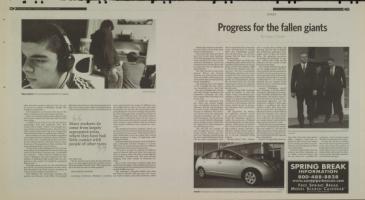
Auto Industry executives leave the White House after a meeting with President Bush
yesterday.
tives that won't have the desired
effect, Congress could have an
impact on the revival of the indus-
try by creating incentives and sub-
sidies for the development of these
new technologies.
Everyone understands that the
industry and these companies are
in trouble. Everyone knows that
the gas prices are a problem for
consumers. And everyone knows
that the environment is in trouble.
So now that we have a solution
that would encourage new growth
in the auto sector, new growth of
biofuel agriculture in the heartland
and a chance to save or create thou-
sands of jobs, why would we throw
it away for the immediate gratifica-
tion of interest groups?
APBPHOTO
BELOW: The Toyota Prius is an example of a vehicle that has given Japanese automakers a competitive advantage in recent years.
Scanned image of the page. Keyboard directions: use + to zoom in, - to zoom out, arrow keys to pan inside the viewer.
November 15, 2006 (vol. 117, iss. 49) - Image 15
- Resource type:
- Text
- Publication:
- The Michigan Daily, 2006-11-15
Disclaimer: Computer generated plain text may have errors. Read more about this.