
32 | OCTOBER 3 • 2024 J
N
I
n the midst of the High
Holidays, Jews around the
world are focused on three
key elements of this period of
reflection and renewal: tefillah,
prayer; teshuvah, repentance to
return to the truest and most holy
version of ourselves; and tzedakah,
righteousness. Together, it is hoped
that achieving these will help
achieve a favorable decree when
the Book of Life is closed on Yom
Kippur.
According to Rabbi
Yechiel Morris, rabbi
of Young Israel of
Southfield, this concept
was mentioned in the
Jerusalem Talmud in
Taanit (9b) in the fifth
century, citing a verse in
Chronicles 2 (7:14).
Today, tzedakah is often taken
to mean charity — the donation of
money to synagogues, nonprofit
organizations and to the needy. But
within Biblical texts and the views
of contemporary rabbis, tzedakah is
based on deeper, core Jewish values.
Rabbi Jeff Stombaugh, executive
director of The Well, says, “A
family needs to think about what
tzedakah means. It
is mistranslated as
charity. There are a
lot of different layers
to what tzedakah is.
Righteousness and
justice come to mind
first.”
Rabbi Morris points out an
article titled “Tzedakah: The
Untranslatable Virtue” by Rabbi
Lord Jonathan Sacks, the late chief
rabbi of Great Britain. Rabbi Sacks
described tzedakah as “distributive
justice” — a means
of leveling society’s
inequities when some
have more than needed
and others lack basic
necessities.
He stated in the
article: “The nearest
English equivalent
to tzedakah is the
phrase that came into existence
alongside the idea of a welfare state,
namely social justice … Behind
both is the idea that no one should
be without the basic requirements
of existence, and that those who
have more than they need must
share some of that surplus with
those who have less.
“This is fundamental to the
kind of society the Israelites were
charged with creating, namely
one in which everyone has a basic
right to a dignified life and equal
worth as citizens in the covenantal
community under the sovereignty
of God.”
Today, tzedakah during the
High Holidays may entail a special
campaign for synagogue charity
funds and donations to Jewish
nonprofits such as Yad Ezra. “This
year Israel is a major focus,” Rabbi
Morris says. He points out that
charity is a form of righteousness.
But tzedakah is not only mon-
etary contributions. It can mean
helping someone find a job, volun-
teering for a nonprofit organization
and other good deeds.
Rabbi Sacks turned to
Maimonides to explain the essence
of tzedakah as helping individuals
achieve independence.
“Maimonides lists the various
levels of giving-to-others, all except
one of which involve philanthropy.
The supreme act, however, does not:
According to Maimonides, ‘The
highest degree, exceeded by none,
is that of one who assists a poor
person by providing him with a gift
or a loan or by accepting him into a
business partnership or by helping
him find employment — in a word
by putting him in a situation where
he can dispense with other people’s
aid.’”
While not everyone can facilitate
another person’s financial indepen-
dence, all are capable of working
toward justice and achieving a gen-
erosity of spirit. The Torah provides
laws for a just society and, as Rabbi
Sacks stated, Jews are obligated not
only to follow them but also to pur-
sue tzedakah in various ways, as we
are reminded at Rosh Hashanah and
Yom Kippur.
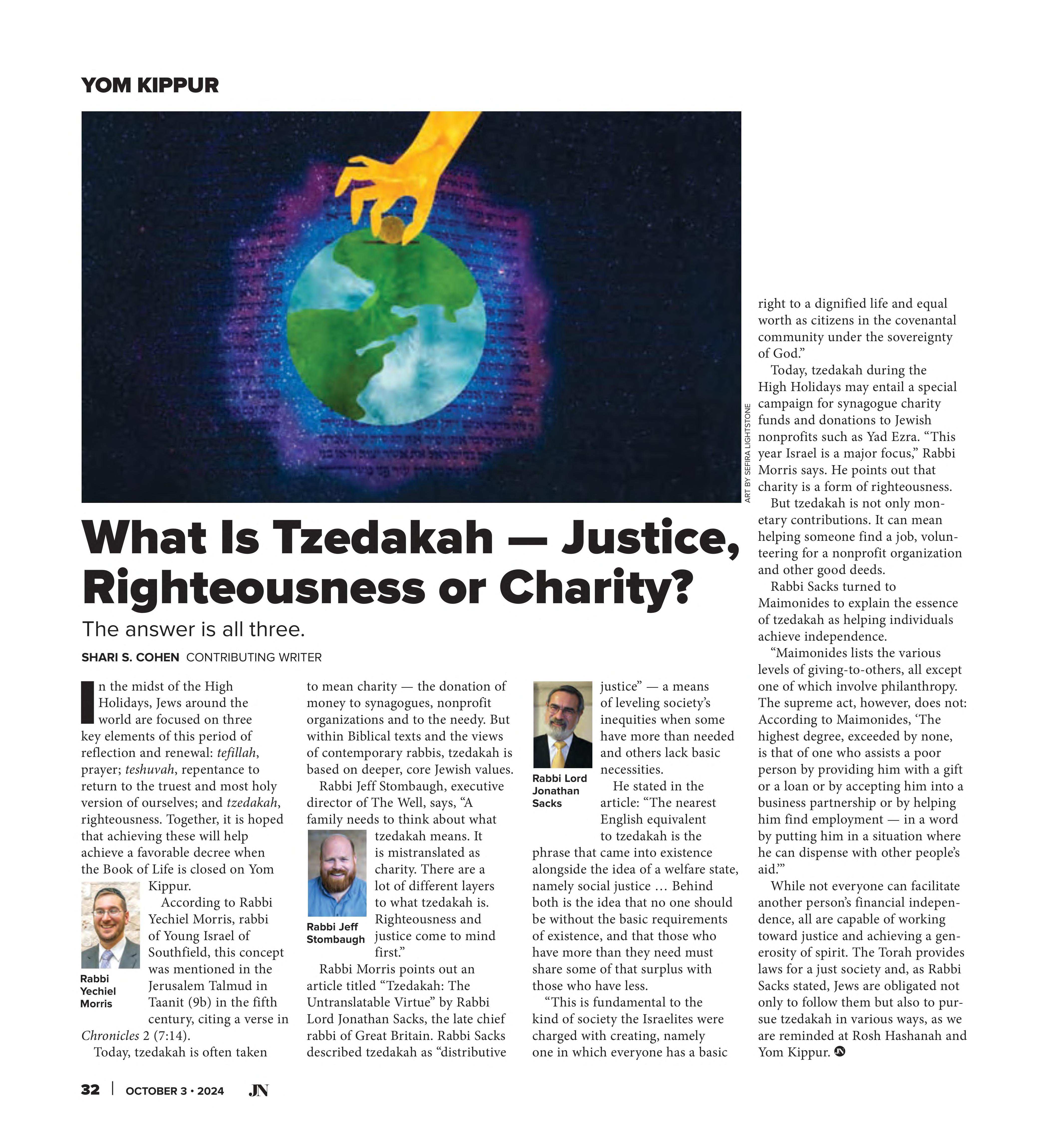
What Is Tzedakah — Justice,
Righteousness or Charity?
ART BY SEFIRA LIGHTSTONE
The answer is all three.
Rabbi
Yechiel
Morris
Rabbi Jeff
Stombaugh
Rabbi Lord
Jonathan
Sacks
SHARI S. COHEN CONTRIBUTING WRITER
YOM KIPPUR