

AUGUST 22 • 2024 | 19
J
N
and their families and help universities see a
path to making life better for students on cam-
pus.
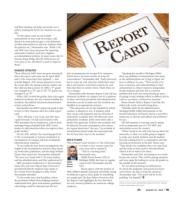
“In the report card, we say include
antisemitism in your code of conduct; talk
about it in your policies; give a real definition
of what antisemitism is; tell your students what
the policies are,” Normandin says. “Both U-M
and MSU have clear processes for reporting
antisemitic incidents and clear religious
accommodations policies. In many cases, they’re
already doing things. But the deficiencies are
very clear to see, and there’s a path to improve
them.”
GRADES UPDATED
Those efforts by MSU have not gone unnoticed.
Since the report card came out in April, MSU
and U-M’s scores have been updated — and
actually flipped. ADL always planned to revise
the scores after the spring semester ended, and
they did just that on June 18. MSU’s “F” grade
was changed to a “D” and U-M’s “D” grade was
changed to an “F.”
When ADL revised the grades, they once again
looked at incidents, the way schools handled the
incidents, the publicly disclosed administrative
actions and policies.
Normandin says MSU’s improved grade is due
in part to their response after the initial report
card.
“They still have a way to go, and they have
a path forward. I’ve had conversations with
MSU president Kevin Guskiewicz, and we have
meetings being scheduled with MSU senior
leaders to talk about how they can improve their
grade further.”
On the ADL website, the reasoning given for
U-M’s revised grade is “serious incident(s) at
encampment on campus and lack of adequate
administration response.”
“It was really the anti-Israel encampments, the
length of the encampments and how they stayed
up weeks after graduation, and the large Intifada
banner that stayed up,” Normandin explained.
“We were very frank with U-M senior leaders
and the administration, and they understood it.”
MSU president Guskiewicz, U-M’s president
Santa Ono and even Wayne State University’s
president Kimberly Andrews Espy spoke at
the Crain’s Power Breakfast in July, which
Normandin attended.
“In the weeks since that breakfast, where
the presidents talked about helping students
understand time, place and manner guidelines,
what things could be tolerated and the fact
that encampments are not good for campuses,
there’s been a lot more activity in terms of
conversations,” Normandin said. “Each university
has to come up with what they think their time,
place and manner restrictions need to be, and
then they have to enforce them. That’s when we
see a change.”
Normandin adds that this Report Card will not
eliminate incidents on campus, but it’s a pathway
to show university presidents and administrators
what they can do to make sure the incidents are
handled in an appropriate manner.
“The university can set the standard by which
conduct is allowed or not. If students think
they can go with impunity and do all kinds of
antisemitic incidents, that will effectuate more
antisemitic incidents. If the universities take a
harder line approach, I believe the incidents will
be deterred, because consequences for actions
are a great deterrence,” she says. “An incident of
antisemitism doesn’t make the university bad,
but it’s how they react to the incident.”
ADL’S PLANS
This is Report Card version 1.0. The ADL’s plan
is to have a new version come out
every year and to expand it.
“This is a starting point,”
Normandin says.
Rabbi Davey Rosen, CEO of
Michigan Hillel, has been in regular
contact with Normandin and the
ADL.
Rosen agrees with the portion of
MSU Hillel/Chabad’s statement essentially saying
it’s difficult to give a letter grade to something
so complicated. He does believe, however, that
the Report Card highlights the fact that there
are real, serious problems on American college
campuses.
“Speaking for myself at Michigan Hillel,
there are problems of antisemitism that many
in the administration are trying to figure out
how to address,” he says. “There needs to be
more awareness and understanding of what
antisemitism is, what it means to marginalize
Jewish students and how this is a serious
problem that won’t just miraculously go away —
it’s going to take strategic effort to address and to
come to a positive, constructive outcome.”
Rosen doesn’t think a Report Card like this
reflects the work currently being done.
“Whether that’s by the administration,
Michigan Hillel, Hillel International or the
Jewish Federation of Detroit, there’s a real effort
underway to educate and address the problems,”
he says.
The fall semester is starting, and it’s going
to be an important one at U-M, MSU and
universities across the country.
“What I need to not only hear but see from the
university, is what is actually going to happen
to make sure Jewish students and all students
feel safe coming back to a constructive and safe
learning environment in the fall,” Rosen says.
“They need to be confident they can come back
and be ready to learn and be welcomed back.
There’s a lot of work to be done.”
Normandin and ADL are hoping to see words
be put into action. They will be paying attention
and once again be looking to revise the grades in
the middle of fall semester.
“It’s not about pointing out deficiencies.
It’s about the pragmatic and practical actions
universities can take to help the situation,”
Normandin said. “The proof will be in the
pudding. I’m hopeful.”
Check out the Campus Antisemitism Report Card here: adl.org/
campus-antisemitism-report-card.
Rabbi
Davey
Rosen