

18 | AUGUST 22 • 2024 J
N
I
n April, the Anti-Defamation League’s
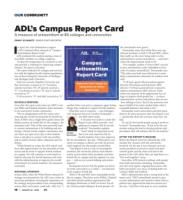
(ADL) national office released its “Campus
Antisemitism Report Card.”
ADL produced this analysis during a time of
incredible volatility on college campuses.
“It takes the temperature at a moment in time
and provides a roadmap for improving campus
climate,” the report card states.
The report looked at 85 colleges and universi-
ties with the highest Jewish student populations,
two of those being the University of Michigan
and Michigan State University.
Only two schools, Brandeis University and
Ilan University, received an “A.” Seventeen
schools received a “B”; 29 schools received a
“C”; 24 schools received a “D” and 13 schools
received an “F.”
U-M received a “D” and MSU received an “F.”
SCHOOLS RESPOND
Soon after the report card came out, MSU’s cam-
pus Hillel and Chabad released a joint statement
to the university’s Jewish community.
“We are disappointed with the report since
reducing the overall environment for Jewish stu-
dents at MSU into a single letter grade misses the
holistic picture of Jewish life on our campus,” the
statement read. “One of the most powerful ways
to counter antisemitism is by building and nur-
turing a vibrant Jewish campus community, and
our doors are open every day so that students
have a safe place to connect with one another,
and to explore Jewish values, education and tra-
ditions.
“While limited in scope, the ADL report card
does offer opportunities for the university to take
action and do more to support Jewish students
on campus. We will continue to work hand-in-
hand to advocate for Jewish Spartans and work
with the administration to improve the overall
environment for Jewish students,” the statement
concluded.
NATIONAL STRATEGY
In June 2023, when the White House released its
strategy on antisemitism, the ADL sent a letter to
university presidents stressing the importance of
the strategy and proceeded to list corresponding
actions their universities could take. After Oct. 7,
another letter was sent to campuses, again listing
things they could do to support Jewish students.
What they saw in response — says Michigan
ADL Regional Director Carolyn Normandin —
was little effort made.
A decision was made to create this
Report Card, which provides “real
pathways to improve life for Jewish
students,” Normandin explains.
“And I think it’s important to say
that it not only improves life for
Jewish students, but it also improves
life for all students,” she says. “When there’s acri-
mony on campus, it affects not only the person
who’s targeted, but the people around them.
“The Report Card is a way of assessing the
incidents, the university policies and adminis-
trative actions about those incidents, and then
Jewish life on campus and the supports on cam-
pus — with an eye toward helping universities
improve.”
Normandin stresses that the grades are direct-
ed at the universities as a whole — not directed
at the campus’ Jewish life.
“Both U-M and MSU have remarkable Jewish
life on campus. They have active Hillels, Chabads
and other Jewish student organizations like
Michigan Wolverine or MSU for Israel. For all
the ‘Jewish people talking to Jewish people,’ all
the checkmarks were green.”
Normandin states that while there were sig-
nificant incidents at both U-M and MSU, where
they really see the story being told is in the
administrative actions and policies — and that’s
where the improvement needs to be.
“For example, neither U-M nor MSU current-
ly have antisemitism really embedded in their
code of conduct and policies,” Normandin says.
“The other area both were deficient at is man-
datory antisemitism education for students and
staff.
“U-M had a good official position against
Boycott, Divestment and Sanctions; MSU
did not. U-M had a good advisory council to
address antisemitism; MSU did not. That’s
where the majority of the opportunity for col-
leges to improve their grades lies — in those
administrative actions and policies that are not
‘Jews talking to Jews;’ they’re the university stat-
ing on behalf of its entire student body what is
acceptable behavior and what is not.”
Normandin wants universities and their presi-
dents to be more proactive after this Report Card
— specifically about the concrete steps they can
take.
“It can’t be the Jewish people saying it needs to
be done,” Normandin says. “It has to be the uni-
versities taking the lead to develop policies and
procedures that will enhance life for all students.”
AFTER THE REPORT’S RELEASE
Before the Report Card was released, the ADL
checked the research with the universities
involved. On the day it was released, each uni-
versity president received an email with their
school’s grade and the name and info of the
person in the ADL office that can help them in a
“let’s work together” sense.
Soon after, ADL hosted a webinar with people
from both universities attending. Normandin
says she’s had regular, ongoing discussions with
both universities ever since, including both uni-
versities’ Hillel and Chabad.
MSU’s administration took a strong look at the
report card. “MSU immediately started to give
us more information and started to share with us
policies they approved but had not enacted yet,”
she says. “And that is the goal, to serve students
A measure of antisemitism at 85 colleges and universities
ADL
’s Campus Report Card
Carolyn
Normandin
DANNY SCHWARTZ SENIOR STAFF REPORTER
OUR COMMUNITY