

JULY 25 • 2024 | 39
THE FOLKLORIST
The folklorist Shmuel
Lehman traveled around
Eastern Europe collecting
enormous amounts of infor-
mation about everyday life
in different Jewish commu-
nities. He learned about
recipes and jokes, songs
and religious observances,
relations with non-Jews and
their relations with Jews, the
religious leaders and the
apostates, the slang of the
Jewish underworld and the
gangsters’ system of justice.
Lehman had a method
for getting informants to
“retrieve the passive knowl-
edge lodged somewhere
deep in their memories.”
He would tell them the
funny words that people in
some other area used. That
brought people “to recall
similar terms from their pasts,
terms that had been long
buried in their subconscious
minds.”
Years later, in Israel,
Auerbach worked at Yad
Vashem, training staff mem-
bers to interview Holocaust
survivors. Auerbach advocat-
ed for using similar methods.
She resisted the plan to use
scripted questionnaires,
rather she encouraged inter-
viewers to let survivors talk
in whatever direction they
chose.
Auerbach called Lehman
one of the lucky ones. As
he was dying peacefully in
his own bed, Lehman sum-
moned Auerbach to visit
him. He had a surprise for
her: His student read from
index cards a long series of
observations that Auerbach
had made about what the
Jews from Lvov had to say
about dumplings (kreplach
or blintzes). In this gesture,
Auerbach understood,
Lehman wanted to “show me
how valuable I had been as
an informant.”
After Lehman died, his
family held on to his archive
of index cards about Jewish
life in all the communities of
Eastern Europe. That invalu-
able collection did not make
it into Ringelblum’s archives,
and so, like Lehman’s wife
and son, did not survive.
A HATMAKER AND
SOME YOUNG GIRLS
As Auerbach’s soup kitch-
en grew, Halina Gelblum
an older woman who had
worked as a hatmaker, orga-
nized the office and became
the hostess. She organized
an office space and con-
jured up aprons for the
kitchen workers. Auerbach
recalls that Miss Halina
“was unpretentious, with-
out guile, unflappable and
blessed with a real empathy
for human suffering. It was
largely because of her that I,
along with my co-workers in
the kitchen, found the inner
strength to bear the unre-
lenting burden of a difficult
job and a desperate struggle
against a frightful reality … no
end of human tragedies …
and our inadequate ability to
really help.”
Dora, Stella, Dina, Khava,
Genya and Henie were the
young girls who helped in
the kitchen. “In the morn-
ings and after meals, they
peeled potatoes, cleaned up,
scraped vegetables, swept
the floor and washed dish-
es. At lunch time, they put
on white aprons, triangular
white kerchiefs and served
bowls of soup.”
Henie, the youngest, only
16, “would take on the tough-
est jobs. She could scrub the
floor and hoist large sacks
person would die, and so would everyone who knew the person
or cared about the person. Writings would not survive. Nothing
would testify that the person had ever lived. Auerbach, with a
short story writer’s focus, counteracts that total extermination.
She takes on the holy task of honoring the memory of each
person.
PRESERVING HER LITTLE WORLD
Ignacy Schiper, one of Ringelblum’s teachers, observed, “What
we know about murdered peoples is usually what their killers
choose to say about them.”
Auerbach devoted her efforts to preserving what she could
about each destroyed “little world.” She wanted to “add a few rays
of light shining on a few faces from the anonymous multitudes of
the murdered.”
Running a soup kitchen presented difficult administrative
problems. In the Ghetto, the kitchen never had enough food
to preserve the lives of its “customers.” By design, the German
rulers did not make enough food available, as they wanted the
Jews to die. Food smuggled in from other sources helped, but
the problem remained. A strictly equal distribution of the food
would seem fair but would not save lives for long. Auerbach
wrote that people who could not get another meal each day were
“swelling up from hunger and perishing.”
Exceptions, extra provisions, had to become possible for the
kitchen workers because “we couldn’t expect the people who
ladled out the food to go hungry themselves.” Could extra
provisions be provided for artists, writers, scholars? Could any
food be provided for the “customers” who did not technically
qualify? People who could eat another meal, in addition to what
the soup kitchen provided, could survive for some time.
Characters You’ll Meet
In Auerbach’s Book
continued on page 40
continued on page 40
WIKIMEDIA
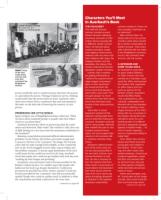
Jewish refugees waiting
in a soup line at a
shelter at 33 Nalewki St.
RIGHT: Three
of the nine
metal boxes
and two milk
cans that
contained the
Ringelblum
Archive
YAD VASHEM