

38 | AUGUST 1 • 2024
J
N
ARTS&LIFE
BOOKS
A
s conditions in Warsaw in
1939 became worse, people
realized they needed to
escape, if that was still possible. Rokhl
Auerbach had begun preparing to
move back to her native Lvov (now
Lviv, Ukraine) when the historian
Emanuel Ringelblum asked to her to
meet him. Ringelblum challenged her
to stay. If capable people all leave, he
argued, who will take care of those
who cannot? “We could not simply
abandon these people.”
He recruited her to manage a soup
kitchen. Ringelblum had become a
full-time community organizer, a
leader of Aleynhilf (Self-Help), which
operated refugee centers, day care
centers, libraries, an amazing array
of cultural institutions and dozens of
soup kitchens. Ringelblum had judged
Auerbach’s skills accurately; she soon
oversaw a staff serving one meal a day
to more than 2,000 Jews.
Ringelblum had another project:
collecting a written record of
everything about life in the Warsaw
Ghetto. At their Friday night meetings,
somewhat ironically named Oyneg
Shabbes (The Pleasure of Shabbat), the
writers planned to record everything
about life in the Ghetto: theater
troops, musical ensembles, religious
studies groups, everything had to go
into the record. Medical professionals
wrote dispassionately about the effects
of gradual starvation on the human
body.
In 1941, Oyneg Shabbes conducted
an essay contest. Ringelblum asked
Auerbach to write about the soup
kitchen. He had chosen well again.
Her essay focused on individuals she
met at the kitchen; she brilliantly
preserved the specific details in her
portraits of each one.
Under normal conditions, when
a person dies, besides official
documents that leave an impersonal
record of a life, the family and friends
cherish personal memories; physical
objects also attest to the person’s
having lived. Under the abnormal
conditions of the Warsaw Ghetto, the
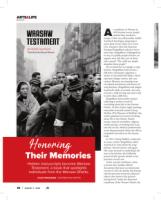
Honoring
Their Memories
Hidden manuscripts become Warsaw
Testament, a book that spotlights
individuals from the Warsaw Ghetto.
LOUIS FINKELMAN CONTRIBUTING WRITER