

AUGUST 1 • 2024 | 23
J
N
continued on page 24
the United States carried an
advertisement signed by many
of the leading Orthodox rab-
bis in America congratulating
Rabbi Rosner and urging
American Jews to consider
joining him.
Jason Schwartz and his
family did just that. They
had already planned to move
from America
to Beit Shemesh.
They just had
to decide on a
neighborhood. A
just-completed
townhouse on
Rehov Hasitvanit
seemed well-built
and spacious enough for the
family, and building a new
community seemed like an
adventure. Furthermore,
Schwartz and his wife, Chani,
had known Rabbi Rosner and
the rabbi’s wife, Dr. Tamar
Rosner, since their school-
days.
Many of the families on that
street are “Anglo-Saxim” (a
term for immigrants to Israel
from English-speaking lands),
but not all. Avner Shlomi, a
native Israeli whose
family roots go back
to Yemen, explains
how his family came
to live on this street
and mentions Rabbi
Rosner right near the
top of the list. “My
Rosh Yeshiva in Israel
approved.”
Even the founding
members of the syn-
agogue were not all
Anglo-Saxim. Rabbi
Amir Avraham, one
of the founding members of
Kehillat Nofei Hashemesh,
was born in Ethiopia. His
family escaped to Sudan,
where they lived in a refugee
camp for three years until
the opportunity came to fly
to Israel. He came to Israel
shortly before his bar mitz-
vah.
What attracted him to Beit
Shemesh? He calls it a strange
story: As a teenager he was
impressed by the polite way
some basketball players from
Beit Shemesh treated each
other and even invited him to
join their game. People think
of native Israelis as assertive
and direct, Ethiopians as def-
erential and circumspect. As a
young man, Avraham felt that
he would like to live in Beit
Shemesh among these polite
Anglo-Saxim. He now says,
with a sweet smile, “After I
served in the Israeli Defense
Forces as a paratrooper, I got
more comfortable with Israeli
manners.”
AN ETHNIC MIX
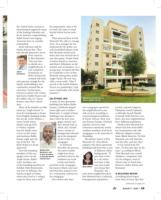
A series of new apartment
buildings line Rehov Rabbi
Yannai, a fishhook-shaped
street right next to Rehov
Hasitvanit. A couple of these
buildings were already in
place when the new syna-
gogue started, and
they already had an
ethnic mix. Israelis
from a variety of
backgrounds showed
up at the inaugural
events of the new
synagogue.
As Schwartz
describes the process,
the native Israelis
might have been
puzzled at first by the
emphasis on social
events and family
activities at the synagogue,
but many of them soon real-
ized that they wanted to live
in a community centered on
the synagogue.
Since those early days,
new synagogues opened in
the neighborhood to pro-
vide services according to
various liturgical traditions
of North African, West Asia
and Eastern Europe. Schwartz
explains, however, that
numerous community events
combine members of all local
synagogues, as do networks of
friendship.
The former mayor of Beit
Shemesh, Dr. Aliza Bloch,
explains why those apartment
buildings had Jews from a mix
of different ethnic
backgrounds. “If
you want to live
in a city where
everyone is like
you, you would
not choose Beit
Shemesh,” she
said. Some neighborhoods in
Beit Shemesh have a relatively
homogeneous population,
secular, national religious,
Ethiopian, haredi Sephardi
or Mizrahi, haredi Hasidic
or haredi Yeshivish; but even
there, the next neighborhood
has a different population.
Modern Beit Shemesh has
always had Jews from differ-
ent communities and with
different religious orienta-
tions. Bloch observes, “In Beit
Shemesh, you will find this,
and also this, and also that.”
It was mixed from the
start. “In the early days of the
state,” according to Bloch,
“Beit Shemesh was a small
Ma’abara, a temporary tent
city for refugees, most of
whom came to Israel from
Morocco, India, Yemen and
Romania.”
A BUILDING BOOM
A building boom began
more than 30 years ago: Beit
Jason
Schwartz
Aliza Bloch
Rabbi Amir
Avraham, one
of the founders
of Kehillat Nofei
Hashemesh
Apartment buildings on
Rehov Rabbi Yannai