

24 | AUGUST 1 • 2024
Shemesh grew into a develop-
ment town, still with a mixed
population of about 25,000
by 1995. A native of Kiryat
Gat, the future mayor grew
up in a family that came from
Morocco. When she married,
she moved to Beit Shemesh
— the first home for the
young couple. Her husband
is a medical doctor, whose
father came from Germany,
and whose mother is from a
sixth-generation Jerusalem
family. Beit Shemesh is a
microcosm of Jewish Israel.
Its citizens are from many
communities; for that reason,
the young couple came.
Bloch says, “Residents of
Beit Shemesh include immi-
grants from 50 countries;
residents speak 50 native lan-
guages — Hebrew (of course),
but English, Amharic,
Russian, Spanish and so on.”
The building boom contin-
ues: Beit Shemesh is now the
fastest-growing city in Israel,
with a population of more
than 150,000. Vistas of the
city include numerous con-
struction cranes. Even so, the
housing market has trouble
keeping up with the demand.
I asked Gashaw Getahun,
an electrical engi-
neer whose fam-
ily traces back to
Ethiopia, how he
came to live on
Rehov Rabbi Yannai.
He simply explained
that a friend told
him that an apart-
ment was available.
Eileen Greenspun,
a retired school
principal, and her
husband, Ira, a psycholo-
gist, began plans to move
from New York to Israel in
2018. They already had one
married daughter in Yad
Binyamin in Israel, and their
other married daughter in
the United States was eager to
move to Beit Shemesh.
Eileen and Ira bought
one of the townhouses
with a garage facing Rehov
Hasitvanit; stairs lead up to
the higher floors of the house,
but Ira’s multiple sclerosis
prevented him from using
the stairs. So, they redesigned
the garage into
living space,
and hired a con-
tractor to build
an elevator for
later. They loved
the community
from the start.
“I don’t think
either of us, ever
for one minute,
regretted it. Not
for one min-
ute. Ira would sit in front of
the house in his wheelchair,
which, Baruch Hashem, is
across the street from the
shul. Everybody who was
going down the block, which
was half the neighborhood,
would stop and say hello,”
Eileen says.
Neighbors regularly invit-
ed them for Shabbat meals,
served in the neighbors’
street-level garages. Ira died
last year; the elevator, Eileen
notes, “was finished the week
after his funeral.” Eileen has
decided to stay here in her
home, in her community.
Linda Lipstein and her hus-
band, Gary, had been living
in Pisgat Zeev in Jerusalem, a
location convenient to her job
in academic administration
at Hebrew University and
his employment in catering.
Then the COVID epidemic
disrupted the catering busi-
ness, and he was eligible for
retirement benefits, while
her employment was also
ending. Their neighborhood
was changing, too, with their
friends moving out, replaced
by younger people.
When Linda and Gary
moved to Rehov Rabbi
Yannai, they discovered that
they have many friends here
already. They also enjoy liv-
ing in an apartment building
with people of all ages and
ERETZ
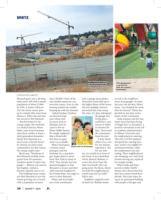
Eileen and Ira Greenspun
continued from page 23
This playground
is up the hill
from the writer’s
apartment.
Beit Shemesh is one
of the fastest-growing
communities in Israel.
Cranes are a common
sight.