

22 | AUGUST 1 • 2024
J
N
A
t the playground
up the hill from the
apartment building
where I live, little children
clamber around all sorts of
play structures.
The children,
Black, white and
shades of brown
in between, play
together. At
the end of the
school day, stu-
dents swarm out
of two schools,
the boys’ school and the girls’
school; the students walk
together. The neighborhood
is thoroughly integrated.
These children are Jewish,
like just about everyone in
this neighborhood called
Nofei Hashemesh in Beit
Shemesh. Most of us are fairly
observant. We, however, look
different from each other
and trace our recent ancestry
back to far-flung parts of the
world. I have been asking
locals to explain how it hap-
pened that we all wound up
in the same neighborhood.
Most of the people on one
street in this neighborhood
come from English-speaking
countries. That did not hap-
pen by accident, as I learned
from Jason Schwartz, who
has lived here since he moved
from America with his family
in 2008.
THE ORIGINS OF BEIT
SHEMESH’S ENGLISH-
SPEAKING RESIDENTS
In the early 2000s, real estate
developers committed to
putting a line of elegant
townhouses along the north
side of a not-yet-paved road
across a steep hill in Beit
Shemesh, facing downhill.
They named the road Rehov
Hasitvanit, after a
local wildflower, the
Sitvanit, the autumn
crocus.
To market these
new homes, the
developers turned
to Shelley Levine,
an immigrant from
America who had
become a power-
house of Israeli real
estate. She proposed
an innovative strate-
gy for populating the street: If
you can, get a respected rabbi
from America to move in, the
rabbi will start a synagogue,
and the community will grow
around the synagogue.
Rabbi Shalom Rosner took
on the challenge of founding
Kehillat Nofei Hashemesh
(Roughly, “Congregation
Sunscape,” echoing
the name of the
city, Beit Shemesh,
“Sun House”). Rabbi
Rosner, then 35
years old, headed a
growing synagogue
in Woodmere, New
York; taught Talmud,
Bible and Jewish Law
at Yeshiva University;
and recorded expli-
cations of classical
Jewish texts for a
huge group of followers.
When, in April 2008, he
announced that he and his
family were moving to Israel,
Jewish publications across
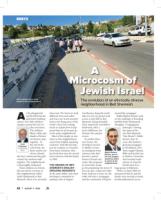
The evolution of an ethnically diverse
The evolution of an ethnically diverse
neighborhood in Beit Shemesh
neighborhood in Beit Shemesh
A
Microcosm of
Jewish Israel
Rabbi Shalom
Rosner, one of
the first English-
speaking rabbis
to move to the
neighborhood.
ERETZ
Girls walking home from
school in the neighborhood
Louis
Finkelman
Contributing
Writer