

18 | JULY 18 • 2024
J
N
O
n Sunday, June
23, The Zekelman
Holocaust Center
hosted its Honey Cake &
Latkes event with more than
200 people in attendance.
The event celebrated the
publication of a new cookbook,
Honey Cake & Latkes, by the
Auschwitz-Birkenau Memorial
Foundation. The cookbook
features the recipes and stories
of survivors of Auschwitz-
Birkenau.
The event began with
introductory remarks from
Rabbi Jeff Stombaugh of
The Well, which partnered
in hosting the event, and
Sue Webber, daughter of
local Detroit Holocaust
survivor Ruth Webber, who
contributed recipes to the
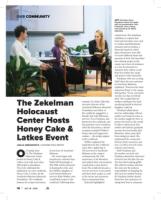
cookbook. Following these
remarks, Dr. Maria Zalewska,
executive director of the
Auschwitz-Birkenau Memorial
Foundation and editor of
the cookbook, engaged in a
fireside chat with Holocaust
survivor Tova Friedman, also
featured in the cookbook, and
her grandson Aron Goodman.
After the discussion, a dessert
reception included Webber’s
honey cake and cappuccino
cookies — the recipes appear
in the cookbook.
Webber explained the
inspiration for the cookbook
came after a gathering of
120 survivors of Auschwitz-
Birkenau at the camp to
commemorate the 75th
anniversary of its liberation
and realized their conversations
would always come back to
food. The cookbook became a
way for survivors to document
and share their recipes, as well
as the stories and memories
that accompanied them.
Zalewska highlighted
content from The Zekelman
exhibition to explain that
food and starvation were used
to weaken and dehumanize
prisoners and to produce a
hierarchy based on which
types of prisoners were able
to receive different kinds and
amounts of food. She described
how sharing recipes in the
camps was a form of resistance
as a way for prisoners to
maintain their culture, recall
their lives before the camps
and preserve their humanity.
Friedman, who was a young
child when she was a prisoner
in Auschwitz-Birkenau,
explained, “Food was the most
important thing” in the camps,
sharing that, “to me, starvation
was the way that everybody
died.” She recalled that her
mother would give her food,
sacrificing herself so that her
daughter could eat.
Friedman talked about
how her relationship with her
mother was based on trust, as
her mother taught her how to
protect her bowl so she would
be able to obtain food. Her
mother also had her gradually
increase her food intake after
liberation, when many died
from eating too much. She
emphasized the connection
between food, memories and
love, as well as survival, food,
memory and trauma.
Both Friedman and
her mother survived, and
Friedman shared her memories
of food in her life after the war.
She described making gefilte
fish with her mother and how
she took over the arduous
responsibility of chopping the
fish once her mother became
ill. Friedman further shared
about how the experience of
eating food from a restaurant
JOELLE ABRAMOWITZ CONTRIBUTING WRITER
OUR COMMUNITY
The Zekelman
Holocaust
Center Hosts
Honey Cake &
Latkes Event
LEFT: Grandson Aron
Goodman shares the stage
with his grandmother Tova
Friedman, who is being
interviewed by Dr. Maria
Zalewska.