

JULY 18 • 2024 | 19
PHOTOS COURTESY THE ZEKELMAN CENTER
does not compare to eating
homemade food and about
the role of traditional foods,
explaining, “It isn’t Friday night
if you don’t have chicken.”
During the pandemic, when
Goodman was 17, he recorded
videos of his grandmother’s
stories and started posting
them on social media to
educate people about the
Holocaust because he saw that
his friends and other young
people did not know about it.
Goodman emphasized that
many people do not have
access to Holocaust education,
and that even for those who
do, there is often a disconnect
between educators and
their students. Working and
traveling together, Goodman
and Friedman tell Friedman’s
story in a way that resonates
with Goodman’s generation.
The pair have developed a
substantial audience of 500,000
followers, about 70 percent of
whom are under 35, and have
amassed about 10 million likes.
Friedman described the
need to portray the events of
the Holocaust as “not long ago
and not far away,” emphasizing
that the antisemitism that led
to the Holocaust is still very
much apparent today. He also
stressed the importance of not
being a bystander.
Friedman has published
a memoir, The Daughter of
Auschwitz, and will soon
publish an illustrated book,
The Girl Who Lived to Tell Her
Story, telling her story as a
12-year-old, based on an idea
from Goodman.
At the dessert reception
following the program,
Friedman signed copies of
the book and attendees tasted
Ruth Webber’s honey cake and
cappuccino cookies, among
other desserts, and discussed
their reactions.
As Zalewska described
during the event, “You cannot
wear your ancestors’ shoes, but
you can make the foods they
cooked,” and the event was
an important opportunity to
connect with survivors’ stories
of their lives before, during and
after the war, and for the love
and memories inherent in their
recipes to endure.
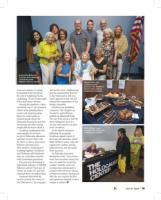
Auschwitz-Birkenau
survivor and cookbook
contributor Ruth
Webber with her family
Ruth Webber signs
copies of the book that
includes her recipes.
Recipes from the
cookbook yield
desserts like Webber’s
Honey Cake and her
Cappuchino Cookies.