

JULY 21 • 2022 | 53
G
abe Karp believes
conflict can be a good
thing, if handled
right.
As an operating partner
at Detroit Venture Partners,
venture partner at Lightbank,
keynote speaker and former
trial attorney, Karp, 52, of
Huntington Woods, recog-
nized that people are always
surrounded by conflict — and,
therefore, causing discontent.
The key to managing con-
flict, however, is learning how
to face it in healthy ways.
“If we detox the negative
conflict and we engage in a
healthy conflict, everything
gets better,” says Karp, who
recently authored the book
Don’t Get Mad at Penguins,
released in April 2022 via
Simon & Schuster.
The book’s focus: how to
make conflict work.
In talking about conflict,
Karp uses a simple analogy to
help people understand the
toxic traps of conflict, one that
translated to the book’s catchy
title. In fact, much of the
book is based on his keynote
speeches and tips and tricks
he’s learned over the years.
“The penguin analogy is
really a lesson in acceptance,”
explains Karp, who says that
although penguins have wings
and feathers, they simply
aren’t able to fly. “We should
accept people for who they
are and not expect them to do
things that they’re not capable
of.”
Adopting this mindset, he
says, can eliminate unhealthy
conflict.
“You either accept that or
you get mad at it,” he says of
penguins’ inability to fly. “You
can keep expecting it to fly,
and every time it doesn’t fly,
you’re going to get frustrated.”
It’s an “absurd thought pro-
cess,” he laughs, but one that
“resonates with people.”
THE NATURE AND
NURTURE OF CONFLICT
Karp says a fear of conflict is
a two-pronged process that
begins as a result of nature
and nurture. “Taking the
nurture side, we’re all social-
ized from a very young age
to shy away from conflict,” he
explains. “Maybe our parents
taught us that if we don’t have
anything nice to say, don’t say
anything at all.”
While this teaches good les-
sons, it can also teach people
to view conflict as a bad thing.
“Nobody wants to be that
person who’s always causing
trouble,” Karp says.
Nature’s influence, on the
other hand, creates a flight-or-
fight instinct, or how our body
reacts as a means to survive.
“We’ve got physiological
things going on in our bodies
that drive really poor uses of
conflict,” Karp says. A region
of the brain known as the
amygdala prepares humans
to detect threats, triggering a
flight-or-fight instinct.
It’s a necessary means to
survival, but it can also set the
stage for poor conflict man-
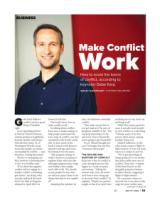
How to avoid the toxins
of conflict, according to
keynoter Gabe Karp.
Make Conflict
Work
ASHLEY ZLATOPOLSKY CONTRIBUTING WRITER
Gabe
Karp
BUSINESS
continued on page 54