

12 | SEPTEMBER 16 • 2021
OUR COMMUNITY
continued from page 11
R
ae Sharfman of West Bloomfield calls
herself “just a small soldier in a big
movement.”
She started volunteering to help save
Soviet Jewry shortly after the first Leningrad
Trial, which happened on Dec. 15, 1970. In
it, a group of Soviet Jews was charged with
attempting to hijack a small Soviet commercial
plane. Their aim was to reroute it to Sweden
from where they would
make their way to Israel.
On the planned day, the
group knew the author-
ities had been alerted,
but went through with
it anyway, prepared to
be arrested and inspire
a movement to free all
Soviet Jewry. As they
walked toward the plane,
they were beaten and
arrested.
The sentences the par-
ticipants received were
harsh, even according
to Soviet standards. Two
were sentenced to death,
and two others were
handed long prison terms.
Soon after the trial, “A woman came to West
Bloomfield and was speaking at one of the
synagogues. Her daughter had been arrest-
ed,” Sharfman recalled. “She stuck her finger
at the audience and said, ‘Your grandparents
left, your parents split, or you could be stand-
ing here begging for the life of your child.’
That hit me right in the heart. And I said, ‘OK,
we have to get involved.’”
Sharfman, whose parents were from the
Soviet Union, began looking for people to
work with and got in touch with Glenn Richter
at the Student Struggle for Soviet Jewry,
which had been founded by Jacob Birnbaum
in 1964 and was among the first grassroots
movements for the liberation of Jews from
the USSR. “He became my mentor,” Sharfman
said. “Then we formed a group in the
Michigan area.”
Armed with a telephone and a list of Soviet
Jews who had been arrested, harassed or
refused exit, Sharfman made calls. “There was
a whole network of people like me making
calls. We were a part of the Union of Councils
for Soviet Jewry. Whatever news we found,
we could send to prominent Soviet Jewry
activist Michael Sherbourne, who became the
center of information in London. We became
very good friends.”
Sharfman remains friends with many of the
people she met in the 1970s in the move-
ment. “We get together and we’re in touch all
the time, whether we’re in Israel or not,” said
Sharfman, who moved
back to Michigan from
Israel two years ago but
hopes to return soon.
One of those friends
was Pam Cohen, whose
book, Hidden Heroes:
One Woman’s Story of
Resistance and Rescue
in the Soviet Union, was
published in July.
During her years as a
volunteer, Sharfman went
to the Soviet Union twice
and constantly lobbied
people in Congress.
“People in Congress were
absolutely fabulous.”
She recalls a trip to
the Soviet Union in 1989 with the Union of
Councils for Soviet Jewry. “The Soviets were
not too happy we were there,” she said.
“People came from all over the Soviet Union
to speak. It was amazing.”
Once the Soviet Union began to break up
in the late 1980s, Soviet Jews were finally free
to go. “Until then, it was a big struggle, but,
thank God, we made it,” Sharfman said.
Sharfman said she knows of someone in
Israel working on a curriculum for high school
students to learn more about the history of
the Soviet Jews and what a “miracle it was
that we won.”
Sharfman is uncomfortable getting acco-
lades for her volunteer work that helped make
that miracle happen. “It’s not me. It was a
whole group of us doing the same thing,” she
said.
Sharfman said a majority of the Jews who
fled the Soviet Union came to Israel, where
more than a million of them live now. “They
have made an amazing contribution to Israel.
They’re just fabulous people,” she said.
A Telephone Soldier
JACKIE HEADAPOHL DIRECTOR OF EDITORIAL
Council like
Yost, was
alarmed by the
censorship. She
pushed hard for
awareness and
quickly became
one of the lead-
ing voices of the
cause.
Between 1984-1989,
Weiner served on the board
of the National Conference
on Soviet Jewry. She, along
with hundreds of others,
wore bracelets bearing the
name of a Soviet Jewish
refusenik. They marched,
protested and continued
to write letters to the gov-
ernment. “Most of it was
to bring attention to the
issues so that every single
congressperson, every sin-
gle senator or person in
the State Department, and
certainly the president, was
aware of it,” Weiner says.
At Passover, many
American Jewish families
also left out extra matzah
on the table in honor of
fellow Soviet Jews unable
to celebrate the holiday. As
more Soviet Jewish families
resettled in Metro Detroit
and the rest of the country,
knowledge about the wide-
spread issues they faced in
getting approval to emi-
grate continued to grow.
“There was a lot of red
tape,” Yost recalls. Some
Soviet Jews waited upwards
of years for approval, often
losing their jobs in the
meantime. Others, like the
refuseniks, waited years and
were still denied, becoming
ostracized from society
and pushed into a state of
limbo.
In 1983, Weiner and a
group of volunteers decided
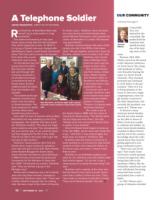
Rae Sharfman, on the far right, with a group
of Soviet Jewry activists in Israel three years
ago.
SHARFMAN
Jeannie
Weiner