

SEPTEMBER 16 • 2021 | 13
OUR COMMUNITY
to take matters into their own
hands. They boarded a plane
en route to Moscow and later
Leningrad with luggage full
of clothing, religious articles,
medicine and electronics
Soviet Jews could later sell,
like cameras. “We went as
tourists,” Weiner recalls, “and
at night we’d sneak out after
dinner to see Soviet Jewish
families.”
While in Soviet airspace,
they didn’t dare utter a word
of their mission in fear of
being overheard. They worked
undercover in partnership
with national organizations
that provided them with the
names and addresses of Soviet
Jews in need. In addition to
the religious artifacts that
helped teach these families
about Judaism, the electronics
and clothing could later be
sold to secure much-needed
cash for the lengthy emigra-
tion process.
The process often involved
a carefully organized pipe-
line that ran from Vienna to
Rome, which refugees would
spend months traveling
through. Prior to leaving,
Weiner and others secured
as many donations of blue
jeans as possible from local
merchants, which were a
hot commodity in the Soviet
Union and sold for high pric-
es, helping families secure
temporary housing in Rome.
In 1987, Weiner also
co-chaired a trip to
Washington, D.C., for Freedom
Sunday for Soviet Jews, a
national march and political
rally held on Dec. 6. There,
250,000 Jews and non-Jews
gathered to rally for more
American governmental sup-
port in the fight for Soviet
Jewry. That afternoon, three
planes full of Detroiters (plus
buses) went to Washington,
D.C. to join the rally.
“It was a massive demon-
stration,” Yost recalls, who also
attended the march.
The relentless efforts of
Weiner, Yost and hundreds of
others eventually paid off. Now,
thousands of Soviet Jewish
refugees and their American-
born families call Metro
Detroit home. They’ve become
an essential part of the Jewish
community and workforce, but
no one, not even those behind
the movement for Soviet Jewry,
could have imagined the extent
of the impact.
“We were up against a
brick wall,” Yost says of the
movement’s early days. “There
seemed to be no way to break
through it. That’s how it felt
for a long time until things
changed. It was a moment that
stands out in my life.”
“WE WENT TO THE USSR AS
TOURISTS, AND AT NIGHT
WE’D SNEAK OUT AFTER
DINNER TO SEE SOVIET
JEWISH FAMILIES.”
— JEANNIE WEINER
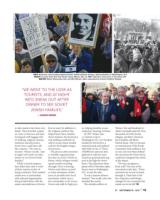
LEFT: American Jews protest against Soviet Jewish policies during a demonstration in Washington, D.C.
RIGHT: A scene from the Free Soviet Jewry March, Dec. 6, 1987, with Sen. Carl Levin in the lower left.
BELOW: Natan Sharansky, left, and Elie Wiesel, right, separated by activist Vladimir Slepak.
© WALLY MCNAMEE/CORBIS/CORBIS VIA GETTY IMAGES, JTA
ADL
PETER TURNLEY/CORBIS/VCG VIA GETTY IMAGES
JTA