

SEPTEMBER 16 • 2021 | 11
Remembering
Our Local Heroes
continued on page 12
Soviet Jewry was organized
by a small group of deeply
committed activists. This, Yost
explains, paved the way for a
wider communal movement to
launch several years later.
Piece-by-piece, awareness of
what Soviet Jews were experi-
encing daily made its way to
Jewish leadership in the Metro
Detroit community. They
learned that many Soviet Jews
experienced constant antisem-
itism, had limited education
and work opportunities, and
couldn’t openly practice their
religion. Children born after
World War II had little-to-no
knowledge of Jewish life, often
never having been exposed to
Jewish holidays or culture.
“It was a gradual awakening
to a very serious problem,” Yost
says.
Yet in the years that followed
the Six-Day War, the issues of
Soviet Jewry became entangled
in other major problems facing
the Jewish community. There
was the Yom Kippur War,
worry about domestic issues
and overall concern for Israel.
A dedicated group of individu-
als continued to push for Soviet
Jewry, though, and moved the
issue to the forefront of Jewish
concerns.
“The Jewish Community
Council was able to get a grant
from the Jewish Federation of
Metropolitan Detroit to focus
on Soviet Jewry,” Yost recalls.
“They were able to hire some-
body to specifically work on
Soviet Jewry, and that was me.”
In the early 1980s and on,
Yost and other supporters
dived straight into raising
awareness for Soviet Jewry, a
cause that was quickly gain-
ing speed and becoming a
major issue not only in Metro
Detroit, but across the entire
United States. They advocated
with elected officials, worked
with members of Congress
and pushed awareness for the
cause through community
education.
Jewish youth who became
bar or bat mitzvahed in the
1980s often participated in
a twinning program, where
they would receive a Jewish
“twin” in the Soviet Union who
couldn’t have their own bar or
bat mitzvah. American Jews
would recite the name of their
Soviet twin at their service,
honoring the individual while
also driving awareness for the
struggles of Soviet Jewry. Many
of these Soviet twins were
“refuseniks” or Soviet Jews
denied the right to emigrate.
FIGHTING FOR
THE REFUSENIKS
Freedom concerts, fund-
raisers, runs and more were
also put on by various Jewish
community organizations
and synagogues to spread the
message about the issue of
Soviet Jewry and catch the
attention of the government.
Many local families also par-
ticipated in an adopt-a-family
program where they would
write letters to a family in the
Soviet Union.
“This was a challenge
because many, if not most, of
these letters didn’t get through,”
Yost recalls. “People were
making phone calls. A lot of
the time the calls wouldn’t go
through.”
Activist Jeannie Weiner,
meanwhile, remembers writ-
ing letters that would receive
censored responses. “Probably
30% of it was missing,” Weiner
says, “but it caused me to learn
even more.”
Weiner, advocating for the
Soviet Jewry movement since
the mid-1970s and involved
with the Jewish Community
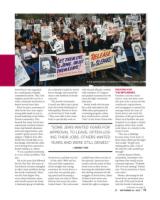
“SOME JEWS WAITED YEARS FOR
APPROVAL TO LEAVE, OFTEN LOS-
ING THEIR JOBS. OTHERS WAITED
YEARS AND WERE STILL DENIED.”
— BEVERLY YOST
A U.S. demonstration on behalf of the liberation of Soviet Jews
RICK MAIMAN/SYGMA VIA GETTY IMAGES VIA JTA