
jews d
in
the
travel
continued from page 107
The Inquisition records also
show details of several tri-
als and executions of Cuban
Judaizers, such as the 1613
burning of a rich landowner
Francisco Gomez de Leon.
The Holy Office in the Spanish
colonies was abolished only in
the early years of the 19th cen-
tury, and until the end of the
Spanish-American War of 1898,
only Catholic religious services
were allowed. What the Cuban
settlers of Jewish descent
wanted was to blend with the
Spaniards and “disappear” into
Cuba.
And they did.
CASTRO’S ANCESTRY
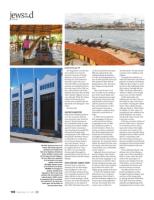
TOP LEFT: Sugarcane press on the
historic 18th-century sugarcane
plantation near Trinidad in the
Valle de los Ingenious. Hernando de
Castro, possibly a converso, built
the first sugar mill near Santiago in
the early 1500s, and is considered
to be the pioneer of the sugar
industry on the island.
TOP RIGHT: Spanish cannons
at the El Morro fort in Havana.
BOTTOM: The synagogue of
Santiago. Founded by the
Sephardim in 1924, it was closed
sometime after the revolution, and
reopened again in 1996 to service
its community of 90 or so members.
But in March 2017, the doors were
locked again. The last family, we
were told, left for Israel.
108
September 14 • 2017
jn
Fidel Castro himself admitted
on a few occasions that his
own ancestors were of Jewish
descent. Patrick Symmes in
his remarkable study of Cuba,
The Boys from Dolores (2008),
quoted Castro’s classmates,
who remembered young Fidel
stating that though many
young people in the 1930s were
fascinated with Hitler, Franco
or Mussolini, he could never
do so because those leaders
were anti-Semitic. And, as
Fidel explained, he could not
be “against the Jews” since
he, Fidel, was one himself:
He descended through his
grandmothers from the Jews of
Spanish Galicia and the Canary
Islands.
20TH-CENTURY JEWISH STORY
Our first stop in Cuba was
Santiago, the city that brings
history pilgrims to the very
roots of Cuban and Jewish his-
tory. Columbus landed in 1492
about 200 km to the east of
what is today Santiago, which
became one of the first Spanish
settlements on the island. In
July 1898, Theodore Roosevelt’s
cavalry attacked the San Juan
Hill and captured the city,
ending Spanish domination
in Cuba and bringing final vic-
tory in both Spanish-American
War and the Cuban War for
Independence. The American
Jews began arriving shortly
after.
They were the first “real”
Jews to settle on the island as
part of the much larger and
fast-growing American expat
community. Attracted by the
opportunities of investment
and the promise of wealth,
they saw themselves as first
and foremost Americans
and sought to replicate their
American environment in
Cuba.
In 1904, they founded the
first synagogue in Havana,
a reformed Union Hebrew
Congregation and, in 1906,
they acquired a plot for a
Jewish cemetery. These two
events are often considered
the official beginning of the
Cuban Jewish community,
an English-speaking Cuban-
American Jewish community to
be precise. An American island
within the island of Cuba came
into being. And American Jews
created their own comfortable
corner within it.
Sephardic Jews arrived next,
mostly refugees from Turkey.
Speaking Ladino, they did not
have the same language or cul-
tural barriers as did the other
Jewish immigrant groups, and
so had an easier time acclimat-
ing to their new home. The
largest group settled in Havana.
In 1914, the Sephardi estab-
lished their own communal
organization Chevet Ahim to
provide Orthodox religious ser-
vices to the entire Sephardim
of Cuba. They built their own
secure corner within the
“Jewish island” of Cuba, firmly
rooted in strict traditions and
religion.
Escaping the escalation of
rabid anti-Semitism and violent
pogroms in Russia and Poland,
Ashkenazi Jews began to arrive
in Cuba in the beginning of the
20th century through the late
1920s. The locals called them
“Polacos” (Poles) even though
many were not from Poland.
Unlike Sephardim, the
Ashkenazim saw their time on
the island as only a brief stop-
over before entering the United
States. They called Cuba the
Akhsanie Kuba or “Hotel Cuba”
in Yiddish. In 1924, when U.S.
immigration laws stiffened, the
Cuban loophole was closed.
The Jewish Cuban “hotel” had
to become a home.
With the economic decline of
the late 1920s came a national-
ist revival focused on return-
ing to the Cubans their rights
over their own country. Anti-
Semitism came naturally along.
Instigated by the Cuban nation-
alists in cooperation with
the Nazi German Embassy in
Havana, hostility toward Jewish
immigrants from Europe fueled
both anti-Semitism and xeno-
phobia.
These attitudes played a sig-
nificant role in the infamous
tragic case of the transatlantic
liner St. Louis, when this ship
with its 937 passengers on
board, most refugees from the
Third Reich, was not allowed
to disembark in Havana and
forced to return to Europe.
The fifth and last wave of
Jewish immigrants in Cuba
brought European refugees and
survivors of the camps prior
to, during and after World War
II. In spite of the anti-Semitic
attitudes and tightening of the
immigration laws in Cuba, more
Scanned image of the page. Keyboard directions: use + to zoom in, - to zoom out, arrow keys to pan inside the viewer.
September 14, 2017 - Image 108
- Resource type:
- Text
- Publication:
- The Detroit Jewish News, 2017-09-14
Disclaimer: Computer generated plain text may have errors. Read more about this.