
jews d
in
the
travel
The
Island
PHOTOGRAPHY BY ALEX SHALAND
Within An Island:
In Search Of
A Cuban
Jewish Story
To be Cuban and to be Jewish
is to be twice survivors.
IRENE SHALAND SPECIAL TO THE JEWISH NEWS
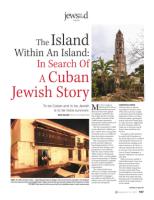
ABOVE: The oldest structure in Cuba — Diego Velazquez House in Santiago, 1516. If Luis de Torres was indeed a rich landowner
in the new colony, he could in all probability build a similar house like this one that used to belong to the first governor of Cuba.
TOP RIGHT: Slave towers like this one were built by rich plantation owners to seek runaway slaves.
M
y visit to Cuba in
March of 2017 led to a
remarkable personal
discovery that went against
everything I read before the
trip. Today, the Jews of Cuba,
once called a remnant of the
15,000-strong community,
demonstrate a phenomenon of
rebirth and reinvention.
The tiny community of 1,000
on the island of 11 million peo-
ple is robust, has a strong sense
of identity and is very different
from the Jewish community
before the 1959 revolution.
The contemporary Cuban
Jewish narrative depicts a
fascinating trajectory. First,
a descent from vibrancy and
prosperity to near oblivion
after the mass exodus of the
1960s and years of imposed
atheism. Then, a recent sudden
ascent to becoming a “Celebrity
of Tropical Diaspora,” arguably
the most visited and photo-
graphed of the world’s Jewish
communities.
The Cuban Jewish story
reflects not a single community
but rather a mosaic of several,
varied greatly in languages
and cultures and built by five
distinct waves of Crypto-Jewish
and Jewish immigrants.
CONVERSOS ARRIVE
Cuba has been a welcom-
ing refuge for the Jews since
1492, when conversos sought
a safe haven from the Spanish
Inquisition. There is no docu-
mented evidence proving the
arrival of the first Crypto-Jews
to Cuba. However, supposedly,
the first European settler in
Cuba was a converso Luis de
Torres, born Yosef ben Levy
Ha-Ivri.
An explorer and translator,
he sailed with Columbus on
the Santa Maria and is credited
with being the first person of
Jewish descent settling on the
island. Moreover, de Torres is
often proclaimed the first Jew
to set foot in the Americas! The
Luis de Torres Synagogue in
Freeport, Bahamas, was named
after him.
Many conversos settled in
Cuba following de Torres, but
little is known about them
and their Jewish ancestry.
The West Indies’ Inquisition
records contain lists of sus-
pected Judaizers. One of those
maranos, Hernando de Castro,
built the first sugar mill near
Santiago and is considered the
pioneer of the sugar industry
on the island.
continued on page 108
jn September 14 • 2017 107
Scanned image of the page. Keyboard directions: use + to zoom in, - to zoom out, arrow keys to pan inside the viewer.
September 14, 2017 - Image 107
- Resource type:
- Text
- Publication:
- The Detroit Jewish News, 2017-09-14
Disclaimer: Computer generated plain text may have errors. Read more about this.