

eretz
New Perspective
Diverse
group
of WSU
students
sees Israel
as a culture
apart from
conflict.
STACY GITTLEMAN
CONTRIBUTING WRITER
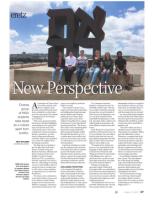
ABOVE: WSU students
at the Israel Museum
in Jerusalem: Matthew
Tukel, Shlomo Muszkat,
Tal Rosner, Annie
Petranovic, Angelina
Starceski and Joseph
Shoukair.
A
contingent of Wayne State
University students with
diverse religious back-
grounds and professional aspira-
tions embarked on what hopes
to be the university’s first annual
“Engaging Israeli Technology”
tour of Israel.
With a jam-packed schedule,
the itinerary blended highlights
and landmarks of a typical first
trip to the Jewish state with
customized visits to sites such
as high-tech startup incubators,
biotech companies, an Arab-
Israeli college specializing in
scientific studies and a pediatric
care center for children from
developing countries.
The May trip was funded in
part by gifts from individual
donors, notably Irving and
Barbara Nusbaum, Michael and
Elaine Serling and the Cohn-
Haddow Center for Judaic
Studies at WSU, according to
Howard Lupovitch, the center’s
director. Depending on funding
sources, Cohn-Haddow plans to
repeat the trip in coming years
to offer other curious students
an opportunity to see Israel for
themselves.
The trip was the culmination
of an Israeli culture course, part
of the Hebrew Israeli Studies
program in the Classical and
Modern Languages, Literatures
and Cultures Department. The
course was taught by professor
Edith Covensky.
“Your journey to Israel was as
unique as the peaceful cooperation
and collaboration found amongst
Jewish, Muslim and Christian
students here at Wayne State,”
Lupovitch said to some of the
students who gathered on campus
in late June for a post-trip debrief-
ing and presentation. “We all may
have read or seen something about
Israel in the media and Israel is
often portrayed through conflict.
But trips like this allow us to see
a culture apart from conflict, and
teach us not to reduce any society
or country down to [a narrow view
of] its problems.”
Lupovitch said plans are under-
way for students to give presenta-
tions about their trips on campus,
as part of the Judaic Center’s
Thursday lunch-and-learn presen-
tations, a session at the upcoming
October Midwest Jewish Studies
Association conference and the
March 2018 Limmud conference.
CHALLENGING PERCEPTIONS
As he wandered through the
streets of Jerusalem and dined
with a Druze family in the Golan
Heights, Near Eastern Studies
major Joseph Shoukair contem-
plated his Arabic identity, as the
trip challenged him to “take a good
look in the mirror and challenge
his own perceptions” about Israel.
“As a Lebanese American,
identity is a big issue for me,” the
Northville resident said. “The trip
was a positive experience because
I got up close to see the details of
Israel, but saw the big picture, too,
in a way that would have been
impossible if I hadn’t gone on this
trip. Jerusalem is like a quilt as you
walk through and experience all
of the different cultures that call it
home.”
Annie Petranovic of Lake Orion
desired to visit Israel since she was
16. As a Christian, she marveled at
both the sites from her own reli-
gion while learning about the holy
spots of others. She even put her
Hebrew minor skills to use.
“It brought all my studies into
focus as I was surrounded by the
language on both religious and
secular levels,” Petranovic said.
“Being in the Old City of Jerusalem
is like falling in love. And on a
practical level, I was able to read
street signs and ask for extra blan-
kets [in the hotel] in Hebrew.”
Geology and anthropol-
ogy major Lisatte Witterodt of
Farmington Hills was enthralled to
learn about the mineral deposits at
the Dead Sea, but what moved her
most were her encounters with the
Arab and Jewish employees at the
SodaStream factory.
“The SodaStream visit was very
powerful,” Witterodt said. “Several
times, people asked me to take
jn
photographs of them or wanted to
pose in photos with me, as if they
wanted me to remember them. It
was a very personal interaction
with the people who live in Israel.”
For some of the Jewish students
on the trip, like Risa White-Mabry,
who have spent several semesters
taking Jewish and Hebraic studies
courses, the visit to Israel filled a
spiritual void.
“You never realize you have a
spiritual vacancy until you find
what makes you complete,” Mabry
said. She added that a visit to
Plurastem, a company that devel-
ops connective tissue to be used
to treat many diseases, made her
realize that Israel is a place where
spirituality and technology feed
off and complement each other.
“In both Judaism and technology,
there is a constant need to seek
out knowledge and truth.”
It was Shlomo Muszkat’s third
trip to Israel. The only religious
Jew of the group, the biology
major from Oak Park found him-
self answering his travel mates’
questions about Judaism and
sharing insights into his Orthodox
upbringing to the others.
“Every trip to Israel is unique,
but on this trip, I found myself
marveling at Israel’s contribu-
tions to the 21st century as well as
confronting my own identity as a
religious Jew.” •
August 3 • 2017
27