

WIKIPEDIA
spirit
Jewish Magic
A
Louis Finkelman
Israeli professor
tackles the
controversial
topic in WSU
Press book.
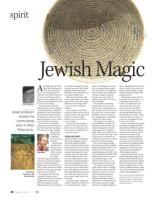
TOP: Ancient
“demon trap” with
Aramaic writing.
28
August 3 • 2017
dvocating for the Torah,
Rabbi Ben Bag Bag says,
“Turn it over and turn
it over, for everything is in it”
(Mishnah Avot 5:22). When Jews
try to view Torah from all per-
spectives, they usually open the
Talmud, which really does seem
to contain everything.
It has, famously, detailed
debates about matters of ritual,
competing analyses of biblical
passages and hard moral ques-
tions, but also medical recom-
mendations, recipes, tall tales,
jokes and advice on how to pro-
tect yourself from demons.
My teachers would either
skip the parts about demons or
read them quickly, translating
the words in a rapid whisper,
trying to get
through the
embarrass-
ment as fast as
possible.
Yuval Harari,
a professor of
literature and
Jewish folklore
at Ben-Gurion
Yuval Harari
University in
the Negev,
takes the opposite approach.
In his new study, Jewish Magic,
Before the Rise of Kabbalah
(Wayne State University Press,
2017), Harari presents a careful
analysis of every passage about
demons in the Talmud.
He supplements this with
examples of magic manu-
scripts from the Cairo Genizah,
sophisticated books of mys-
tical lore, popular amulets,
Babylonian bowls with Aramaic
jn
inscriptions designed to keep
demons away and other magic
paraphernalia from Roman
Palestine, Persian Babylon and
the Islamic Middle East.
But first, Harari deals with
some tough problems in defin-
ing his terms. How does magic
differ from knowledge (what
we call “science”) and from
religion?
For example, can invisible
creatures make a person sick if
the person eats with unwashed
hands? A Talmudic rabbi
believes they can. Is that sci-
ence or magic?
If someone calls on higher
powers to heal a patient or to
deliver rain in a drought, does
that count as a magical rite or
as a pious prayer?
JEWISH AND MAGIC
Another problem of definition:
What does “Judaism” mean?
The Torah explicitly forbids
forms of magic (Exodus 22:18 &
Deuteronomy 18:10-13), and rab-
binic literature formulates rules
condemning magic, but many
ordinary men and women prac-
tice their Judaism with a rich
mixture of superstitions. Some
historians insist that Judaism is
what those sophisticated rab-
bis say. Other historians say we
need to pay just as much atten-
tion to the Judaism of ordinary
folks. Still other historians point
out rabbis who themselves do
just as much magic as the ordi-
nary folks.
And what makes magic into
“Jewish” magic? Jews always live
in contact with other civiliza-
tions, and historians can assert
that our magical ideas or prac-
tices come from our neighbors,
each with their own traditional
versions of magic. Certainly,
though, some of the flow of
ideas goes the other way, from
Jews to gentiles.
The problems of defining
precise limits does not stop
Harari from considering exam-
ples of magic in Jewish sources.
He settles on a common-sense
definition: Any sort of adjura-
tion, calling upon a supernatu-
ral spirit for help, counts.
For example, in analyzing
the prohibition on magic, the
Talmud records that the sage
Abaye distinguishes between
“tricking the eyes,” sleight of
hand, which one should not do
because it looks like magic, and
using ritual or incantation to
actually produce objects, which
deserves the death penalty.
On the same page, though,
the Talmud records that Rabbi
Hanina and Rabbi Oshaia stud-
ied the laws of Creation and
regularly produced a heifer they
ate on Shabbat (Sanhedrin 67b).
What they did does not count
as forbidden magic to the
editors of the Talmud — but
Harari includes it in his book.
Accusations of practicing
magic define others as danger-
ous outsiders. Some medieval
Karaites (members of a once-
powerful Jewish group that
observes Torah but rejects
rabbinic authority) charged
rabbinic Jews with believing in
and trying to practice magic.
Defenders of rabbinic Judaism
had to distinguish between mir-
acles, which can or could once
happen, and forbidden magic,
which should not happen and
perhaps cannot.
Maimonides seems the first
to absolutely reject magic — it
is forbidden and it does not
work; we should know from
experience that it does not
work and from logic that it
cannot. Harari warns histori-
ans against identifying with
Maimonides: We cannot under-
stand the fullness of history if
we persist in judging the past
by our own criteria.
Books of Jewish law tell us how
the authors thought Jewish life
should be lived. Other materials
tell us how life was lived. Harari
examines the whole picture. He
reads texts of recipes for get-
ting spirits to help in mystical
experience, in mastering Torah
or success in love, or protection
from disease or injuring enemies.
He examines artifacts, bowls
designed to make a house safe
from demons and amulets to
effect medical miracles.
Harari calls this book, even at
569 densely argued pages, a pre-
liminary study. His book is pep-
pered with invitations for further
study. The book and the studies
it aims to inspire invite us to do
what my Talmud teachers could
not: Look at the history of Jewish
magic without judging it. •
Note: This Yuval Harari is different from
Yuval Noah Harari, an Israeli futurist
who wrote Sapiens: A Brief History of
Humankind and Homo Deus: A Brief
History of Tomorrow.