

arts & life
books
Renega
New York artist Archie Rand takes on the
Torah's 613 commandments — his way.
David Van Biema
Religion News Service
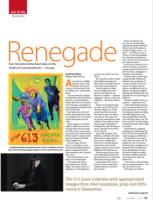
Archie Rand (below) completed his series, The 613, in 2008; for the first
time, all of the paintings appear together, in a book released last month.
new book by a trailblaz-
ing artist raises an old
question: Is there such
a thing as truly Jewish art? And
its corollary: If so, would anyone
buy it?
This past November, Penguin
Random House's Blue Rider Press
released a 1-pound high-gloss
volume titled The 613. It consists
of 613 full-page, screamingly col-
ored paintings by Brooklyn-based
artist Archie Rand.
Each features one of the 613
Jewish commandments (or mitz-
vot), distilled by the 12th-century
scholar Maimonides from the
Torah.
Rand's images, in a style that
might be called Leviticus meets
Amazing Stories (the ultra-pulp
mid-20th-century comic series),
incorporate each commandment's
Hebrew number. Captions stand-
ing in for museum wall labels
provide English text.
The first image, To Know
There Is a God, depicts a blue-
clad astronaut floating upended
against a background of char-
treuse mountains and a hot-pink
alien moon.
The $45 book boasts a mur-
derer's row of testimonials.
"Conceptual and retinal,
altar and push-cart, lox and
bagels:' raves Maus creator Art
Spiegelman. "In the beginning
was the word, and the word was
`Wow!"'
He is joined by novelist Cynthia
Ozick, Pulitzer-winning poet
John Ashbery, filmmaker Ang Lee
and a dozen more luminaries.
It almost makes you forget
just how unlikely the book is,
and how hard Rand, 66, has
labored in a tradition — painterly
engagement with the central texts
of Judaism — that almost doesn't
exist.
Western art developed largely
out of the soil of 1,500 years of
Christian religious art. In that
period, beyond the decorative
ritual objects, there was almost
no Jewish art. One reason was
the Second Commandment, often
rendered, "Thou shalt not create
graven images:' Although the
wording leaves room for interpre-
tation, it paralyzed art by believ-
ers for centuries.
Even today, the ghost of the
inhibition, combined with assim-
ilation and art-market ambiva-
lence, exerts a chilling effect.
Artists who are Jewish abound;
artists whose work seriously
engages Jewishness (such as Marc
Chagall and R.B. Kitaj) are few.
Museum-quality artists consis-
tently addressing the faith's beat-
ing textual heart are a small band,
Rand foremost among them
— claiming back "the conversa-
tion from which we have been
rebuffed and that we ourselves
have rejected:'
Rand, a secular Jew, did
not start out a Jewish painter.
Although he attended childhood
Hebrew school in Brooklyn, he
cracked the gallery scene — at
age 16 — in 1966 as, he says, a
"mascot" of color field painting,
New York abstractionism's last
wave. The New York Times lauded
his "impressive debut:'
But his career swerved in 1973
when he received a commission
to paint a mural of the interior of
the B'nai Yosef, a synagogue on
Brooklyn's Ocean Parkway.
Suddenly solvent, Rand began
mining the Bible, Talmud and
Judaism's vast commentary for
a visual vocabulary. But he ran
afoul of two groups: abstract
painters scandalized not only by
figurative painting but religious
painting, and Orthodox Jews who
regarded the exact same things as
idolatrous.
His backers boldly set the core
question — could Jews do art?
— before Rabbi Moshe Feinstein,
then American Orthodoxy's fore-
most legal scholar. The rationale
for Feinstein's positive oral ruling
eventually appeared in a post-
humously published book: Not
only could Jews make art for "the
honor of [God]; but those failing
to employ their gift "will be called
to account:'
Rand thinks the completed
synagogue, all 13,000 square feet
of it, is the first thematically illus-
trated synagogue in 1,800 years.
He imported his new subject
matter into his secular work. He
painted the cycle of 54 annual
Torah lectionary readings; the 18
blessings of the Amidah prayer;
the 60 manifestations of truth.
His style was highly accessible
but always included irreducibly
Jewish particulars, often the
Hebrew text.
"I don't want to make paintings
that were about Jewishness — but
that are Jewish:' he said.
Aficionados were effusive.
The 613 pairs mitzvahs with appropriated
images from Mad magazine, pulp and 20th-
century illustration.
continued on page 40
JN
December 31 •2015
37