

arts & life
film
Son OfSaul
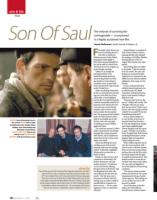
Geza Rohrig plays Saul in
Son of Saul
Left to right:
Sonderkommando member Dario
Gabbai, actor Geza Rohrig and
filmmaker Laszlo Nemes
FACING PAGE, TOP: Nemes and
Rohrig on set FACING PAGE,
BOTTOM Rohrig shooting a scene
details
Son of Saul won the 2015 Cannes Film Festival's Grand Prix; the 2015
New York Film Critics Circle Best First Film and Best Foreign Film;
2015 Los Angeles Film Critics Association Best Foreign Language
Film and runner-up for Best Actor, Geza Rohrig, plus many more.
It has been nominated for Best Motion Picture - Foreign Language
by the Golden Globes, which will air Jan. 10, 2016; Academy Award
nominations will be announced Jan. 14, and awards will be aired
Feb. 28. Son of Saul is scheduled to open in Detroit on Feb. 12.
38 December 31 • 2015
OM%
The mitzvah of surviving the
unimaginable — as examined
in a highly acclaimed new film.
F
Naomi Pfefferman I Jewish Journal of Greater L.A.
filmmaker Laszlo Nemes and
actor Geza Rohrig stood on
both sides of Auschwitz-
Birkenau survivor Dario Gabbai,
grasping his hands tightly as
they slowly and painstakingly led
him up the path to a home in the
Westwood area of Los Angeles on a
recent Monday morning.
Gabbai, 93, is perhaps the
last living member of the
Sonderkommando, prisoners
forced to drag bodies out of the
gas chambers, to burn them in
crematoria ovens, to grind their
bones and shovel the ashes into the
nearby Vistula River.
Nemes and Rohrig, respectively,
are the co-writer/director and lead-
ing actor in the film Son of Saul,
which offers a visceral glimpse
into the life of a Sonderkommando
rendered emotionally numb by his
gruesome work until he discovers
a boy who has survived the gas
chamber, only to witness a Nazi
doctor murder the boy minutes
later. The eponymous Saul embarks
upon a feverish mission to find a
rabbi to say Kaddish and to bury
the boy, even as his comrades
are plotting an armed rebellion
against the Nazis.
The movie has received a Golden
Globe nomination for best foreign-
language film, among numerous
other honors, and is considered a
virtual shoo-in for an Oscar nomi-
nation next month.
Nemes and Rohrig have been
traveling as part of the movie's
extensive press tour, but meeting
Gabbai "is definitely a highlight:'
Rohrig said in an interview as
Nemes nodded.
Rohrig, an observant Jew, cited
a character in Dostoevsky's The
Brothers Karamazov who tells
another character, 'In deference
to your [enormous] suffering:
then goes down on his knees:' said
the Hungarian-born actor, who
met Gabbai for the first time last
month. "I feel the same way in
the presence of Dario. He's been
through such an ordeal. I think he
sanctified life by trying his very
best to survive. ... It's very mean-
ingful just to have a conversation
with him"
Michael Barker, co-president of
Sony Pictures Classics, which is
releasing the film, also attended
the meeting, as did Hilary Helstein,
founding director of the Los
Angeles Film Festival, who video-
taped it.
When Rohrig first met Gabbai
in November, "I did not ask him
to see the movie the actor said.
Rohrig was concerned the film
might prove too traumatic for the
elderly survivor, who has suffered
nightmares of the camp over the
decades.
It was a sentiment shared by
Gabbai's closest friends and even
an official at the USC Shoah
Foundation. Gabbai had become
frail in recent months, finding it
difficult to walk.
"Everyone said, 'Don't see this
movie: " Gabbai said recently. "But
I thought, 'What do you mean,
don't see the movie?' I had to see it
because who else is going to tell the
world [if ifs accurate]? I'm the last
[Sonderkommando] alive."
Even so, before Gabbai was
to view the film at the home of
his good friend Paul Soroudi, a
45-year-old entrepreneur, another
close friend, ophthalmologist
Warren Reingold, took this report-
er aside. "I feel like I must protect
Dario:' Reingold said. Both Soroudi
and Reingold had spent a mostly
sleepless night worrying about
Gabbai seeing the movie.
When Gabbai requested that he
view the movie in private, I left,
only to receive a call from Soroudi
about an hour later saying Gabbai
had been fine with the film, which
his friends played with the lights
on and the sound turned low. They
invited me back to screen the sec-
ond half of the drama with Gabbai,
who was calm and dignified as
Son of Saul played to its harrowing
conclusion.
"The movie is pretty accurate
Gabbai said afterward. The sounds
emanating from the gas chamber
mostly rang true. "But nothing you
can see on film can ever be 100
percent:' he added.
Several days later, as the film-
makers met with Gabbai at
Soroudi's home, Nemes revealed