

arts & life
books
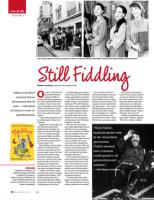
Left to right: Fiddler's Broadway marquee. The 1968 cast: Adrienne Barbeau, Bette Midler (making her Broadway debut) and Tanya Everett
F
•
Barbara Isenberg I Special to the Jewish News
Fiddler on the Roof's
universal themes
still resonate after 50
years — read about
its history in a new-in-
paperback book.
The Highly Improbable, Ultimately Triumphant Broadway-to-Hollywood
Story of Fiddler on the Roof, The rimer Most Beloved Musical
Barbara Isenberg...,
neal,efs. .aut
details
Adapted from Tradition!: The
Highly Improbable, Ultimately
Triumphant Broadway-to-
Hollywood Story of Fiddler on the
Roof, ,The World's Most Beloved
Musical (St. Martin's Press), recently
released in paperback.
34 December 24 2015
0
n Sept 22, 1964, after the
long-awaited Broadway
opening of Fiddler on
the Roof invited guests gathered at
New York's swank Rainbow Room
to celebrate. The first review that
came in that night was from Herald
Tribune critic Walter Kerr, and it
wasn't good. But producer Harold
Prince read it aloud to his guests
anyway.
"I can't resist reading this to you:'
he said that night, "because it's so
irrelevant."
Apparently so. Nearly eight years
and 3,300 performances later,
Fiddler became the longest-run-
ning show on Broadway. Winner
of nine Tony Awards, including
best musical, Fiddler was still on
Broadway when United Artists
released Norman Jewison's film of
the same name in 1971.
Rarely offstage, rarely on hiatus,
Fiddler on the Roof has already
been back on Broadway for four
revivals, played London's West End
four times and remains among
Broadway's 16 longest-running
shows ever. There have been stage
productions all over the world —
including 15 in Finland alone —
plus thousands of schools, commu-
nity centers and regional theaters.
"Fiddler on the Roof re-created
musical theater; says Tony-winning
set designer Robin Wagner. "Until
Fiddler, musicals spoke only to
the immediate generation. Fiddler
showed how a musical could speak
to all generations and cultures."
Yet Fiddler began quite simply, a
work of passion by three Broadway
veterans seeking their next project.
In fall 1960, a friend sent lyricist
Sheldon Harnick a copy of Sholem
Aleichem's 1909 novel Wandering
Stars with the notion it might make
a good musical. Harnick loved it,
and so did his longtime collabora-
tor, composer Jerry Bock, with
whom he'd written the score for
Fiorello!, the Tony-winning musi-
cal about former New York Mayor
Fiorello H. LaGuardia.
When the two men took the
idea to playwright Joseph Stein, he
told them it was too sprawling a
story. Stein countered with Yiddish
humorist Aleichem's short stories
of Tevye the milkman, which
Stein's Poland-born father had read
to him in Yiddish when he was
a boy and which he thought had
better odds as a musical. The more
the three read the stories, the more
excited they got. And in March
1961, they had their first formal
meeting to talk about it.
Never mind that the project res-
onated with their Jewish heritage
and came from their hearts. Even
Prince, who was their first choice
to produce it, turned them down
initially, and so did other produc-
ers, one of them even asking what
they would do when they ran out
of Hadassah audiences.
"We had no idea what would
happen to this project," said Bock.
"What was special about it was our
personal connection to the material."
That connection surely bol-
stered them through several years
of work and frustration. When
Jerome Robbins came in to shape
and direct the show, they did what
composers, lyricists and librettists
have always done — they rewrote.
Through rehearsals and tryouts,
first at Detroit's Fisher Theatre,
then in Washington, D.C., Robbins
was their fourth author as they
turned what Prince calls "a simple
folk tale" into an American classic.
Stein turned out five drafts of
the show's book, and the songwrit-
ers came up with about 50 songs;
fewer than one-third were used.
Repeatedly, Robbins asked them
what the show was really about,
and he didn't stop until Sheldon
Harnick finally said, "It's about tra-
dition': Robbins replied, "That's it
Write that:' and so they did.
Fiddler's groundbreaking open-
ing number, "Tradition:' replaced
"We've Never Missed a Sabbath
"Until Fiddler,
musicals spoke only
to the immediate
generation.
Fiddler showed
how a musical
could speak to all
generations and
cultures."
— Robin Wagner, set desi ner