

arts & life
film
Featuring
documentaries with a
Jewish connection.
An Os ar
Overview
Tom Tugend I Jewish Journal of Greater L.A.
H
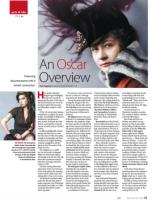
TOP RIGHT: The Outrageous
Sophie Tucker chronicles the
life of immigrant Sonya Kalish,
shown in 1917. ABOVE: The life,
in her own words and archival
footage, of the late English
singer Amy Winehouse
is chronicled in Amy.
ow foreign volunteers
fought to get the fledgling
Israeli Air Force off the
ground and the antics of the Last of
the Red Hot Mamas are two of the
storylines explored by documen-
tary filmmakers vying for a 2016
Oscar.
Of the 124 documentary features
competing in a category that usual-
ly plays second fiddle to Hollywood
blockbusters and glamorous
stars, at least 10 percent deal with
themes or personalities of special
interest to Jewish (and pro-Semitic)
viewers.
In Above and Beyond, archival
footage and interviews re-create
the tense days of 1948, when pilots,
navigators, bombardiers and radio
operators from English-speaking
countries smuggled in and flew
planes to form the nucleus of the
Israeli Air Force.
The emphasis is on a differ-
ent war and mood in Censored
Voices, in which Israeli soldiers
who fought in the Six-Day War talk
about their experiences immedi-
ately after returning to their kib-
butzim in 1967.
Far from boasting about their
miraculous victory over the forces
of five Arab nations, the returning
veterans dwell mainly on the bru-
talizing effect of war on the victors.
The British documentary Amy
probes the life and early death of
singer-songwriter Amy Winehouse,
described by her brother as "a little
Jewish kid from North London
with a big talent:'
Her meteoric career and tortured
life was cut short at 27 through
drug abuse and alcohol poisoning.
Among the greatest gifts Jewish
immigrants brought to the New
World is the old-time deli, and the
film Deli Man proves it by touring
some of the best establishments
from Broadway to Hollywood to
Montreal.
The Diplomat honors the career
of the late U.S. Ambassador Richard
Holbrooke, who, despite his Anglo
last name, was the son of Jewish ref-
ugees from Germany and Poland. In
the greatest achievement of his dis-
tinguished service, Holbrooke bro-
kered the 1995 peace treaty among
warring factions in the Balkans.
Jan Karski was a Polish-Catholic
and resistance fighter who sneaked
into the Warsaw Ghetto to witness
for himself the fate of Jews under
Nazi rule. Karski and the Lords
of Humanity tracks his desperate
mission to convince British and
American leaders, including a
face-to-face meeting with President
Franklin D. Roosevelt, that unless
they took action, the Jews of
Europe would be exterminated.
The Outrageous Sophie Tucker
chronicles the ups and downs
of the title character, who trans-
formed herself from immigrant
girl Sonya Kalish into America's top
female entertainer in the 1930s.
She got her start singing for the
patrons of her parents' kosher deli
before hitting the big time as the
Last of the Red Hot Mamas.
As confidante of a who's-who
of Israeli prime ministers, Yehuda
Avner has literally written the book
on the country's leadership and
diplomacy. His writings yielded the
earlier film The Prime Ministers:
The Pioneers, which has now been
followed up by the documentary
The Prime Ministers: Soldiers
and Peacemakers, focusing on
the leadership of Yitzhak Rabin,
Menachem Begin and Shimon
Peres.
Rosenwald honors the life and
works of Julius Rosenwald, a son of
German-Jewish immigrants and a
high-school dropout, who rose to
become the head of Sears, Roebuck
and Co. He spent a large part of his
fortune on funding thousands of
schools for black students in the
Jim Crow South of the early 1900s.
Henry Schoenker was born
in the Polish town of Oswiecim,
which the German occupiers
renamed Auschwitz, and was the
only member of his extended
family to survive the Holocaust.
Now deaf but unimpaired in voice
and memory, he tells of fleeing
from one hiding place to another
in The Touch of an Angel. Amid
a world indifferent to the fate of
Jews, Schoenker also encountered
heroic strangers who risked their
own lives to save those of hunted
strangers.
Some Palestinian filmmakers
apparently have realized that por-
traying absurdity may make their
point better than acts of terrorism.
Based on an actual incident, The
Wanted 18 tells the story of an
Arab village in Israel that decides
to stop buying milk from Jews
by purchasing 18 cows to make
"intifada milk:' When some Israeli
authorities declare the cows a
national security threat, the villag-
ers hide the animals.
The documentary is a
Palestinian-Canadian co-produc-
tion, created by Muslim, Christian
and Jewish filmmakers.
Hans Frank and Otto von
Wachter were Hitler's two top
deputies in Poland, responsible
for the killing of millions of Jews
and Poles. In the film What Our
Fathers Did: A Nazi Legacy,
human-rights lawyer Philippe
Sands, himself raised by survivors,
takes the sons — Niklas Frank and
Horst von Wachter — back to the
scenes of their fathers' crimes and
witnesses their different reactions.
In addition to the longer feature
documentaries listed, a separate
Academy of Motion Picture Arts
and Sciences category applies to
short documentaries. The list of 74
entries already has been whittled
down to 10 semifinalists, including
Claude Lanzmann: Spectres of the
Shoah.
In the short, French director
Lanzmann dissects the making of
his epic 91/2-hour documentary,
Shoah, which was 11 years in the
making and was released in 1985.
The 88th Academy Award nomi-
nations will be announced on Jan.
14. The Oscar winners will deliver
their acceptance remarks on the
evening of Feb. 28. *
December 24 . 2015
33