

1
Yet:' a song replete with references to
plucking chickens and baking challah.
Also scrapped were such songs as "A
Butcher's Soul" and "Dear Sweet Sewing
Machine:'
"Do You Love Me?" Tevye's query of
his skeptical wife, Golde, emerged in
Detroit, while Robbins' inimitable Bottle
Dance took shape in Washington, D.C.
While their first Tevye, Zero Mostel,
often sprinkled too much shtick over
his performances, sometimes squeezing
Tevye's wet rags over the orchestra pit or
joking with an audience member in the
front row, he was a comic genius. The
show's first review in Detroit was dismis-
sive of everything and everyone else, yet
Mostel was praised as "extraordinary"
and in New York, Newsweek's cover
headline was "Hail the Conquering Zero."
The day after Walter Kerr's lukewarm
review, favorable word of mouth was
offered by the rest of the critics. Ticket
sales didn't flag, and on July 21, 1971,
just months before the Fiddler film's
premiere, the show became the longest-
running musical on Broadway. Prince's
office reported that Fiddler had already
returned nearly $7 million on its original
$375,000 capitalization. Six other per-
formers had succeeded Mostel as Tevye
on Broadway, and the show had played
32 countries, from Spain to Rhodesia.
As Fiddler traveled the world, few
countries embraced the show more than
Japan. Its first performance there, in
1967, has been followed by hundreds
more over the years. Playwright Stein
said their first Japanese producer asked
him if they understood the show in
America. "When I responded, 'Why
do you ask?' recalled Stein, "He said,
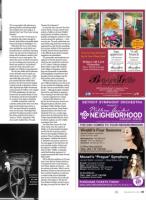
Zero Mostel
as Tevye in
the 1964
Broadway
production
`Because it's so Japanese:"
In much the same way that The Diary
of Anne Frank is not just a Jewish story,
neither is Fiddler on the Roof Fiddler's
strong themes of tradition, repression,
prejudice and diaspora continue to evoke
common ground for audiences — wher-
ever they are. The well-crafted book and
memorable songs don't hurt, but they are
augmented by a plot that has something
for everyone, whether ifs the importance
of family, friction between generations
or the difficult choices that accompany
emigration and assimilation.
The universality and timelessness are
captured in Norman Jewison's movie,
which has also traveled the world since
its 1971 release. Production designer
Robert Boyle created 1905 Anatevka
in the villages of Yugoslavia, and the
large cast represented 10 nationalities.
Cinematographer Oswald Morris shot
through women's stockings to get the
film's earthen colors and textures.
While the film's star, Chaim Topol,
says 1 billion people have seen the movie
by now, Jewison had challenges making
the film. First he worried that he wasn't
Jewish — although his agent reminded
him that he wasn't black yet made the
Oscar-winning In the Heat of the Night
— and also anguished over casting.
Convinced that Mostel was "too
big" for the role onscreen, Jewison was
besieged by phone calls from actors
and agents; Walter Matthau, Danny
Kaye and, says Jewison, Frank Sinatra
expressed interest. But when he saw
Topol play Tevye on a London stage,
Jewison knew he had found his Tevye.
"Chaim Topol breathed life into Tevye,"
he told the audience at a 2011 Fiddler
screening in New York.
For Frank Rich, former New York
Times drama critic, the creators of
Fiddler on the Roof similarly breathed
new life into the American musical.
Director-choreographer Robbins and
producer Prince, working separately
and together, "redefined the musical
to dramatize such serious concerns as
the street gangs of West Side Story, the
semi-psychotic mother of Gypsy and
the pogroms of Fiddler on the Roof'
observes Rich. "Fiddler, coming last,
ended the Broadway supremacy of
escapist hit musicals like Funny Girl and
Hello, Dolly!"
Will it still move audiences in 50 more
years? Actor Harvey Fierstein thinks so.
"I've played the show in San Francisco,
Fort Worth, Atlanta and Toronto ... and
the reaction is the same. When I was on
Broadway, I'd look out into the house and
there would be Chasidic Jews and nuns
or maybe a high-school cheerleader
team in town, and they all sat with rapt
attention. They all got it. The day the
boys finished writing it and put it up on
the stage, it was part of our cultur' *
Open
Christmas Eve,
New Year's Eve
and New Year's
Day!
Now Serving Brunch!
Sat & Sun 10am-2pin!
Holiday Gift Card
Promotion
Buy a $50 Gift Card and
eceive a $10 Bonus Card.
free
appetizer
$5 off
brunch
with purchase
of 2 entrees*
$20 purchase
minimum
"Must present coupon. Not valid
with other offers or prior purchases.
Expires 1-30-2016.
*Must present coupon. Not valid
with other offers or prior purchases.
Expires 1-30-2016.
,WensteinWrille
eVensteinWrille
Commerce Twp. 248-624-4100
Commerce Twp. 248-624-4100
food
BE
cocktails
eWensteiZrill
2435 Benstein Road ommerce
etween Maple and Glengary
248-624-4100
Mon.-Thurs. 4-10pm • Fri. 4-11pm • Sat. 10am-11pm • Sun. 10am-8pm
www.bensteingrille.com
■
38890
DETROIT SYMPHONY ORCHESTRA
PRESENTS
NEIGHBORHOOD
CONCERT SERIES
MADE POSSIBLE BY THE WILLIAM DAVIDSON FOUNDATION
THE DSO COMES TO YOUR NEIGHBORHOOD!
Vivaldi's Four Seasons
James Feddeck, conductor
Chee-Yun Kim, violin
•••
Mendelssohn Fair Melusina
Vivaldi The Four Seasons
Schubert Symphony No. 3
In West Bloomfield
THU., JAN. 7 AT 7:30 P.M.
The Berman Center for the Performing Arts
KIM
Mozart's "Prague" Symphony
Leonard Slatkin, conductor • Maya Beiser, cello
Dvofak Serenade for Winds
Elgar Serenade for Strings
Mohammed Fairouz Cello Concerto
Mozart Symphony No. 38, "Prague"
In Southfield
THU., JAN. 14 AT 7:30 P.M.
Congregation Shaarey Zedek
BEISER
PURCHASE TICKETS TODAY!
OR 313.576.5111
JN
December 24 2015
2043410
35