

world
Meet The Enigmatic,
Unpredictable Israeli Voter
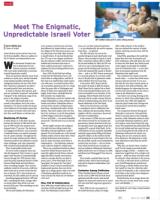
IDF soldiers take part in early voting process
I
Haviv Rettig Gur
Times of Israel
Israeli election returns had not come in by
the JN press deadline. Please see updates on
the JN website, www.thejewishnews.corn.
W
ho dominated Tuesday's elec-
tion to determine the next
Knesset and prime minister?
Why were earlier Israeli polls so uncertain
at predicting election results?
These are questions asked by many Israel
watchers in recent years, and by frustrated
Israeli political pundits watching with
undisguised jealousy the ease with which
their American counterparts are able to
accurately predict their own elections.
In Israel, in election after election, poll-
sters are constantly "surprised" and pundits
"stumped" by the unforeseen surge of one
party or the collapse of another.
The trouble with Israeli polls is not
rooted in the pollsters, but in the voters
themselves. It is hard to predict the Israeli
voter's behavior for the simple reason that
vast numbers of Israeli voters don't know
how they would behave on election day.
Shattering Of Parties
It wasn't always so. In the three decades
between the election of 1969 and the elec-
tion of 1999, Israeli voter turnout never
dropped below 77 percent. The electorate
was engaged and decisive, even in periods
of national trauma, war and the assassina-
tion of a prime minister. Throughout this
period, the major political parties offered
coherent narratives and solutions to Israel's
major challenges, and voters responded
with consistent and predictable support.
Then, Israeli politics broke down.
It's not too hard to pinpoint when and
why this happened. Voter turnout is a good
signal. After decades of consistently high
turnout through the 1999 election, there
came the prime ministerial election of 2001
between Ehud Barak and Ariel Sharon,
when everything changed. Voter turnout
suddenly crashed to 62 percent, a fall from
which it has yet to recover. In the last elec-
tion, in January 2013, voter turnout rose
somewhat, but still couldn't pass 67 percent.
Something happened between 1999 and
2001, something that had a stronger effect
on Israeli politics than all the wars and
turmoil of the past. That something was the
Second Intifada.
The Second Intifada, the Palestinian
terror assault on Israeli towns and cities
that followed (or, Israelis believe, caused)
the collapse of the Oslo peace process, was
not objectively worse than other traumas
in Israel's history. It was less bloody than
the 1973 war; it was cheaper and shorter
than the Lebanon conflict. But the Second
Intifada had one feature that none of
those conflicts possessed: it could not be
explained by the prevailing political narra-
tives of the day.
Since 1992, the left had been telling
Israelis that the Palestinians have a just
moral claim to independence, and that if
this claim was satisfied they would recipro-
cate with peace. As suicide bombers blew
up in Jerusalem pizzerias in the very weeks
when the peace talks in Washington and
Sharm al-Sheik were supposedly at their
height, Israeli voters concluded that the
left's narrative was simply false.
The Palestinians cannot be satisfied with
simple independence, many, perhaps most
Israelis now believe. Palestinians desire a
reversal of the narrative of dispossession
that forms a fundamental anchor of their
identity. They don't simply wish to be free,
but to be victorious, to see the descendants
of 1948 refugees returned in triumph to
Tel Aviv and Haifa — not merely Ramallah
and Jericho. The left hasn't won an election
since.
But the right's narrative also collapsed.
The right had been telling Israelis that
Palestinian national aspirations could be
ignored. Yet most Israelis saw in the Second
Intifada evidence that by sheer dint of their
political dysfunction and extremism —
and, for many, also their moral claim to
independence — the Palestinian national
cause could not simply be wished away.
This is not a sentiment limited to today's
Israeli left. Naftali Bennett, head of the
staunchly rightist Jewish Home, acknowl-
edges this shift in Israeli consciousness
when he concedes that his own plan to
annex Area C of the West Bank is not a
"good plan," but merely the "best plan"
available to Israel. It leaves unresolved the
fundamental question that even the far
right can no longer ignore: what to do with
a Palestinian population Israelis do not
want in Israel, but which has no Palestine
of its own?
Rise, Fall Of Unilateralism
Since 2000, then, Israelis' faith in the old
narratives of left and right has been shat-
tered. The Palestinians cannot deliver
peace, nor can their national aspirations
— or, less idealistically, the need to separate
from them — be ignored.
The 2001 election was won by the
grizzled old general and Likud leader Ariel
Sharon, who proceeded to launch in April
2002 a systematic military effort to defeat
the Second Intifada. By 2003, the IDF was
well on its way to dismantling the terror
groups and the funding and training net-
works that sustained the assault on Israel's
cities — and so, in 2003, Sharon announced
to a stunned audience at a security confer-
ence in Herzliya that he planned to unilat-
erally withdraw from the Gaza Strip.
In December 2005, Sharon had his
first stroke. By January 2006, his deputy
Ehud Olmert had to replace him as head
of the newly founded Kadima party, and
Israel was headed to new elections. In the
campaign, Olmert bluntly told the Israeli
electorate that he would continue Sharon's
policies by implementing some form of uni-
lateral withdrawal in the West Bank.
Olmert won that election, and with
it a mandate for such a withdrawal. But
then, suddenly and spectacularly, Olmert,
together with his countrymen, discovered
the limits of unilateralism.
In the summer of 2006, just two months
after Olmert formed his new Kadima-led
government, Hamas launched its first tun-
nel operation from Gaza against Israel, kid-
napping IDF corporal Gilad Shalit. As the
confrontation in Gaza escalated, Hezbollah
seized the opportunity, killing and kidnap-
ping IDF soldiers on the northern border
and sparking the Second Lebanon War. For
the next month, Israelis were bombarded by
rockets from two fronts — the two fronts
from which Israel had most recently car-
ried out unilateral withdrawals: Barak had
pulled Israeli forces out of Lebanon in 2000,
and Sharon had "disengaged" from Gaza in
2005.
Now, Israelis concluded that even the
political center, with its hard-nosed gen-
erals and its skeptical unilateralism, had
failed them.
Confusion Among Politicians
When President Barack Obama arrived
on the scene in 2009 with his fresh-faced
optimism and talk of peace and mutual
dignity, the Americans seemed not to notice
how tone-deaf their eagerness appeared to
Israelis.
Since 2006, for the vast majority of
the Israeli electorate, politics no longer
offers viable solutions to the problem
that once defined the contours of Israeli
politics: achieving a secure peace with the
Palestinians.
Likud MKs, appealing to the small ideo-
logical base that votes in primaries and
party institutions, often talk about the need
to annex the West Bank. But Likud's actual
voters support in principle the establish-
ment of a Palestinian state — or any other
form of permanent separation from the
Palestinians that might work.
This confusion has created a powerful
Israeli center — a center that avoids issues
of peace, land and security. It is no acci-
dent that the two major centrist parties in
this election, Yesh Atid and Kulanu, offer
detailed programs for improving the econ-
omy but only rhetorical lip service when it
comes to the Palestinians or peace.
And Labor's own strong showing in this
election, in which it has polled higher than
at any time since 1999, only happened
when the party's leader Isaac Herzog took
a decisive pivot toward that amorphous
Israeli center.
The comparison between Herzog and
Netanyahu is instructive. Herzog bluntly
refuses to promise peace in his campaign
speeches, while Netanyahu refuses to reject
in principle Palestinian statehood. Labor's
new support comes from former left-wing
voters who abandoned the political left after
the Second Intifada and have spent the past
15 years fearing that the left could not see
Palestinian dysfunction for what it was.
Herzog, they are now convinced, shares
their skepticism. His skepticism is vastly
more important to them than his dovish
aspirations.
Why, then, are Israeli voters so hard to
read? For the simple reason that double-
digit percentages of them — pollsters' esti-
mates have ranged from 20 to as high as 40
percent — didn't yet know who they would
be voting for when asked late in the process.
For most, it will come down to personal
trust. Could Netanyahu be trusted more
than Herzog, or Moshe Kahlon more than
Yair Lapid? Is it time for a fresh face after
six years of Netanyahu, or for a steady hand
at the helm as the country faces dangerous
regional turmoil ahead?
Israeli elections are no longer about solu-
tions; they are, at most, about trust, compe-
tence and likability.
❑
Haviv Rettig Gur is the Times of Israel's political
correspondent.
March 19 • 2015
33