

world
The World Loses A Great Leader
JTA
N
elson Mandela, the revolution-
ary South African leader who
forged close ties with his coun-
try's Jews in his fight to dismantle the
apartheid regime, has died.
Mandela, South Africa's first black
president, was 95. The current president,
Jacob Zuma, announced his death on
Thursday, Dec. 5.
Throughout his struggle against
apartheid, including 27 years imprison-
ment, Mandela found allies among that
country's Jewish community. "I have
found Jews to be more broad-minded
than most whites on issues of race and
politics, perhaps because they themselves
have historically been victims of preju-
dice:' Mandela once wrote.
There were tensions between Mandela
and the Jewish establishment over his
African National Congress' alliance with
the Palestine Liberation Organization.
Jewish groups mourned his pass-
After his election in 1994, however,
ing, with statements from the Anti-
Mandela sought out
Defamation League,
the American Jewish
Jewish leaders and
embraced them, making
Committee, the
American Jewish World
clear he saw a thriving
Service and B'nai B'rith
Jewish community as
International coming
essential to his country's
well being.
in the minutes after the
announcement of his
Mandela visited Israel
and the Palestinian areas
death.
in 1999.
"Nelson Mandela was
In both cases, he
a modern-day prophet
for human dignity
confronted and compli-
mented his hosts, telling
whose voice was heard
Israelis he sympathized
around the world, and
he inspired me and mil-
with Palestinian aspira-
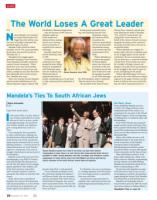
tions for statehood, and Nelson Mandela, circa 1998
lions of other Jews with
Palestinians that he
his message of equality
understood the fears of
for all:' Ruth Messinger,
Israelis, considering years of Arab rheto-
the AJWS president, said in a statement.
ric that countenanced the elimination of
"May his memory be a blessing:'
Israel.
The president of the State of Israel,
Shimon Peres, released a special state-
ment following the death of Mandela.
"The world lost a great leader who
changed the course of history. On
behalf of the citizens of Israel we mourn
alongside the nations of the world and
the people of South Africa, who lost an
exceptional leader.
"Nelson Mandela was a fighter for
human rights who left an indelible mark
on the struggle against racism and dis-
crimination. He was a passionate advo-
cate for democracy, a respected mediator,
a Nobel Peace Prize laureate and, above
all, a builder of bridges of peace and
dialogue who paid a heavy personal price
for his struggle in the years he spent in
prison and fighting for his people.
"Nelson Mandela's legacy for his peo-
ple and for the world will forever remain
engraved in the pages of history and the
hearts of all those who were touched by
him. He will be remembered forever:'
❑
Mandela's Ties To South African Jews
Moira Schneider
J TA
Cape Town, South Africa
I
n the early 1940s, at a time when it
was virtually impossible for a South
African of color to secure a profes-
sional apprenticeship, the Jewish law
firm Witkin, Sidelsky and Eidelman
gave a young black man a job as a
clerk.
It was among the first encounters
in what would become a lifelong rela-
tionship between Nelson Mandela and
South Africa's tiny Jewish community,
impacting the statesman's life at several
defining moments — from his arrival in
Johannesburg from the rural Transkei
region as a young man to his years of
struggle, imprisonment and ascension to
the presidency.
Mandela wrote of the early job in his
autobiography, Long Walk to Freedom,
and acknowledged the disproportion-
ate role that Jews played in the struggle
against apartheid. Lazer Sidelsky, one
of the firm's partners, treated him
with "enormous kindness" and was
among the first whites to treat him with
respect.
South Africa's Jews remembered
Mandela, the country's first democrati-
cally elected president, as a close friend,
one with deep ties to prominent com-
munity figures and a partner in the
28
December 12 • 2013
m
Nelson Mandela salutes the crowd at the Green and Sea Point Hebrew
Congregation in Cape Town on a visit shortly after being elected South Africa's
president in 1994. Joining Mandela, from left, are Rabbi Jack Steinhorn; Israel's
ambassador to South Africa, Alon Liel; Chief Rabbi Cyril Harris; and Mervyn
Smith, chairman of the South African Jewish Board of Deputies.
decades-long effort to end apartheid.
"I was extremely privileged to lead
the community during his presidency:'
said Mervyn Smith, who was chairman
and later president of the South African
Jewish Board of Deputies, the commu-
nity's representative body. "We met with
him on many occasions and the talk was
direct and open."
For Mandela, who rose to prominence
as a leading opponent of the discrimina-
tory racial regime known as apartheid,
Jews were vital allies.
Jewish lawyers represented him in
multiple trials, and Jewish activists and
political figures played leading roles in
the fight.
His Early Years
Nelson Rolihlahla Mandela was born
in 1918 in the village of Mvezo, in the
southeastern part of the country. As a
young lawyer he was active in the African
National Congress, which was beginning
to challenge laws it considered unjust and
discriminatory.
In the 1950s, Mandela was among 30
people tried for treason in Pretoria. They
were acquitted with the help of a defense
team led by Jewish attorney Israel Maisels,
whose son Dr. Jeffrey Maisels now lives in
Bloomfield Hills.
Jeffrey, whose father also was a well-
established leader in the South African
Jewish community, recalls Mandela
coming for dinner at the family's
Johannesburg home and later consult-
ing with his father on issues affecting the
Jewish community and the State of Israel.
Their relationship continued. At his
home, Jeffrey Maisels has a letter to his
father written by Mandela, congratulating
the elder Maisels on his 80th birthday.
Mandela also attended the shivah for his
father in Johannesburg in 1994.
Several years after Mandela was aquit-
ted in the treason trial, he was accused
of attempting to overthrow the apartheid
regime during the Rivonia Trial, Mandela
was defended by several Jewish lawyers.
Mandela was found guilty and sen-
tenced to life in prison in 1964. He served
most of his sentence on Robben Island, a
Mandella's Ties on page 65