

A Man For All Families
Local doctor remembers Mandela's impact on his family.
N
elson Mandela, or Madiba as he is affectionate-
ly called by millions of his admiring country-
men, exemplified an ideal of authentic leaders
who listen to the "still small voice within" and devote
their lives to the welfare of others. He dedicated his life to
the struggle of the South African people, fighting against
both white and black domination in a country plagued by
racism, poverty, inequality, corruption and oppression.
My white family benefited
directly from his courage, kind-
ness and perseverance. It is 60
years since we first knew him as a
customer in Johannesburg. During
that time, his influence grew from
legal support for poor blacks, to
local politics, to anti-apartheid
activism, to incarceration on
Robben Island for treason, to his
much-publicized release from
prison, presidency of South Africa
and exuberant worldwide admira-
tion. He was an international leg-
end, and his deeds and actions transcended color, race,
creed and ethnicity.
In 1953, Mandela opened a law office with Oliver
Tambo in Chancellor House on Fox Street, directly across
from the Magistrate's Court and just a short city block
away from my father's gas station. One of only a few
black men with a car, he was a regular customer.
My father talked about him with reverence, an unusual
style of language for a white man when talking about any
black person during the apartheid era of South Africa. I
heard stories about his activities in the court. He had a
self-confident, flamboyant style, while the black men I
knew were usually subservient in the presence of whites.
His legal skills were legendary for helping otherwise
helpless black people recover their dignity in a bewilder-
ing court system that usually landed black people in jail
for petty reasons. He was a hero to many, even in those
early days.
I saw him only once when he drove his colossal
Oldsmobile up to one of the gas pumps. My father rushed
out of the store to pump his gas and urged me to follow
so he could introduce me, but I was young and shy. The
only image I remember is of a black man with a white
scarf around his neck, perhaps a metaphor for the apart-
heid government choking the South African people.
That was the year that Mandela saved my father's life
from an angry crowd.
A Tragedy Averted
My father's buxom, fiery, flirtatious, red-haired secretary
ran the business office, stocked the shelves with auto-
mobile parts and served customers at the front desk. A
young black man walked into the shop and approached
the counter and she confronted him, calling him "boy."
He was offended and reminded her he was a man. She
quickly called her husband who owned a grocery store
about 300 yards up Commissioner Street. Her husband
ran into the store and confronted the bewildered young
man. He hit the black man on the head with a pistol and
then kicked him as he fell to the floor. My father and a
few of his gas pump attendants helped the bleeding cus-
tomer and restrained the grocer.
As the story of this unprovoked assault spread, a large
skilled in the 11 major languages of the country. They
were part of a new era of democracy that encouraged
open dialogue with representatives of women, business,
labor, land rights, youth, religious groups, senior citizens
and socio-economic rights. They formed a team to write
the new constitution, a document that set out the rights
and duties of all the citizens of the country.
Josh interacted with Mandela on many occasions and
was impressed with his memory of people and events
and his patient, ego-less approach to problem solving.
The president trusted Josh enough to put him in charge
of the ceremonies, voting and the presidential dinner
surrounding the adoption of the new Constitution. The
entire diplomatic corps, all the parliamentarians and a
range of other South African dignitaries attended. At the
party, Mandela's dignity fueled enthusiasm and excite-
ment. His influence on Josh was immense, exposing a
young white American to a great South African leader.
Mandela's heroic human values continued to influ-
ence powerful leaders in our own time, including the
president of the United States. I'm grateful that Mandela
played such a prominent role in saving my father's life
and business and that he gave my son an opportunity to
experience the birth of a new nation. Madiba, the wise
father to people of all colors and creeds, inspired us with
his wisdom and charisma. He has created a giant legacy
of social justice, an example for the rest of Africa and for
the world.
❑
Mandela casting his vote in the 1994 election
Dr. David Nathanson is a general surgeon in West Bloomfield.
crowd gathered around my father's store and threatened
to burn the business down. Mandela heard the noise and
walked down the street to see what caused the ruckus.
My father, by this time trapped in his store and praying
for a miracle, watched as the young black lawyer spoke
to the angry mob and urged them to disperse before the
police came. Mandela's presence of mind was evident that
day as the crowd listened and slowly dissipated. It was
the same dignified courage and charisma that has fueled
and expanded his legend.
The way Mandela helped my father exemplified the
leader's true heroism at a time when his own power was
eroded by the color of his skin. Nevertheless, his values
were defined by what he believed to be just and moral.
He did what was right, honest and good, even for those
who might have opposed his ideals.
Building A New South Africa
Forty-one years later my son, Joshua, soon after gradu-
ating with a degree in political science from Columbia
University in New York, worked with Madiba as one
of only two non-South Africans on a team of people
to develop a new constitution. He worked with the
Community Liaison Department of the Constitutional
Assembly (CA) in the first democratically elected govern-
ment in the history of the country, to arrange a series of
public participation hearings in which members of par-
liament met with various interest groups (seniors, tribal
leaders, educators, etc.).
Between February and August 1995, Mandela's team,
including Josh, held 26 Constitutional Public Meetings
in rural areas in all nine provinces to ensure that local
issues were addressed. CA members met with more
than 20,000 South Africans whose views were carefully
recorded and, when necessary, translated by a team
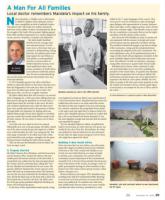
Mandela's cell and courtyard where he was imprisoned
for 27 years
JN
December 12 • 2013
29