

Work that matters
At Wayne State,
relevant research is
everyone's business
By Paula Neuman
All members of the Wayne State University
community, whether students or faculty,
have a variety of opportunities to engage in
research — creating new knowledge, new
products and new practices in their fields of
interest.
Over the past year, for example,
IIII David Rosenberg, M.D. discovered
a way to distinguish children and
adolescents with major depressive
disorder from children who are not
depressed.
N Roberto Romero, M.D. and Sonia
Hassan, M.D. discovered a way to
reduce the rate of preterm birth for
millions of women.
Jerry Ku began leading a team of
students in a competition to reduce
vehicles' petroleum use and emissions.
Research at Wayne State focuses on
improving lives here and around the world.
And these faculty members' research,
while certainly notable, is just the tip of
the iceberg. WSU's annual research awards
total more than $185 million. The university
spends more than a quarter-billion dollars
on research every year, ranking it high
among the nation's public universities for
research expenditures.
The Carnegie Foundation for the
Advancement of Teaching classifies Wayne
State as RUNH, a "Research University
(Very High research activity)," a designation
shared by only 2.3 percent of American
colleges and universities.
Students as well as faculty
contribute to research at
WSU. For example, Karen
Keaton Jackson was a
graduate student when
she helped lead a service-
learning research project
exploring how best to teach
children to read and write.
Through the King Chavez
Parks Future Faculty Fellows
Program and her studies in
the English department, she
guided undergraduates who
worked with at-risk middle-
school students, helping them
create online magazines and
studying how they learned to
write effectively.
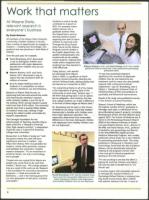
Roberto Romero, M.D, and Sonia Hassan, M.D. led a widely
publicized clinical study into a new method for preventing
premature birth.
Today Jackson, who earned
her doctorate from Wayne
State in 2004, is a professor at North
Carolina Central University, directing the
school's Writing Studio, passing along what
she learned as a researcher at WSU.
"An overarching theme in all of my classes
is the importance of giving back to the
community in some way," Jackson says. "I
tell them that giving back is not an option,
but an obligation. And certainly, the idea
that college students can make a difference
in the lives of others began at Wayne State."
Dr. Rosenberg and his team in the School
of Medicine are doing "work that matters"
dramatically to families with children who
have major depressive disorders. The
researchers determined that measurable
differences in the brain distinguish children
with depression from healthy children who
are not depressed.
Researchers in all fields of study are "well-
focused on where the work will have
significance and how it matters," says
Hilary Horn Ratner, WSU vice president for
research, whose office promotes, assesses
and facilitates the university's complex
research enterprise. "It's an investment in
America's future, not only in technology,
but in people.
"People who are a good fit for Wayne are
people who come here to do work that
matters," Ratner says. "We change people's
lives as a result of the work we do. Research
is the foundation for innovative educational
programs — inside and outside the
laboratory — and is the training ground for
our next generation of educators, scientists
and leaders."
4
"It may have potential treatment
significance for one-third of depressed
children who do not respond to any
treatment, and for many who also partially
respond with continued functional
impairment," says Dr. Rosenberg, who is
Miriam L. Hamburger Endowed Chair of
Child Psychiatry at WSU and professor of
psychiatry and behavioral neurosciences.
Results of his study were published recently
in the Archives of General Psychiatry.
Wayne's School of Medicine, which has
the highest number of M.D. graduates in
Michigan each year, is well-known for its
groundbreaking research projects, including
development of AZT, the first effective drug
against AIDS. The School of Medicine also is
home to the Perinatology Research Branch
(PRB) of the National Institutes of Health.
Last year Roberto Romero, M.D., director of
the PRB, and Sonia Hassan, M.D., professor
of obstetrics and gynecology and director
of the WSU/PRB/DMC Maternal-Fetal
Medicine Fellowship Program, led a widely
publicized clinical study into a new method
for preventing premature birth. The study,
published in Ultrasound in Obstetrics and
Gynecology, found that the rate of preterm
delivery can be dramatically reduced by
treating at-risk pregnant women with
a low-cost gel of natural progesterone
starting in the mid-trimester.
"It's very exciting to see that the effort is
paying off, and that mothers and infants
will soon be able to benefit from it," Dr.
Hassan says.
David Rosvnborg, MD: 4nd tii.$ rtsearch tarn
disc-ovmd that measurabit diffor@nceLs in the
bTdill distinguish thildwn with de mssion
from healthy children who are not Qprvssvd,
In another project with immediate reference
to everyday life, Assistant Professor of
Psychology Richard Slatcher is studying how
risky family environments affect children
with asthma. Asthma is the No. 3 cause of