

ass ac
Theatre professor hits
the mark with students
cind audiences alike
By Rebecca Kavanagh
One of Professor David Magidson's favorite
class assignments is deceptively simple:
Write a theatre review in one sentence.
His Wayne State University students groan
at the prospect of squeezing in every last
who, what, when, where and why before
the period. But they manage to prevail,
eventually, and the exercise helps them
with the next challenge: Write a theatre
review in one paragraph. By the time
Magidson grants his students an entire
page for stating the facts and expressing
their opinions, they feel as though they've
been given a gift.
And truly they have. These students have
the good fortune of learning their craft
from one of the most admired theatre
professionals in Metro Detroit.
Magidson entered the scene in 1991 as
dean of WSU's College of Fine, Performing
and Communication Arts. He quickly
became involved in off-campus theatre
endeavors, making connections and
joining the board of the Jewish Ensemble
Theatre Company. Now Magidson is a WSU
professor of theatre and has been artistic
director of JET since 2009.
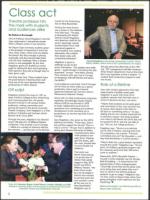
Through the years, Magidson has directed
nearly 100 plays for 16 different theatre
companies, most recently God of Carnage
— billed as a comedy of manners without
the manners — late last year at the Berman
Center for the Performing
Arts in West Bloomfield.
Among the roses thrown
was a review in The Oakland
Press that read, "The play
is directed by JET Artistic
Director David Magidson,
who deserves credit for the
actors' seemingly natural
transformation from mild-
mannered yuppies to
foul-mouthed, rum-swilling
adversaries who unleash
their darker sides with
unrestrained abandon."
aftWil 144414% 411 t tti**,01-% Ctomwmwoity Cwittitet
wiikw& lopte,s;it 4Atirt rArdemiiikomctt 4trfr tug(4.
Magidson is quick to
Nkw
attribute success to the
actors themselves. "Our people were really
good — good enough to be doing this play
anywhere," he says. "And that's coming
from someone who saw God of Carnage
on Broadway with Jeff Daniels and James
Gandolfini."
Local audiences concurred. God of Carnage
ran for twice as many weeks as a typical
production, due in part to a formal
agreement between JET and Ann Arbor's
Performance Network Theatre.
Along with six other professional companies
statewide, the Michigan Equity Theatre
Alliance (META) was formed in 2009
to foster collaboration at all levels of
operations from marketing and audience
development to the mounting of co-
productions, as was the case with God of
Carnage.
Says Magidson, who serves on the META
steering committee, "These days, there's
less and less support for the arts. This is a
way to survive." He says that in addition to
saving each theatre thousands of dollars,
co-productions allow
more people to see
each show. Theatres
split the duties, split
the costs, double their
run and double the
audience.
ttmi Ugstiarkt &Iva, Saab 444~4, Mk**
IMO
'Nowa U.sniku iktuPs 66li O'Ciottiae Aft pyoxistzldt IbT *Omit*
trocexitok litmitim amid iklifmnank* Natootitik.
That point was
driven home during
a co-production of
Palmer Park, jointly
staged in May 2010
by JET and WSU's
Hilberry Theatre. "We
knew there would
be a lot of people in
Detroit who wanted
to see that show but
who wouldn't come
all the way out to
West Bloomfield,"
Magidson says of
the play about the aftermath of the 1967
riot. "JET management and Blair Anderson
[WSU theatre department chair at the time]
felt it was important to find a solution." It
worked: Both productions played to sold-
out houses.
Role of a lifetime
Even with creative approaches that help
make theatre a feasible career path,
Magidson is aware that most of his
students' parents wish their kids were in
school to become doctors, not actors.
"Wayne State students are all quite good
and committed to this crazy business but,
of course, their parents want them to
fall back on something serious," he says,
adding that his own mother expected him
to become a lawyer. She always puzzled
over what to tell friends her David did until
he earned his Ph.D. and she was able to
say, "My son, the college professor..."
Magidson says, "We do try to talk kids
out of a life in theatre, warning them that
it's a marathon, not a sprint." The truly
committed ones can't be dissuaded — and
they find themselves in a prime position.
"Wayne State has a great theatre reputation
around the world," Magidson says. "At one
point, the Hilberry graduate program had
five vacancies and more than 500 actors
came to audition."
Meanwhile, WSU's Bonstelle Theatre —
housed in what originally was the Temple
Beth-El building — is renowned for the
opportunities it offers undergraduates.
"Local high school kids see the great work
we're doing here and realize they won't
have to stand in line behind graduate
students to get on stage," Magidson says.
"So they come to Wayne State rather than
going someplace more expensive and less
interestingAt
fkikecra ikOktifiggji41 ft Pr,"
//Vila/ VW/WM qtk
1k440* Utek WWI**