

points of view
EDITORIAL BOARD:
Publisher: Arthur M. Horwitz
Chief Operating Officer: F. Kevin Browett
Contributing Editor: Robert Sklar
>> Send letters to: letters@thejewishnews.com
Guest Column
Editorial
E
O
0
4.13
.0
Tisha BrAv Recalls
Our Darker Times
I
Mission After The Mission
Jewish/African American communities
find a common ground to build from.
QuanTez Pressley and Ben Falik
T
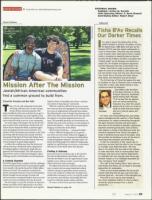
ake a 29-year-old, enthusiastic Jewish dad
with long, curly hair and a 24-year-old, pas-
sionate African American preacher with
longer dreadlocks of his own and what do you get? A
lesson on how individuals can come together across
cultures and experiences to find value in collaboration
and to share this value in service to our community.
Our story begins with burgers. We met for the first
time recently at the world-famous Checker Bar and
Grill to discuss Repair the World, a national organi-
zation developing a Detroit service initiative. A bi-
product of that conversation was Summer in the City's
partnering with the Checker Bar to paint a 90-foot-
long mural of the Spirit of Detroit and skyline. But it
was clear from that first encounter that we had even
more potential to do great things together.
As odd as this coupling may seem, the Jewish and
African American communities share a long history
of working together to advocate for people who are
oppressed and disadvantaged. This cultural partner-
ship, however, needs to be pronounced again as these
challenges persist in both familiar and evolving forms.
A Coming Together
We had the opportunity to explore both the challenges
and unrealized potential when we participated togeth-
er last month in the Jewish Council for Public Affairs
Mission to Detroit. The conference, hosted by the
Jewish Community Relations Council of Metropolitan
Detroit, brought several pairings of Jewish and
African American community leaders from across the
country to assess and address the issue of poverty.
We were happy to accept the invitation to represent
Detroit and embraced the opportunity to be ardent
ambassadors for our city. Spending the week together
helped us foster a friendship and achieve a cohesive-
ness aimed at impacting our community.
While the conference allowed the group to see just
how severe poverty and segregation are in Detroit, the
focus was on organizations and people here admira-
bly addressing the crises of hunger, homelessness and
other issues that result from poverty. We also observed
the absence of everyday integration between cul-
tures. This provoked questions and conversations on
whether race and racism continue to stunt progress in
Detroit and beyond — with conference participants
lining up on both sides of the debate.
However, the Detroit duo — young and restless
— share a different vantage point as our genera-
tion views race and culture without the baggage of
our predecessors. For us, interpersonal relationships
trump demographic dynamics. Through culture col-
lisions that bring people from different backgrounds
together on equal footing, we can have a conversation
that focuses on the future rather than the past.
Finding A Gateway
Race and racism do not preoccupy us the way they
have historically hindered relationships. Still, we
have thus far failed to seize the opportunity to come
together across cultures to chart a course based on
shared investment and mutual gain.
We walked away from the conference with a mis-
sion: to inspire and encourage intentional cultural
collisions among our generation that are rooted in
service and conducive to fellowship. We believe that
collaborative community service can help lift people
out of poverty and cultivate relationships that tran-
scend race, ethnicity, gender, culture and class.
Of course, we have more questions than answers.
t 's a day to mourn the destruction of the
Jewish Temples in ancient Jerusalem, first by
the Babylonians (586 BCE) and later by the
Romans (70 CE), plus the Jewish settlements in
Israel at those times. Tisha b'Av also has become
a day to mourn other destructive times in Jewish
history, including the deadly Exodus-era decree
by God, the fall of Betar and when Jerusalem was
"plowed under" by the Romans and rebuilt as a
pagan city. The English and Spanish expulsions
and the Holocaust have ties to the Ninth of Av.
Today, Tisha b'Av is a day to mourn the sav-
agery to Jews at the hands of Jew-haters who
not only border Israel, but who also infect France,
Iran, South Africa, Germany and other places
that harbor anti-Semitism and anti-Zionism.
The full fast day of Tisha b'Av begins this year
at sundown on Aug. 8. Beyond a day of mourning,
Tisha b'Av is when Jews lament being in exile,
scattered around the diaspora.
Says Rabbi Leiby Burnham
of the Weiss Partners in Torah
Program hosted by Southfield-
based Yeshiva Beth Yehudah:
"It is the day that we agonize
over not having merited the
messianic era, when the Jewish
people will all return to Israel to
Rabbi
build the third and final temple
Burnham
and live in eternal peace and
harmony."
For many Jews living fulfilling lives, the holiday
seems outmoded and the need for a Third Temple
unnecessary. For Jewish communities throughout
the ages, messianic harmony and world peace
were seen as the antidote to prejudice, oppression,
expulsion and being persecuted. Jews certainly
have stature in chunks of the West; yet Israel, the
ancestral homeland of klal Yisrael, the people of
Israel, is belittled around much of the globe. Tisha
b'Av provides the backdrop to pray for the kind of
world peace the messianic era would bring.
To feel the inspiration of this Jewish day of
mourning, we must feel the effect of our struggle
as a people. Says Rabbi Burnham, "We may
have a rich Jewish life, but what of the millions
of Jews who know close to nothing about their
heritage, who have never had the opportunity
to celebrate their bar mitzvah, have never said
Shemah Yisrael or lit a Chanukah menorah? Do
they not need a Third Temple?"
He's right in that feeling others' pain, when we
look deeply into others, we can begin to exchange
destruction for redemption.
That's an ever-elusive pathway. But its pursuit
indeed could help heal the pain, overcome hate,
promote good will – and usher in the messianic era.
Tisha b'Av is not a day to greet people; in
fact, that's prohibited. Rather, it's day to reflect,
recalibrate and re-energize from a Jewish
perspective. Li
Guest Column on page 26
August 4 2011
25