

points of view
Commentary
Guest Column from page 25
Floodgates Of Assimilation
Omaha/JTA
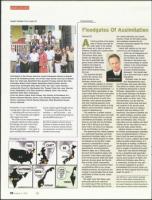
Participants of the African American Jewish Community Mission to Detroit
pose at the Heidelberg project, one of their stops during a bus tour of Detroit.
Back row: Allan Gale, Bloomfield Hills; QuanTez Pressley, Detroit; Ben Falik,
Huntington Woods; Emily Kaplan, Washington; Roslyn Duman, Denver;
Sarah Crane, Farmington Hills; Diane Fisher, San Jose; Joana Thurston,
Jacksonville; Elana Fox, Washington; Rev. Thomas Fisher, San Jose; Cherrish
Pryor, Indianapolis; Ariel Pearl-Jacobvitz, Oakland, Calif.; Irwin Venick,
Nashville; David Sklar, Indianapolis.
Front row: Marty Cooper, Scott Libman, Jim Vincent, all Providence, R.I.;
Barbara Shannon-Banister, Aurora, Colo.; Nickolas Alexander, Jacksonville;
Sharon Luckerman, Detroit; Rachael Malerman, West Bloomfield; Howard
Gentry, Nashville.
Nonetheless, we are committed to
creating space where our communities
— beginning with our own social cir-
cles — more frequently and emphati-
cally engage each other.
The success of our common endeav-
or depends entirely on others joining
this dialogue. We want to hear from
anyone and everyone — young or
old, male and female — who wants to
speak candidly, listen respectfully and
Greenberg's View
26
August 4 • 2011
pursue common goals through service.
If you'd like to be part of the con-
versation — and the action — you
can reach us at ben@werepair.org and
pressleyq@detroitmi.gov.
Ben Falik is manager of Detroit Service
Initiatives for Repair the World. QuanTez
Pressley is community outreach director
and speechwriter for Detroit City Council
President Charles Pugh.
t least a portion of my home-
town of Omaha may well be
‘atk under water in the coming
days. Pumps are in place at various
locations, including at a nuclear power
plant not far from town.
The Missouri River, which
borders our Nebraska city,
has risen to potentially dan-
gerous levels. Some Omaha
residents have taken to
sandbagging to help rein-
force critical locations along
the river.
This potential disaster
mirrors the serious chal-
lenge facing the non-
Orthodox Jewish world.
Non-Orthodox Judaism is confront-
ed by rising levels of secularism that
almost always lead to assimilation – a
trend that within a generation or two
could render Reform and Conservative
Judaism largely irrelevant in North
America (and abroad as well). Non-
Orthodox Jews' general discontent
with and resulting departure from
Jewish life, left alone, stands to bring
Reform and Conservative Judaism to
a state of obsolescence.
This prediction is neither original
nor new. From studies about very high
interfaith marriage rates to growing
assimilation percentages, we should
know by now that the non-Orthodox
way of life is failing by just about
every metric we have at our disposal.
(I am not Orthodox, by the way.)
This distancing from Jewish religious
(i.e., God-based) teachings and ritual
experiences inevitably leads to a dis-
tancing from Jewish purpose. So Jews
increasingly try to find their Judaic
meaning in social/political causes
(immigration reform, Supreme Court
appointments, environmentalism,
women's rights, etc.). Putting aside
the merit of the positions taken, let's
be honest: These tikkun olam [repair
of the world] pursuits might feel good
and even do some good, but they do
little to build Jewish communities.
If Jews continue to prioritize these
social/political efforts over proven
religious practices, we must have the
courage to acknowledge that we have
substituted all these secular causes
for Judaism.
We might insist that tikkun olam
and social justice are central to
our Jewish way of life, but they are
increasingly taking the place of seri-
ous Jewish education and Jewish
practice. Those are the water pumps
and sandbags employed by the
Orthodox movement against the rising
tides of assimilation.
I watch with sadness as the semi-
naries of our non-Orthodox move-
ments lay off employees and
close programs. National
non-Orthodox day school
attendance represents only
a small percentage of Jewish
children in the United States.
And it's not because the
economy started spiraling
downward – the trends lead-
ing to this point were in place
long before.
Orthodox Jews, for what-
ever disagreements many
non-Orthodox Jews have with them,
have grown in number, and not only
by sheltering themselves in haredi
Orthodox communities. In contrast
to the haredi Orthodox, the Modern
Orthodox largely swim in the same
secular waters as other Jews: They
own televisions, use the Internet,
attend secular universities and work
and vacation in the secular world.
But they also hold to a religious
discipline that they believe is life
improving. They observe Shabbat and
the Jewish holidays, and they study
Jewish texts in far greater numbers
than non-Orthodox Jews. They are
more likely to have children, and their
children are far more likely to marry
Jews and make Jewish homes.
Judaism teaches us how to be bet-
ter friends, businesspeople, husbands,
wives and philanthropists. It tells us
how to help the weak and when to
fight evil. In short, Judaism done right
makes us better human beings. It is
the discipline of leading a traditional
Jewish life that also reminds us how
best to engage in repairing the world.
Must every Jew become Orthodox
to live a committed and meaningful
Jewish life? Clearly not. There are, of
course, great numbers of highly com-
mitted non-Orthodox Jews. But as
a community, at least for now, we'll
be severely weakened if we don't
acknowledge that we must repair our-
selves far more urgently than we must
repair the world.
Joel Alperson is a past national campaign
chair for United Jewish Communities. His
views do not necessarily represent those of
the Jewish Federations of North America, for-
merly known as United Jewish Communities.