

allows you to actually build the tree. And
once you list your family members, it lets
you know each individual on your family
tree who is also listed on another family
tree. Then, with a paid subscription, it will
provide linkage to those other trees:'
Gunsberg's project is a continuation of
one begun by a relative. "My [late] father
Richard Gunsberg's first cousin Harry
Gunsberg began by listing family names
in 1983 or '84 on a typewriter," he said.
"After he died, it sat for quite a few years
until I picked it up to expand it in honor
of the Gunsberg family involvement at
Congregation B'nai Moshe for its 100th
anniversary celebration this past May"
The West Bloomfield synagogue's name,
`B'nai Moshe' means 'Children of Moshe.
Gunsberg's great-grandfather was Morris
(Moshe) Gunsberg.
On geni.com , Gunsberg not only was
able to list names and dates but also to
scan and store photos, family documents
and records.
More than 100 of his family members
have signed onto his geni.com page. `All
of them can add anything about their
branches of the family; that info is then
visible to everybody who logs in," he said.
"And cemeteries can help with birth and
death dates."
Through the Machpelah Cemetery
Association in Ferndale, Gunsberg's cous-
in Harry found that some family members
had been named Gunsberger, a helpful
clue in researching ancestors.
Grey often refers family tree researchers
to the Jewish Federation of Metropolitan
Detroit's Irwin I. Cohn cemetery index of
the Leonard N. Simons Jewish Community
Archives in Bloomfield Township.
"It has 64,000 names of Detroit-area
burials, which is about half,' he said.
"Marc Manson is working with Federation
to hopefully have approximately 30,000
names added this year. A global Jewish
online burial index is in the works,
facilitated by the IAJGS (International
Association of Jewish Genealogical
Societies) and volunteers like Marc."
The Simons Archives works in partner-
ship with the Walter P. Reuther Library at
Wayne State University, where more than 2
Suzy Eban with Jim Grey in 1982.
million documents are open and available
for researchers.
Headstones also provide information,
like dates and parents' names. Nearby
stones may also provide information on
other relatives.
"Not only are family members buried
near one another, but there was a time
when it was very common for friends to
be buried close to one another," Grey said.
"If their families can be found, they should
Online Collaboration
Gunsberg also accessed ancestry.com .
"It is a paid website with family tree
software," he said. "They digitize stan-
dard records from a number of sources,
including Ellis Island ship manifests and
military records, birth, death and census
records and other public site documenta-
tion."
The family tree he created now goes
back six generations from his ancestors'
original immigration to America in 1900.
Among the names on it is his cousin
Karen Rader, a former Detroiter now living
in St. Louis, who contacted him through
Facebook after noticing his name on a
mutual friend's "wall." Her late mother's
maiden name was Gunsberg, so she sent
him a message to see if they were related.
Their online connection became a col-
laboration, and the two began to work
on their joint family trees together. Turns
out Rader is the granddaughter of Harry
Gunsberg, who originated the tree she
and Larry Gunsberg were expanding. She
remembers her grandfather working on it.
"With no access to computers, most
of what he recorded was from memory
and from searching through books for
clues:' she said. Rader, related to Gunsberg
through her mother, also is researching
her father's family, discovering she was
already on the tree of another Detroiter:
Jim Grey.
Go To Shul
In Jewish genealogy, a logical starting
point can be accessing synagogue mem-
bers' records. "Synagogues can also help
with cemetery names," Gunsberg said.
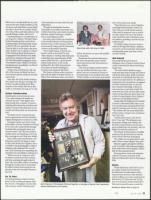
Marc Manson of Farmington Hills put together a montage of photos that represents
several generations of his family.
have stories about your family.
"Funeral homes, too, can be helpful in
providing family members' names," he
said. "Also, in a Jewish burial, someone
either paid for perpetual care or may be
writing a check every year. The funeral
home would have that individual's name
and address, providing a trail for this par-
ticular person."
For families whose ancestors came to
America through Ellis Island, a database
of records can be searched for information
including ship name, year they arrived
and date of birth.
Old Detroit
The Jewish Historical Society of
Michigan's tours of historic Jewish Detroit
can be customized for those researching
family trees.
"We work with the family to map a
route that takes them through told' Detroit
and by the homes their family or families
once lived in," said Wendy Rose Bice, the
society's associate director. "In addition to
seeing many old communities, synagogues
and other landmarks that our docents
have extensive knowledge of, these pri-
vate tours have a particular benefit: the
memories that come out from elder aunts,
uncles and grandparents about their lives
as kids. For genealogists, these firsthand
memories are absolutely priceless."
Temple Beth El's Rabbi Leo M. Franklin
Archives in Bloomfield Hills offers access
to local information including birth, b'nai
mitzvah, marriage and cemetery records.
"The archives also has many family files,
which contain a treasure trove of informa-
tion," Bice said.
"Another great source is the Jewish
News:' Grey said. "The obituaries may
list parents, siblings and children, but
the birth announcements can also have
great-grandparents and ancestors who the
babies are named in memory of."
The Simons Archives houses microfilm
versions of the Jewish American and the
Detroit Jewish Chronicle newspapers.
"Our rabbis, too, are great sources espe-
cially if they've done eulogies:' Grey said.
Manson suggests joining the JGSMI as
a way to network with other genealogists,
share information and techniques and for
help for those getting started.
The group hosts events and maintains
a library of resource materials at the
Holocaust Memorial Center in Farmington
Hills.
Myths
"People think they can't look for ances-
tors whose records were lost during
the Holocaust, but information can be
obtained from survivors, other families
and the millions of records maintained by
Yad Vashem, ITS (International Tracing
Service in Gemany) and the hundreds of
Holocaust memorial centers around the
Growing A Family Tree on page 12