

metro
Growing A Family Tree from page 11
Corey Samuels
world, as well as from the government
archives located in the told countries,"
Manson said.
"A common myth is also that names
were changed at Ellis Island. No names
were ever changed there': he said. "The
manifests from the ships people came here
on were made before they left, at the port
they came from, so their original surnames
should be accurate."
Manson said many researchers find
documents in other languages, like Yiddish.
"If you post them on Jewishgen.org on the
`viewmate' section today, by tomorrow they
will be circulated around the world and you
will have at least five responses': he said.
Grey said, "If someone thinks they
can't get information because their family
members have died, they should realize
they can get as much from birth, marriage
and death records — which often include
names of survivors or ancestors — as they
can from living family.
"I learned my great-grandparents'
names from my grandfather's death cer-
tificate," Grey said. "It also said where they
were from in Lithuania."
Vital records, including birth, death and
marriage certificates, are public informa-
tion and can be accessed by phone, mail,
in person or on the Internet from hospitals
and government offices.
"Before phone books, there were R.L.
Polk city directories, which have alpha-
betical listings of people and their family
members, occupations, ages, complete data
on business activity in the city, categorical
sections by type of business or institution,
with houses of worship listed:' Manson
said. These and other city directories are
housed in libraries in the cities for which
they were published.
Census records are available online on
ancestry.com and on microfilm at most
major libraries. Public libraries may pro-
vide access to the U.S. edition of www.
ancestry.com Library Edition at no charge.
Helping One Other
Manson hopes to run classes for school-
children and at Jewish senior apartments
with children and their grandparents and
great-grandparents to get the kids inter-
ested and to begin their research.
Grey, who speaks regularly on geneal-
ogy, gives specific information to older
groups. "A group in their 80s wants to be
able to help their grandchildren and future
generations': he said. "They don't want
to know how to access websites. I talk to
them about how to preserve their stories
on audio or videotape and about labeling
their pictures. They don't want history les-
sons; they've lived it!'
At 19, Corey Samuels Rosen of
Farmington Hills does want to delve into
the past.
"I love history, and a family tree is your
12
July 14 » 2011
personal history:' he said. "I wanted to find
out more about who I am and why my
ancestors made the decisions they made. It
is fascinating to trace them from Europe to
America and then all around the country,
and then put that into a historical context
and see what was going on in the world at
that time."
Among the 1,204 names on his tree is
his great-great-great-great-grandfather. "I
found cousins of my grandmother who she
had never even heard of — in just a few
days': Rosen said.
"I discovered that some ancestors were
rabbis, some were distillery owners, others
married their nieces and that my grandpa
was at least a fourth-generation baker. I
discovered dozens of relatives who were
victims of the Holocaust. I also found out
that my fourth cousin — whom I've never
met — married my longtime math tutor's
son."
Included in the websites he has accessed
is www.familysearch.org ."It has a lot of
historic government documents on it:'
Rosen said. "An invaluable resource for
locating and getting pictures of out-of-
state graves is www.findagrave.com ."
Recording The Past
Earlier this year, Karen Rader flew to
Miami Beach to tape conversations with
an 85-year-old cousin, who is her great-
grandmother's grandson. "He had a little
black notebook that had my great-grand-
mother's recipes and papers with the name
of the city she lived in and the ship she
came to America on',' Rader said. "Finding
information is like adding pieces to a jig-
saw puzzle.
"When I was with my cousin, I told him
that I remembered a giant blue marlin that
somebody caught that hung over a piano
in my great-grandmother's home when I
was a child. He told me the marlin wasn't
in her house, it was in his house and he had
caught the fish. Meeting him allowed me
to share my memories and have them vali-
dated;' she said.
In September, Rader plans to come
to Detroit to go to area cemeteries and
take pictures of headstones over her
great-grandparents graves so they will be
recorded in case the already-fading writing
disappears.
When Rader's mom died, she found
8mm films of her parents and grandpar-
ents that she converted into DVDs for her
children and future generations.
Unusual Research Site
This summer, Rader plans to travel to Salt
Lake City, Utah, where Grey said he and
Manson have visited "to do real research:'
at the vast index of genealogical informa-
tion at the LDS (Latter-day Saints) Family
History Library.
"When the Mormon Church cast a net
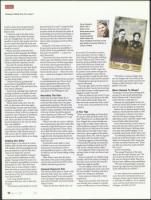
Rosen and a
photo of his
great-great-great-
grandparents
Israel Grossman
(1827-1920) and
Hava Friedman Grossman in the
late 1800s in Ostrow, District of
Lomza, Poland
for records of its members' ancestors
from a particular city, town, village or
shtetl, they got all the people, including
the Jews," Manson said. "This is how I
found my great-grandfather Meier Mac
(Matz) from Skaryszew, Poland, and
his original birth record from 1872,
written in Russian Cyrillic. It gave me
his parents' correct names and ages, his
maternal grandfather's name, Boruch,
and age, and then I found Boruch's death
record from 1895, which listed his parents."
Technology has sped up the process of
research immensely.
"Ten years ago I had to travel to Utah for
a week to do what I can do now in an hour
in my office because of subscriptions and
digitized records': Grey said.
"When my father-in-law retired 25 years
ago, he sat down at the dining room table
with a roll of white butcher paper and
drew the family connections with a ruler."
In later years, Grey transferred it to the
computer.
A Few Tips
"When we do genealogy, we always keep
the maiden name, the birth name Grey
said. "That's how we can find people who
have changed their names through mar-
riage or, like my father whose name was
Archie Goldstein, changed to Grey. At the
Burton Historical Collection at the Detroit
Public Library, I was able to have copies
made from a glass negative of his gradu-
ation picture from 1921, with his cap and
gown, filed under his 'maiden name."
Gunsberg suggests social networking.
"I Facebooked (Gunsberg' and contacted
people about building a family tree': he
said. It's like a family reunion online."
Grey suggested, "Don't create your own
software; most of what's out there is user-
friendly."
Resource materials are available using
Soundex, which lists names according to
how they sound, not how the researcher
thinks they might be spelled.
"It's also helpful to know that a lot of
people with similar last names came from
the same families': Gunsberg said. Some
names were changed or shortened.
Some names are distinctive to where
people lived.
Manson discovered his own name was
once Manskij and is unique to a specific
section of Volkovysk, in a town in Belarus.
"This hobby can become bigger than
you can imagine, but if you focus on the
part you want to get started with, like your
mother or father's family, it will be man-
ageable," Grey said.
Who's Related To Whom?
"Genealogy is not just about finding dead
ancestors; it's also about finding living
family': Manson said. "I found a third
cousin who lives a mile from us!'
Manson's son and daughter-in-law con-
tacted and visited fifth cousins who turned
out to be rock star brothers in Costa Rica.
Manson also is related to Betty Provizer
Starkman, who founded the JGSMI in 1985.
Grey found he is related to Suzy Eban,
wife of Israel's former foreign minister,
Abba Eban, and he visited the couple while
in Israel before Abba Eban's death.
Rosen discovered that a third cousin on
his mom's side and a third cousin on his
dad's side, both living in California, know
each other and worked together. "It's an
incredibly small Jewish world': Rosen said.
"In combining family trees with others, I
found one of my best friends is now on my
family tree because his wife's cousin mar-
ried into my family:' Manson said. "When
you find one connection, it gets attached
like a virus."
And it's neverending.
"You can get 80 percent of the work
done in the first year': Manson said. "The
next 20 percent will take the rest of your
life, and you will never finish. That job is
left up to your children and grandchildren.
"The time to do genealogy is yesterday
because last night someone died who had
all the infOrmation you needed!' ❑
For more information on getting started,
access the Jewish Genealogical Society of
Michigan website at jgsmi.org/home/contact
or call (248) 553-2400, ext. 16. To schedule
a tour with the Jewish Historical Society of
Michigan, call (248) 432-5517.