

Growing A Family Tree from page 1
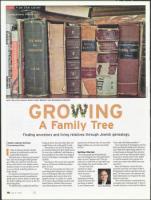
Just a few of the resource books in Marc Manson's vast genealogical collection
I I\IG
Family Tree
Finding ancestors and living relatives through Jewish genealogy.
Shelli Liebman Dorfman
Contributing Writer
f Marc D. Manson hosted a family
reunion, he would need to send out
nearly 6,000 invitations.
"And that's just to those on my personal
tree," said the Farmington Hills genealo-
gist."When it's combined with the trees
of four other Detroit-area families whose
members connect to one another, the tree
is now at 56,346, including relatives no
longer living."
An interest in learning about his ances-
tors got Manson started researching his
family and its history almost 30 years ago;
the thrill of adding more names to the tree
keeps him going.
"It's difficult and complicated and frus-
10 July 14 a 20'
trating at times, but more often than one
would think, we do strike gold:' he said.
"Thousands, if not tens of thousands,
get started looking into their family ances-
try every day, worldwide,' said Manson, a
past president of the Jewish Genealogical
Society of Michigan in Farmington Hills
(JGSMI).
"Genealogy is the second most popular
topic on the Internet (behind pornogra-
phy)," he said.
"There are more people now than ever
researching their family trees': said Jim
Grey of Farmington Hills, also a JGSMI
past president and current chair of its
speakers bureau. "A catalyst is a couple
of TV shows about finding ancestors and
family history. Software from ancestry.
corn, which sponsors one of the shows,
spurred a lot of interest also. It's one of the
biggest hobbies you can have practically
for free."
Getting Started
"Too many people get frustrated and
quit researching because they don't know
where to stare,' Manson said. "They go
online, hit a road block or make their way
into websites they aren't familiar with."
He and Grey both
regularly use their
experience to help oth-
ers do research.
"I recommend
beginning by listing
yourself and everyone
you know is related
to you',' Manson said.
Larry Gunsberg
"Next, talk with family members."
Larry Gunsberg of Farmington, who has
been searching for family since February,
said, "Find your oldest living relatives. Go
to their house, go through their pictures,
get their stories, get other people's names,
reach out to cousins you've never talked
to. You'd be amazed at the reaction of a
cousin you contact who didn't know you
were alive."
Next, said Manson, comes the more
extensive search for new names, both of
living family members and those who are
gone. The best source is the Internet, but
much information can be gained by mail,
phone or in person.
"One of the websites I started with was
www.geni.com ," Gunsberg said. "I chose it
because its basics are free and its software