
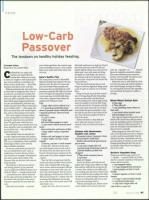

Low-Carb
Passover
The lowdown on healthy holiday feasting.
Annabel Cohen
Special to the Jewish News
C
arbohydrates are sugars and
starches, and nearly all foods
contain them. Many of us trying
to watch our weight or with medical prob-
lems such as diabetes or metabolic syn-
drome, want to avoid carbs — fewer than
30 grams each day for a low-carb diet.
Without getting into the whys and hows,
we don't have to completely steer clear of
of carbs (we need them for energy) if we
choose the right carbs. Complex carbohy-
drates are often acceptable on low-carb
diets. Whole grains, legumes and brown
rice (for you Sephardim), and most veg-
etables are good carbs. What we must pass
up are "simple carbs" — white sugar and
flour, very sweet fruit, and starchy vegeta-
bles, such as white potatoes and carrots.
This can be tough on Passover, where
we are commanded to eat matzah (only
during the seder, however), and drink
wine. The good news is that there are
lower-carb whole-wheat matzahs, but even
these should be eaten in moderation. And
we can drink wine — the carb limit is
about three ounces.
Many holiday foods are naturally low
in carbs. Unprocessed meat, fish, poultry,
eggs fats and oils (including cheeses), have
little or no carbohydrates. Most vegetables
(those high in fiber) can be eaten in
almost limitless quantities.
For dessert, some fruits and most ber-
ries are considered low-carb , eaten in
moderation, of course. Berries, melons
and avocados are examples. Unsweetened
nuts and coconut, other staples of the
Passover table, are also low-carb, eaten in
small amounts.
The lowdown is that you can eat low-
carb during Passover, if you cook and
count carefully. For gefilte fish, leave out or
limit the "fillers" — usually matzah meal
— and substitute low-calorie sweetener
for the sugar and you're mostly there. Cut
the onions a bit and don't eat the carrot
and you've made the fish extremely low-
carb.
Make that roast brisket — just leave
out or limit ingredients that contain sugar
(such as ketchup and wine). Even matzah
balls can be made with whole-wheat mat-
zah meal.
Sara's Gefilte Fish
This recipe, from a friend in Bloomfield
Hills, has already been adapted to be natu-
rally low-carb. Yes, there are onions and
just a bit of whole-wheat matzah meal,
but because they are distributed in small
quantities among the fish balls, the amount
is low. The high-carb ingredients missing?
Carrots and sugar in the fish balls them-
selves. Note: I prepared this without the
matzah meal with good results.
Fish:
1 large white onion (about 8 oz.)
3 1/2 pounds ground fish (from
about 4 pounds whole whitefish and
3 pounds pickerel). Reserve head
and bones
1 /2 cup ice water
3 large eggs
Salt and white pepper to taste
1 /4 cup whole-wheat matzah meal
Stock:
Reserved heads and bones of fish
1 large yellow onion, unpeeled
Water
Kosher salt and pepper to taste
2 celery stalks, cut into 3-inch
lengths
2 carrots, cut into 1/4-inch rounds
Prepare fish: Peel and cut the onion
into small chunks (reserve both ends of
the onion). Place the onion pieces in the
bowl of a food processor and process the
onion until it very finely chopped (almost
a paste).
Place the fish in a large bowl. Add the
onions and water and mix with an electric
mixer until combined. Mix in the eggs,
one at a time, until incorporated. Add salt
and pepper to taste (start with 1 tsp. salt
and 1/2 tsp. white pepper). Test the season-
ing by placing a small amount of fish on a
dish and microwave for 1 minute. Taste for
seasoning. Add additional salt and pep-
per to taste. Mix in the matzah meal. Chill
until ready to use.
Prepare the stock. Place the reserved
fish heads and bones in a large pot. Season
the heads and bones well with salt and
pepper. Add the whole onion and reserved
onion ends. Cover with water and bring
the liquid to a boil. Reduce the heat to a
low boil and cook for 30 minutes. Strain
the stock into a large bowl and discard the
head and bones.
Place the stock back into the pot and
bring to a boil over high heat. Bring anoth-
er pot of water to a boil (to use if needed
later).
Using wet hands, form the fish mixture
into 12-20 egg-shaped balls (depending
on the size you prefer) and drop them
into the boiling stock. Add enough boiling
water (if needed) to cover the fish. Bring
to a boil and cook for 30 minutes. Add the
celery and carrots and cook for one hour
more (shake the pot occasionally so that
the balls do not stick to the bottom of the
pot). Turn off heat and allow the fish to
cool in the stock.
Remove the fish to a deep dish and
cover with stock (reserve carrots if
desired). Cover and chill until ready to
serve.
Chicken with Mushrooms,
Shallots and Lemon
8 boneless (about 3 pounds) chick-
en breast halves (with skin)
Kosher salt and fresh ground pep-
per to taste
1 /3 cup extra-virgin olive oil
1 pound fresh mushrooms, halved
1 pound shallots, peeled and
chopped
1 Tbsp. fresh rosemary leaves
1 cup water
Juice of 1 lemon
Season the chicken well with salt and
pepper. Heat a large, heavy skillet over high
heat until hot. Add half the oil and heat for
1 minute. Place chicken in the skillet with-
out crowding, skin side down in the hot pan
and cook until the skin is golden (the chick-
en will not be cooked through). Remove the
chicken to a baking dish, skin side up and
repeat with remaining chicken.
Without cleaning the pan, add the mush-
rooms, shallots and rosemary and sauté
softened.
until the vegetables are
Spoon the vegetables around the chicken.
Pour water and lemon juice around the
chicken. Cover and chill the mixture until
about 40 minutes before serving.
Preheat the oven to 350F. Place the chick-
en in the oven and cook until the chicken is
just cooked through. Arrange the chicken
on a serving dish and spoon the vegetables
over and drizzle the liquid over. Makes 8
servings.
Whole - Wheat Matzah Balls
4 large eggs
2 Tbsp. olive oil
1 /2 cup sparkling water, seltzer or
club soda
1 cup whole-wheat matzah meal.
Salt and pepper to taste
Place eggs in a large bowl and whisk well.
Whisk in the oil and water. Add the matzah
meal, salt and pepper and stir well (taste the
batter for saltiness). Chill (uncovered) for 1
hour. Use wet hands to form the batter into
about 16 to18, 1-inch balls.
Bring a large pot of water with 2 tsp. of
salt to a boil (the balls need room to expand,
so don't crowd the matzah balls). Drop the
balls into the water. Immediately cover the
pot and cook for 30 minutes or until cooked
through (limit lifting the lid of the pot for
best results). Makes about 8 servings (eat
less for low-carb).
Bertha's Vegetable Soup
We grew up with this soup, served "as is"
— chunky — or pureed (with a bit of olive
oil). For a creamier consistency of the pureed
version, add more potato.
1 cup chopped onions
1 1/2 cups chopped fresh tomatoes
1 green pepper, cut into 1/2-inch
chunks
2 chayote squash, cut into 1/2-inch
chunks
1 1/2 cups 1/2-inch zucchini chunks
1 /2 cup sliced mushrooms
1 /3 cup extra-virgin olive oil
Low-Carb on page 42
March 18 2010
41