
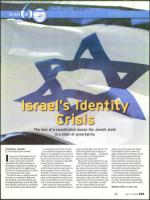

The lack of a constitution leaves the Jewish state
in a state of uncertainty.
MICHAEL JACOBS
I
Jewish Renaissance Media
is a part of U.N. Resolution 181, the
1947 measure that authorized the
creation of the State of Israel. It's
embedded in the Israeli Declaration of
Independence right before the pledge that
Israel will be open for the ingathering of
the exiles. It's a fundamental part of almost
every modern democratic nation.
But after 60 years as a nation, Israel still
doesn't have a constitution. While Israel
has withstood every external threat since
declaring independence in mid-May 1948,
some scholars see the lack of a constitution
as an internal threat to the nation's future.
"A constitution for the State of Israel .
.. is an existential requirement without
which we are risking the very survival of
the State of Israel: said Arye Carmon, the
head of the Israel Democracy Institute
(IDI), which has worked since July 2000
to bring Israel a constitution.
Proposals for an Israeli constitution,
of which there have been more than two-
dozen complete drafts over the years,
inevitably crash into Israel's uncertainty
about its own identity. A ratified consti-
tution would represent some kind of res-
olution to the debate over what it means
to be a Jewish and democratic nation.
"Most Israelis do understand that we
need a constitution:' said Yedidia Stern, a
senior research fellow with the IDI. "We
need some ground rules according to
which we fight our fights ... The ground
is more ready now for some kind of
agreement or compromise'
The ground wasn't ready 60 years ago.
Throughout the 20th century, the cre-
ation of a constitution has accompanied
the creation of a nation, from countries
formed out of former colonies in Africa
and Asia after World War II to republics
that found themselves freed from Soviet
domination in the early 1990s. That was
supposed to be the case for Israel as well.
It's not that a constitution is manda-
tory for a nation. Britain is the most
famous example of a nation that thrives
without such a document. But Britain
had hundreds of years to evolve the
rights of Parliament, said Atlanta-based
Emory University professor Kenneth
Stein, who heads the Institute for the
Study of Modern Israel. Israel, by con-
trast, had to come up with a political
system while under constant Arab attack.
The conflict, he said, has delayed the
maturation of Israeli institutions.
U.N. Resolution 181, which provided
for the partition of British Palestine
into an Arab state and a Jewish state,
was clear: Not only did it mandate that
each of those new nations had to draft a
Identity Crisis on page A26
May 15 • 2008
A25