

Identity Crisis from page A25
constitution, but it laid out some of the
provisions those constitutions had to
include.
The United Nations required that Israel
draft a democratic constitution that
enshrined protection for and access to
holy sites; freedom of religion; nondis-
crimination on the basis of race, religion,
language or sex; equality protection
under the law; primary and secondary
education for minorities in their own
language; and respect for land ownership.
Sure enough, Israel's Declaration of
Independence covered the required
issues and pledged to adopt a constitu-
tion by Oct. 1, 1948. That Oct. 1 deadline
has passed 59 times so far.
"We lost the precious historical
moment with the foundation of the state
60 years ago," Carmon said.
The problem in 1948 was that Israel
was in the middle of a fight for its life. A
constitution would have been meaning-
less if the Arabs drove out the Jews.
A constitutional committee did meet
more than half a dozen times, starting
in the summer of 1948, and the first
The Big Issues
Knesset, seated in early 1949, took up the
idea of writing a constitution, Stein said.
A Knesset committee started work
on a constitution in the middle of 1949,
studying other nations' constitutions,
then writing drafts. But in early 1950,
Prime Minister David Ben-Gurion and
other members of the Knesset began to
have doubts about any constitution.
"Ben-Gurion took the view, as did oth-
ers in his party, that they were afraid a
constitution, if it specified certain rights
and privileges about citizenship, it might
cause some diaspora Jews not to immi-
grate Stein said.
Ben-Gurion was more interested in
the ingathering of the Jewish exiles than
any constitution, Stein said, and he con-
sidered it unfair for the minority of the
world's Jews in Israel in 1950 to establish
a constitution that would bind the dias-
pora Jews as they made aliyah.
Not that a constitution is at the top of
the list for Jews considering immigrating
to Israel. Bart (Barak) Cohen, an Atlanta
native who made aliyah in 2005 and
works for the IDI, said he didn't know
Among the questions that must be answered to enact an Israeli constitution:
• How Jewish should Israel be? That applies not only to Jewish/non-Jewish
matters, but also to differences among Orthodox, Conservative, Reform and
secular Jews. The Israel Democracy Institute's proposal says Israel shall be a
"Jewish and democratic state" and shall act with equality toward all citizens.
The Institute for Zionist Strategies first says Israel is "a Jewish state and the
National Home of the Jewish People," then says it is democratic and respects
"'human rights. The issue is whether equality or Judaism takes precedence.
IF • Who may immigrate under the Law of Return? Currently, anyone with a
Jewish grandparent is eligible. Both the IDI and the IZS would change that to
a Jewish parent, but neither would have the state deciding whether the immi-
grants are Jewish.
• Whose culture is it anyway? The IDI proposal would enshrine respect for
all cultural traditions in the Land of Israel. The IZS plan would give each com-
munity the right to preserve its heritage, but the state would act to preserve
the Jewish heritage.
• What about marriage? The IDI would leave religious marriage ceremonies
in the control of the Orthodox rabbinate, but would create a civil union for
those who don't want an Orthodox ceremony. The IZS would give religious
courts authority over religious marriages and divorces, but allow civil mar-
riages as well.
• What about secular courts? The IDI would entrust the Supreme Court to fill
a judicial review role similar to that of the U.S. Supreme Court. The IZS would
give the Knesset veto power over court decisions regarding the constitutional-
ity of laws.
• How would ties to the diaspora be affected? Critics of the IDI proposal say
it would cut those ties by no longer requiring the government to encourage
aliyah and by limiting the Israel Defense Forces to the protection of the State
of Israel. The IZS calls for the state to gather in diaspora Jews and settle them
in Israel and continues the IDF's role as a protector of Jews anywhere in the
world.
A26 may 15 • 2008
Israel lacked a constitution before he
made the move.
"On one level, it's a bit frightening to
know that there is not a constitutional
blanket protecting Israeli citizens:' he
said. "However, it is also quite exciting
to be a part of a 'work in progress! You
feel empowered to improve Israel, to
help build this country, in a way that you
could never feel in a country as large and
firmly established as America!'
eon.,
, 1■ 11 71411AwirlAtZ
rbvi01151
evryrrl Wm, Slya
mrsigh
1wP,r4
-vwc
VYA ^tl 67 trjuw,
4drat
Cr,rtr, rt's,S1
.1'1,7
7:2 r:e4tWo ' L%, ....1.1, •• • 11.:Z: 1:4••••••'•
1..;••,1•••1.
rrq ,eso
■ 1.1.1 sq•”
rum
•fetr, V, SPr7 M1,14.04,1 rt, rt.
tty.
Ur,
•.nrvaTootkr‘
ui.) 1,41Y11,,,11 +3,174.• or /112,
9r ,
vrt, „„
rtIsS flAt
oY
Vti,
VV,X
ttfltel,Y2
,,,
;,$,I1•• t,
ty,3 l t,1 nv r .
.1". r b,s , •If••••■■•3 79.1•1•
, 116:7 '0711 ,3
r
Institutions Define Roles
So in June 1950, the Knesset adopted the
Harari decision: Instead of creating a
constitution, the Knesset would enact a
series of basic laws that ultimately would
be brought together to serve as a consti-
tution. It took 42 years for lawmakers to
enact 11 basic laws, two of which have
since been replaced. Not only don't those
11 laws come close to a comprehensive
constitution, but most of them also can
be amended or repealed as easily as any
other law.
The lack of a constitution forced
Israel's institutions to define their own
roles in society and their powers relative
to one another, Stein said. That trend
came to a head in the 1990s.
After the Knesset passed two basic
laws related to human rights in 1992,
activist Supreme Court Justice Aharon
Barak saw the opening for a "constitu-
tional revolution" and said the court, not
the Knesset, protected rights and had
the power to judge the legality of laws
- even though no document established
judicial review.
"Almost simultaneously;' Stein said,
"other institutions in the Israeli political
system asserted themselves in a more
public fashion:' including the attorney
general, the state comptroller and the
Israel Defense Forces, because "there is
no constitution that limits what their role
should be."
Having seen what happens when
various institutions decide their pow-
ers, Israel is closer today than ever to
a constitution, Stein said. "And Israelis
want a constitution. They're no longer
afraid of alienating Jews in the diaspora
or furthering the cleavage between left
and right."
Closing an assortment of such cleav-
ages would be a benefit of a constitution
with a bill of rights, Carmon said. "Israeli
society at Israel's 60th anniversary is
very deeply cleaved between Arab and
Jew, veterans and newcomers, secular and
religious, haves and have-nots ... Rather
than move in the way of integration,
we're moving in the direction of disinte-
etswi,
""
-Yort rZ 7
7,1,1t1 1,,••9 ••
wormy.., rr•17r,
Ant t71, Ar114,
./1 197tr,i, :UAW k.
e”-tsrp•s
,11-•0 •••,•••
,47 M3,
.47
ter,
p3+.13
CM,* n.,1,142 Ii
rion *111,
0-0 St11, 1317.0 /,0•17-,..1
3, 11'1 ;Tr+, •,1
n ,1
..7,•••1
prg,reir.•
71..14 1,1, Y. ••1,
►rtsr013,
P.140
r ,„.„
,),"
,r•3
pq r,
•••,
*SI 21):17. PTA
.71,4017%
,t6
.Trorve
).7)11 ;IYI•1•3
wy.try
13P: 111 , 33T,
77,W,
,-.1V1;717i1
W17,1 117 ,,, Z ,
X7M13 C•r•97 ,3 1.1M
;1,17 ,
.7•b•l,
1 ,•;/
=.1•134:3
Mira":
T"):•:
1,
,t,41
••:••N
• ••. 1.1.4 .
ryy•,.
Pvt., *
- 1414
1•41•34, 11,7
t7•
:1 .4131,
rtArt-0.0 kftr:
Criyrs:v.rwir.
',apt 1•1•1t•• ry.,)
r, tr, 1:yr
r:•Mt..•Itt
rv.
lit ;II
ram Pn-err:
rrn,r,
r.... 47:1,
- .01
2,,,•:', V/7 7t,201
311,.;C•
,••••••••%,
?,411e., 711•7•0
■•;
•••- - -,Itt2 V p•••,..
prIttm,
trvr. r.74,
Fkrt
r*,, ,Irp, 1,7
T3N
11.• MI
!34 0•
prw,
6
avn
r:1;71•7
r•t,
nr) ,
Z;1 1..Vr, Trrvb 7.41
3rt17
•• z•a
ta•rn ••11kM
tr1101
1=-1•2%,
Tsnell'sts 1 777
M ,X , F. - 13N
17.= 1 ,27
r. ,,r;r1
awtsa,
6
‘•.›7
"rt
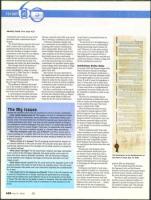
The Declaration of the Establishment of
the State of Israel, May 14, 1948
gration. Rifts are deepening."
The rifts include animosity between
the Supreme Court and the Knesset,
between the Knesset and the government
led by the prime minister, and between
the court and the government, he said.
"You have to take an interest in analyz-
ing this country's internal conflicts, as
opposed to purely focusing on the exter-
nal conflicts:' Cohen said. "The internal
threats to national unity, to social and