

Arts & Entertainment
Cyrano from page 49
libretto because I wanted to collaborate
with someone who understands what's
essential!'
To convince DiChiera, Uzan did a one-
man reading of the play in French in
1999, acting all the parts. Then he wrote a
short scene from the end of the play, and
DiChiera spent a few months setting it to
music. "I was struck by the dual aspects of
Cyrano's personality, a powerful struggle
between his external bravado and the
inner sadness and anguish of his external
persona:' DiChiera explains. "When you
add Roxane to the mix, you have a tale
similar to Romeo and Juliet a great love
story. And as I composed, I thought, `I just
can't hear this in English. The French lan-
guage is so beautiful!"
With a fascination for Cyrano's charac-
ter, Uzan had dreamed of playing him on
the stage but never got the chance. "His
image has always been in my mind since
my youth, and I cannot believe I had the
opportunity to be the librettist for David's
beautiful music:' says Uzan. "It's a wonder-
ful story, full of pathos and humanity, and
the French text makes it special."
French playwright-poet Rostand's
Cyrano de Bergerac is a romantic trag-
edy, blending nostalgia for 17th-century
French life with swashbuckling heroism,
romance and lyrical verse. Cyrano is a
charismatic nobleman with a great per-
sonality, skilled as a swordsman and as
a writer. He is physically plain — except
for an astonishingly huge nose, a symbol
of his own weaknesses and lack of confi-
dence. Despite his overwhelming love for
his beautiful cousin, Roxane, he agrees
to help his younger rival, the handsome
Christian, win her heart.
"I'm really very much a romantic, a
melodist, and I've composed a romantic
opera that's faithful to what Rostand
wrote DiChiera notes. "The score is lush
and, at times, big and sweeping, but it's
also tender and nostalgic at other times,
such as the final letter scene!'
DiChiera did most of the composing for
the opera at home, early in the morning,
but he also was inspired to write the music
in other locales, including California, New
York, Scotland and the Caribbean.
Uzan calls Rostand's original play "a
masterpiece," asking, "How could I pretend
to rewrite these words, these lines which
have been my companions since youth,
with four hours of text and a multitude
of characters?" He said cutting secondary
characters "became increasingly excruci-
ating and eliminating each word caused
a real dilemma, but I had to keep the
essence of the play (originally 400 pages).
I had to cut and summarize and cut some
more. David I went back and forth in per-
son and on the phone many times."
—
52
October 4 • 2007
MOT General Director David DiChiera: "I always wanted Director Bernard Uzan: "[Cyrano's] image has always been in my
to compose an opera but never found the right subject
mind since my youth, and I cannot believe I had the opportunity to be
or had the time."
the librettist for David's beautiful music."
Cyrano has 15 characters and will be
performed over three hours with three
acts and five scenes.
Uzan points out that others have tried
to write operas based on the Cyrano
story, but he feels they haven't succeeded
because "they haven't portrayed the sensi-
tivity of the period accurately" He adds: "I
saw Placido Domingo sing [another ver-
sion of] Cyrano in New York. He was good
but not the opera in general. It's common
for different composers to try the same
opera with different names, such as Romeo
and Juliet and Faust. La Boheme has even
been done at least twice under the same
name."
Uzan was born in Tunis, Tunisia, a small
country in northern Africa with a Jewish
population of 100,000 in the 1940s —
"down to only about 300 now:' he laments.
He had a bar mitzvah there, and the family
observed the Jewish holidays.
"But the government seized my father's
olive oil factories, and we fled to Paris
when I was 15 to start over again:' he says.
"The fact that we were Jewish added to
our problems as anti-Semitism reared its
Cantor Covers Christian
Jewish chazzan
understudies role
of Roxane's lover
in MOT's Cyrano.
he cantor is covering for
Christian.
Translation: Cantor
Benjamin Warschawski may play the
role of Christian, Roxane's lover, in
Cyrano. That is, if Jose Luis Sola, the
Spanish tenor making his U.S. opera
debut in the role, were unable to
appear in any of the five performanc-
es. "Cover" is a more professional-
sounding term for "understudy."
"It's sort of amazing that a Jew,
especially a cantor, would play the role
of a character named Christian," says
Warschawski, 32, a tenor who was
ordained at Yeshiva University in New
York. He lives in Boca Raton, Fla., with
his wife, Chana, and daughter, but con-
ducts services at many synagogues,
mostly Conservative and Orthodox,
and spent the recent High Holy Days
at Niles Township Congregation in
Skokie, Ill.
"I prefer being a full-time opera
singer and a part-timer cantor,"
Warschawski explains. "Michigan
Opera Theatre offered me the regular
Christian role, but I didn't want to
be tied down. Cyrano's five perfor-
mances are spread over two weeks,
and I can do other work in between."
Warschawski has had leading roles
in 17 operas and performs about 100
concerts a year.
Born in Switzerland, Warschawski
was raised in Baltimore and started
singing with a private voice coach at
the age of 16 while in a Baltimore syn-
agogue choir. He later spent five years
as cantor there. While getting a degree
at the University of Maryland's College
of Fine Arts, he starred in some musi-
cals, playing Nathan Detroit in Guys
and Dolls and singing with members of
the baseball team in Damn Yankees.
"I fell in love with opera at 18 and
have played many of the traditional
roles in Madama Butterly, La Traviata
and Tosca, but Cyrano is an unusual
Us.
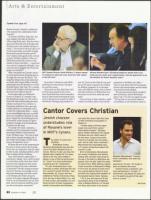
Benjamin Warschawski: "Cyrano's
music is beautiful, very tonal and
harmonic."
experience," he says. "It's tough to
learn an entirely new score.
"Cyrano's music is beautiful, very
tonal and harmonic," he adds. "It
should have a big impact on opera lov-
ers. It's great to be part of the cast,
even as a cover." II
— Bill Carroll