

•
PriO! • .... .
•.6;
,
I g4 . 4.
7 r
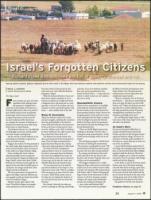
Wearing modern fashions, Bedouin shepherds tend to their flocks in the Negev. One clash between tradition and modernity involves the environmental impact of the grazing.
Marcy J. Levinson
Jewish Renaissance Media
The Negev, Israel
F
east on lamb, rice, peas and other
vegetables while relaxing under
the expanse of a brightly deco-
rated tent in the middle of the desert at a
Bedouin halfla (feast). Take a few puffs of
pure Turkish tobacco from an authentic
hookah pipe while drums and Bedouin
stringed instruments set the mood for
fun and traditional debke (line) danc-
ers. Imagine the romance of sleeping in a
Bedouin tent under the stars, then rising
before dawn to climb Masada.
That Bedouin itinerary is a trip highlight
for Birthright Israel tours, school groups
and other tourists visiting Israel.
But the real life of Israeli Bedouin is not
something you will find in a glossy bro-
chure for Israeli tourism.
Maggots, the stench of rotting animals in
the nearly triple-digit temperatures of the
desert and raw human waste are just part
of the reality of a Negev Bedouin village.
Dusty, winding dirt roads without
adequate grading traverse recognized
and unrecognized villages throughout the
Negev Desert, where more than 110,000
Bedouin live. Streams run through the vil-
lages, but the water, like the halfla party, is
an illusion: It's sewage runoff from other
villages, Jewish and Bedouin.
The seven government-recognized vil-
lages in the Negev where the Bedouin are
encouraged to settle are barely discernible
from the unofficial villages.
Bedouin society often clashes with
Israel. The official villages, for example,
create problems because the Bedouin
hierarchy divides tribal groups by skin
color and caste. And traditional Bedouin
polygamy is illegal.
While the Bedouin lifestyle is basic and
often lacks modern amenities, it is not
immune to influences of high-tech Israel:
a shepherd with a cell phone but no work-
ing toilet; a shack of tin, chicken wire and
tarpaulin-covered wood held together with
twine — and a satellite dish on the side.
Winds Of Uncertainty
Today, the Bedouin culture faces many
internal struggles, including the transition
from the grazing fields to the factories
where Bedouins hold jobs; the disconnect
between the home setting and the class-
room for children; and a shift in thinking
for those battling for the right to graze and
live on land they deem their own.
The Bedouin are Israeli citizens who
often seem forgotten by the Israeli govern-
ment. They face high unemployment, a
high educational dropout rate, soaring
crime and a large population of idle youth.
New York real estate management
magnate Robert Arnow is a Conservative
Jew who is concerned about the Bedouin
and Israel. He established the Center for
Bedouin Studies at Ben-Gurion University
10 years ago, and in May the center was
officially dedicated and named for him.
"For an American Jew to be identify-
ing with the Bedouin of the Negev is very
important," Arnow said. "This is a problem
that's not going to go away. Israel was able
to create a Third World country here in
the Negev by not helping the Bedouin. If
you care about Israel, you care about the
Bedouin."
Ben-Gurion University has taken up
Arnow's challenge by offering scholarships
and hope. It has more Bedouin students
than ever and just graduated its first
female Bedouin doctor — a big stride for a
culture in which women are not tradition-
ally sent to study.
Unsympathetic Concern
Others are less sympathetic to the plight
of the Bedouin. Environmentalist Mon
Tal, the founder of the Arava Institute for
Environmental Studies, which is known for
bringing together Arabs and Jews to learn
about and appreciate the Negev, is disgust-
ed by the illegal structures the Bedouin
build in the Negev and by the grazing of
their livestock on land that belongs to the
Jewish National Fund.
"There are 50,000 illegal construction
buildings in the Negev," said Tal, who is
writing an article on grazing laws. "Surely
50,000 Jewish buildings would not be tol-
erated!'
Tal said illegal grazing by 100,000 head
of livestock is hurting the environment.
"The situation is intolerable he said. NF
[Jewish National Fund] has hired a guard
to protect the trees they recently planted!'
By contrast, the Bedouin in the north
work with JNF in the Atir Forest to the
benefit of all, Tal said. "Properly taken care
of, there can be sustainability."
JNF's biggest initiative now is called
Blueprint Negev, which aims to settle half a
million Jews in the southern desert within
a decade. The program, JNF spokeswoman
Jodi Bodner said, is "about developing the
Negev Desert for the betterment of all its
citizens. It will drive dramatic, positive
change in the region and substantially
increase the standard of living for all
— Jews, Arabs and Bedouin alike."
The Israeli government has pledged
$4 billion toward the development of the
Negev, Bodner said. The plans include
transportation, schools, agriculture and
employment opportunities.
"There is a romantic view of the life of
the Bedouin — that they are sustainable in
their own right. But that is not the truth:'
Bodner said. "Rather, the Bedouin are deal-
ing with old vs. modern lifestyle issues,
sky-high population growth, 90 percent
unemployment, extremely low school
attendance and high crime rates."
She said Blueprint Negev hopes to "alle-
viate some of the sharp edges" of the issues
that affect the Bedouin.
An Imam's Story
One person facing the difficulties of
change is Bedouin Imam Kamal Abu
Heniya, who lives in the first government-
organized Bedouin village, Tel Sheva. He
welcomed 15 Jewish media members to
his home on a warm May day to share sto-
ries of his 12 children.
Located off the modern main street of
the village, the seemingly large house had
piles of concrete block and other building
supplies beside the driveway. The home
looked complete, yet in a state of constant
renovation. The air was heavy with foreign
smells and the dust lingered.
As the sheik, or man of the house, Imam
Heniya came out of his home wearing a
red-and-white head covering, a gray tunic,
pants and sandals. Expressionless except
for the years of hard work etched into his
face, he shook the hands of the men in the
visiting group and said in Arabic that he
was pleased to have guests at his home.
The guides for the day were Jamal Al-
Forgotten Citizens on page 18
August 9 • 2007
17