

Dangerous Democracy
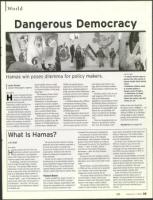
Left to right:
Hamas win poses dilemma for policy makers.
• A Hamas activist holds an
election flier with a photo of
Hamas founder Sheik Ahmed
Leslie Susser
Jewish Telegraphic Agency
Jerusalem
amas' sweeping election
victory is forcing all key
players to reassess their
positions on the Israeli-
Palestinian conflict and has cre-
ated a widespread sense of
uncertainty about the future.
Israelis, Palestinians and out-
side observers are raising a host
of fundamental questions. The
big question is whether Hamas in
power will moderate its radical
positions or put Palestinian soci-
ety on a collision course with
H
Israel and the western world.
There will be enormous pressure
on Hamas to adopt a more prag-
matic line.
The European Union, which
provides up to 90 percent of
international aid to the
Palestinians, is threatening to
suspend its economic support
unless Hamas recognizes Israel's
right to exist and renounces vio-
lence, and the United States
appears poised to do the same.
In the short term, cutting off
these funds could leave a Hamas
government unable to pay the
salaries of 155,000 Palestinian
civil servants, including the
30,000-strong Palestinian
Authority security forces. In the
longer term, ambitious plans to
jump-start the stalled Palestinian
economy may have to be shelved,
perpetuating poverty and unem-
ployment.
A militant Hamas also will face
international isolation, giving
Israel the moral and diplomatic
high ground for tough responses
to Palestinian terror.
On the diplomatic front, Israel
won't talk to Hamas in its present
form; as to the economy, the
Palestinians are dependent on
Israel for electricity, the transfer
of tax revenue, goods, services,
What Is Hamas?
JTA Staff
Jerusalem
amas, which will form the next
H
Palestinian Authority government
that ostensibly is to negotiate
peace with Israel, has a long history of
violence against the Jewish state.
Its ideology is based on the destruc -
tion of Israel through jihad, Muslim
"holy war." The group's 1988 charter
states.that "Israel will exist and will con-
tinue to exist until Islam will obliterate it,
just as it obliterated others before it."
It adds that the territory of Israel is
"Islamic Wakf" – part of the Muslim reli-
gious trust, which can not be given to
non-Muslims – and that "the law gov-
erning the land of Palestine is Sharia,"
or Muslim law.
The group presents itself as having
separate social and military branches, a
formula that seeks to insulate the
group from charges that it is a terrorist
organization. However, few serious
observers believe the branches are
truly separate.
Hamas has its origins in the Muslim
Brotherhood, a fundamentalist Muslim
group founded in Egypt in the first half
of the 20th century. The brotherhood
inspired Hamas founder Sheik Ahmed
Yassin's notion that Israel is Islamic land.
Violent Roots
Yassin founded the Islamic Center in
the Gaza Strip in the 1970s, turning it
into a major religious organization and
laying the groundwork for a network of
social and welfare institutions that
work places and border cross-
ings; and, if terrorism escalates,
Hamas leaders could become tar-
gets.
Therefore, while it won an out-
right majority of 74 of the 132
seats in the Palestinian
Legislative Council, Hamas wants
the defeated Fatah movement to
stay on in government to give it a
semblance of respectability. Still,
Hamas for now probably will
refuse to moderate its ideology,
which calls for Israel's destruc-
tion.
There are strong pressures on
Hamas to maintain its radical
line. Iran, for example, could
increased the movement's popularity.
He continued to absorb the violent
and nationalist ideas of the Muslim
Brotherhood, and gradually shifted the
group's focus from welfare to violence.
That paved the way for the founding of
Hamas – "zeal" in Arabic, and an
acronym for the Islamic Resistance
Movement – after the first intifada
began in 1987.
As early as the first intifada, Hamas
also targeted suspected Palestinian col-
laborators and rivals in the Fatah move-
ment.
Hamas began using suicide bombers
in 1994 and has carried out at least 60
such attacks; many more have been
stopped by Israeli security forces.
The group began launching rockets at
Israeli targets in 2001, using crude
Kassam rockets from Gaza to hit Israeli
towns in the Negev, notably Sderot.
The group's attacks have killed hun -
dreds of Israeli civilians in the past five
Yassin.
• Palestinian children stand
at a polling station in
Hawara, south of Nablus.
• A Palestinian, his finger
stained with voting ink,
flashes the victory sign after
voting Jan. 25.
make up for some funds the
European Union withholds — on
condition that Hamas remain
militant. Fidelity to its ideology,
and goading by other militant
groups, also could shunt Hamas
away from moderation.
Dangerous on page 34
years alone, prompting Israeli legal and
military responses. The United States
and European Union consider Hamas a
terrorist organization.
An Israeli court sentenced Yassin in
1984 to 13 years in jail, but he was
released a year later in a prisoner
exchange. He was imprisoned again in
the 1990s, but was released in 1997 in
another prisoner exchange.
During the second intifada, the Israel
Defense Forces began targeting Hamas
leaders for assassination. Yassin was
killed in March 2004 by Israeli helicop -
ters. Abdel Aziz Rantissi, who was
appointed Hamas head in Yassin's place,
was assassinated a month later.
Some of Hamas' fund-raising and
propaganda activity takes place in
Western Europe and North America. In
2004, the United States convicted the
Texas Holy Land Foundation on charges
that included money laundering for
Hamas. ❑
February 2 2006
33