
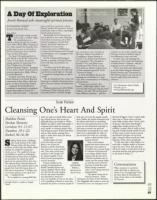

A Day Of Exploration
Rabbi Elliot Ginsburg of Parde'
Hannah leads a breakout session: .
Jewish Renewal seeks meaningful spiritual practice.
SHOSHANNA COHEN
Special to the Jewish News
Ann Arbor
he day began simply enough
Kith a song, a wordless nigun.
No introduction, just a
melody wafting through the crowded
room. When Rabbi Elliot Ginsburg of
Ann Arbor repeated his beautiful tune,
people began to join in, hesitantly at
first then growing in fervor, until the
room was alive with spirit.
For those 120 people gathered in
early March at the Jewish Community
Center in Ann Arbor, the spirited
singing signaled the beginning of "A
Day of Exploration: Revealing
Judaism's Spiritual Depths," a program
of Ann Arbor's Pardes Hannah and the
national organization, Aleph: Alliance
for Jewish Renewal.
Founded more than 10 years ago,
Pardes Hannah is the Jewish Renewal
community of Ann Arbor, which has
grown to about 30 member families.
In general, the Jewish Renewal
movement is committed to strengthen-
ing the three pillars of Jewish life —
prayer, study and action — using tradi-
T
don, sacred text, mysticism, culture,
history, modern life experience and per-
sonal inner truths to find a meanin
Jewish spiritual practice.
Sponsorship of the daylong event
was as diverse as the crowd, including
Ann Arbor institutions such as Beth
Israel Congregation, Temple Beth
Emeth, the Jewish Federation of
Washtenaw County, Jewish
Community Center of Washtenaw
County, the Reconstructionist Havurah
and Jewbilation and Congregation Shir
Tikvah of Troy.
For Pat Chomet of Huntington
Woods, a member of Temple Ernanu-
El in Oak Park, this diversity was
attractive.
"It's always nice to be able to go
someplace outside your own safe circle
and feel that you fit right in," she said.
"I considered coming today as a gift to
myself."
The day featured services, music and
learning in a relaxed, welcoming atmos-
phere that put veterans and newcomers
at ease.
Breakout sessions were led by Rabbi
Ginsburg of Pardes Hannah and an
associate professor of Jewish thought
and mysticism at the University of
Michigan; Rabbi Chava Bahle of
Congregation Ahavat Shalom in
Traverse City; Rabbi Tirzah Firestone
of Congregation Nevei Kodesh in
Boulder, Colo.; and Rabbi Arnie
Sluetelburg of Shir Tikvah in Troy.
They spoke on subjects ranging from
"Jewish meditative practices" to the
"emotion of liturgy."
At times throughout the day, the
language was reminiscent of a yoga
class, with a concentration on breathing
and intentions.
"I invite you to receive a few
breaths," Rabbi Bahle offered. After
everyone held hands and sang the word
"shalom," she said, "We are here from
many different traditions ... and that
moment we can sit here together and
hold the moment of shalom with all
our differences is very, very holy."
At other times, the language was
reminiscent of the music and teachings
of Rabbi Shlomo Carlebach, with an
emphasis on love and holiness.
"Never turn down the opportunity
to do the littlest thing for someone,"
Rabbi Firestone said."Sometimes, as
Reb Shlomo used to say, you are sav-
ing the world when you smile at
someone."
❑
For information about Pardes
Hannah, go to
www.pardeshannah.org.
Torah Portion
Cleansing One's Heart And Spirit
Shabbat Parah,
Parshat Shemini:
Leviticus 9:1-11:47;
Numbers 19:1-22;
Ezekiel 36:16-38.
S
habbat Parah poses a challenge.
The Torah portion of the week,
Shemini, deals with the certain
sacrifices and the rules that define which
animals are suitable for eating and
which are not. The maftir for this spe-
cial Shabbat is equally as challenging.
Chukat instructs Aaron how to prepare
the red heifer; the vehicle by which
Israel can be expatiated from their sins.
The haftorah keeps with the theme of
sin and purity when Ezekiel relays to the
people how God will cleanse them of
their sins and promises, "I will give you
a new heart and put a new spirit into
you ..." (Ezekiel36:26).
Try to explain to a young child that
Jennifer Kroll is a rabbi at Temple
Israel.
their sins, nor were the people actually
when we wash our hands before enter-
ing a shivah house, that we are not
dirty. Rather, the actions themselves and
the objects used teach us something
physically dirty, just ritually so. When
about our own personal power to over-
children are told to wash their hands, it
come our evil inclinations and help us
is because their hands are covered in
find ways to remove any spiritual
mud, marker or whatever project they
shmutz (dirt) accumulated in our souls.
were doing at school. If they look down
Each of us is responsible for what we
and see clean hands, washing them
put out into the world, be it through
again to make them clean just doesn't
action or deed and the conse-
make any sense.
quences thereof
Another aspect of ritual
Both commentators
purity that does not make
argued that these actions and
sense to me is how the
the objects were meant to
Israelites could be freed from
exemplify that a human being
their sins by no action of their
is a mixture of the best and
own. True, they could bring
worst things. Rabbi Hirsch
sacrifices to the Temple, but
explains that the ash of the
the priests handled it from
red heifer symbolizes the tri-
there; personal participation
umph over the animal within
was not necessary.
us, and the purity of the liv-
I found comfort in the
RABBI
ing water is proof that each
writings of commentators
JENNIFER
Rabbis Ovadiah Sforno and
human being is endowed
KROLL
with a "never dying immortal
Samson Raphael Hirsch. Both
Special to the
men felt that the only explana-
spiritual being."
Jewish News
This lesson comes just in
tion for the rituals of purifica-
time for Passover, Oman
tion described in these por-
Cherutainu, the Time of Our Freedom.
tions was symbolic. It was not the ashes
or the sprinkling of blood or water that
Our Haggadah tells us that we must see
ourselves as if we, too, had gone out of
possessed the power to cleanse people of
the land of Egypt. I know I wasn't really
there, just as I know that my hands
aren't really unclean. when I enter a shiv-
ah house. I also know that though I
might allow another person to fix a
problem I caused, there is really no heal-
ing until I make amends myself In each
of these cases, I must choose to honor
the freedom God gave me by living
right, caring for those around me, mak-
ing peace where I have caused pain.
At this time, like at Yom Kippur, we
must take a cheshbon nefesh, an account-
ing of our soul. Then, and only then,
will we be ready to accept from God the
new heart and the new spirit promised
in the book of Ezekiel.
Conversations
What rituals do we perform
today that help us cleanse our-
selves of our wrongdoings? How
do these ideas of cleansing our-
selves of sin relate to the holiday
of Passover?
IN
3/31
2005
57