

Holiday Tensions
Author offers tips for dealing with difficult relatives.
LEONARD FELDER
Special to the Jewish News
A
t my grandfather's Passover seders in Detroit
when I was very young, there was a lot of
love and, at the same time, some strong per-
sonality clashes.
There were arguments between the Reform
branch of our family and the Conservative-Orthodox
branch of the family. There were battles over the
changing role of women — or as one of my aunts
used to say, "What am I, chopped liver?" There were
comments about whether the matzah balls were too
hard or too soft and whether the seder was too long
or too short. But somehow, the love and the sense of
family prevailed.
Flash forward 40 years to 2005, and the phone
rings at my psychotherapy office in Los Angeles.
Someone on the staff of Congregation Shaarey
Zedek in Southfield has been reading a recent best-
selling book called When Difficult Relatives Happen to
Good People: Surviving Your Family and Keeping Your
Sanity. The staff member asks program director
Tobye Bello, "Can we get this author to come to
Michigan before Pesach this year to give a talk for the
community on how to deal with difficult family mem-
bers, especially with the holidays coming up?"
Bello replied, "Of course, I can get this author to
come to Michigan. It's my cousin Lenny."
The presentation and discussion about When
Difficult Relatives Happen to Good People will take place
at 7:30 p.m. Monday, April 4, at Shaarey Zedek's B'nai
Israel Center, 4200 Walnut Lake Road in West
Bloomfield. Admission is $5.
Why did I write this book? Maybe it was to sort out
what works and what doesn't work in my own compli-
cated Detroit family and in my wife Linda's complicat-
ed family in Los Angeles. Or maybe it was because I've
found that nearly every one of my counseling clients,
even the ones who appear to have it all together with
their successful careers and attractive looks, still have at-
least one family member who makes them feel 5 years
old and powerless during family get-togethers or family
phone calls.
Leonard Felder, Ph.D., is an award-winning psycholo-
gist in Los Angeles, who has appeared on "Oprah
Winfrey," NBC's "Today" show, CNN and the BBC,
and whose nine books on combining Jewish teachings
and psychological counseling have sold more than 1
million copies and been translated into 14 languages.
He grew up in Detroit at Congregation Beth Abraham
and Temple Israel religious schools, where he was presi-
dent of Michigan State Temple Youth (MST)).
3/31
2005
56
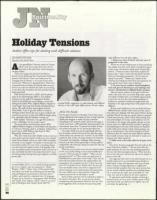
Leonard Felder: su • • estions to make dealing with difficult
relatives at this se er night different from all other nights.
I I
All In The Family
For the past 23 years as a therapist, I have been coun-
seling individuals and couples on how to deal with the
clashes that happen in nearly all of our families.
According to the research study I did two years ago in
which more than 1,300 randomly selected people were
interviewed, more than 75 percent of us have at least
one relative who gets on our nerves year after year.
You might think you are the only family that has
lots of tension mixed with lots of love, like the maror
(bitter herbs) and charoset (nut "mortar") in the Hillel
sandwich. But, in fact, it's quite common for Passover,
Chanukah, bar mitzvahs, weddings, baby namings,
funerals and other family gatherings to bring together
mishpachah who don't get along too easily but who are
family nonetheless.
What do you say when your not-too-subtle brother-
in-law, your pushy sibling or your never-satisfied par-
ent says, "Have you put on weight?" "When are you
getting married?" or "How come your kids aren't as
well-behaved as your sister-in-law's kids?" How do you
deal with the clashes between the traditionalists, the
progressives, the secularists and the "I don't want any
part of it" branches of your family? How do you stay
sane and healthy when your seder is supposed to be
about letting go of our enslavements and narrowness,
but your relatives say or do insensitive things that
remind you how far we still need to travel?
Each of these questions will be explored in detail at
the April 4 discussion. But, in case you are already
anticipating and preparing for Passover, here are a few
brief suggestions that can make the upcoming seder
night different from all other nights:
1. Bring your sense of humor and your sense of
perspective to the seder.
When one of your relatives says or does something
that makes your skin crawl, that's a wonderful oppor-
tunity to say a humorous, silent prayer of gratitude,
such as, "Thank you that I don't have to spend 24
hours a day, 7 days a week with this family member
who is so insensitive sometimes." Or you can say
calmly to yourself, "Thank you, Creator of the
Universe, for letting me learn from this particular rel-
ative exactly how I don't want to behave."
2. Do your best to combine chesed (lovingkind-
ness) and gevurah (firmness) in your dealings with
invasive, self-absorbed or difficult family members.
Like an intense workout in the gym or like the
sand in the oyster that can slowly help make a pearl,
our family members give us wonderful opportunities
to see if we can live up to the sacred teachings of
Judaism to somehow combine lovingkincIness and
firmness in the right proportions with people who are
difficult.
If your usual tendency is to be too kind and your
difficult family member often treats you like a door-
mat, then your dealings with this person before, during
and after Pesach this year are a good chance to practice
a little more gevurah, which means limit-setting, firm-
ness and strength. Or if your usual tendency is to be
too harsh or too abrupt with people who get on your
nerves, then your difficult family member is going to
be presenting you this year with chances to bring for-
ward a little more chesed, which means patience, car-
ing, or consideration. One of the mysteries of God's
universe is that if it weren't for these difficult relatives,
how would we know what we still need to work on to
improve and refine ourselves?
3. Make room at the seder table for all types of rel-
atives.
One of my favorite paragraphs from the seder is the
story of the four children — the one who takes the
seder seriously; the one who asks doubting questions;
the one who feels estranged and says, "What does this
have to do with me"; and the one who is too simple or
pure to ask at all.
Our sages put that story in the seder because we as a
Jewish people and as an extended human family are
called upon to love and appreciate each type of ques-
tioner. Instead of being impatient or judgmental
toward a family member who is far more serious than
you or toward a family member who is feeling skepti-
cal or removed, the seder says beautifully to "wel-
come one and all to share in the story together."
To appreciate each family member as having a
welcome point of view and a hidden spark of holi-
ness deep inside can allow you to lighten up a bit
and enjoy the gathering. ❑