

For information on submitting an announcement,
please visit mazeltov@thejewishnews or call (248) 351-5147
Still Good Friends
After seven decades, this group of boyhood buddies remains together.
LEONARD POGER
Copy Editor
T
wenty Jewish teenage boys formed an
unusual — and enduring — group 70 years
ago.
There were no bylaws, officers, dues or program
chairmen. The members just wanted to be with each
other and enjoy sports and conversation.
It was during the Great Depression and the boys
were about to graduate from Durfee Intermediate
School on Detroit's near west side and enter nearby
Central High.
The boys became men together, went to war,
raised families and built careers while maintaining
their friendship through the decades. After 70 years,
they remain so dedicated that one member even flies
in from California to enjoy the fellowship of their
monthly meetings.
The club, called the Kiroes, "exemplifies true and
lasting friendship, loyalty and camaraderie," said
Norman Sommers of Bloomfield Hills, one of the
founders.
On Monday, Oct. 11, the surviving 11 members
and their wives will gather for a 70th anniversary
dinner.
"The group association was based on close friend-
ship," he said. "We had baseball and basketball
teams and participated in league competition."
Sommers, a semi-retired attorney, said the group's
name has no special meaning or relevance. "It was
just picked out of the sky — it was just a wild name."
Sonimers stressed that the name, which is pro-
nounced "Cairo," has nothing to do with the name
of the Egyptian capital. But he did say that everyone
who hears the name asks about its origin.
Finding Success
JN
10/ 8
2004
76
At the beginning, the group was geared toward
achieving success in American society. It would meet
every other Sunday at members' houses.
"One distinct feature of those meetings," said
Sommers, was the 'round table' discussion, where
members critiqued the conduct of each other on a
very constructive basis, without any animosity, to
help each member improve himself in social con-
duct."
After graduating Central in 1937, nearly all the
Kiroes members went on to college. Growing up
during the Depression and coming from poor fami-
lies, most of the Kiroes' families didn't have money
for tuition. But they took advantage of a federal
National Youth Administration program that
enabled students from poor families to pay for their
college education by doing work on campus. Since
the program covered only tuition and books, several
Kiroes also had to work in the private sector to earn
money for miscellaneous expenses.
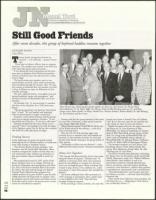
About 30 years ago, celebrating four decades together are, front row, Cyril Astrein, Dr. Norbert Ketai,
Dave Muskovitz, Dr. M Robert Yoffee, Dr. Maurice Fried and Hal Eisenberg; back row, Dr. Jack Weiss,
George Lerner, Albert Gendel, Leo Keeps, Donald Corn, Norman Sommers, Martin Mattler, Dr. Alex Weinberg,
Dr. Leon Firestone and Ben Lerner.
Sommer said that the group wanted its club name
to sound like a fraternity, so they picked a pseudo-
nym, Kappa Alpha Xhi (KAX).
When America entered World War II, all but two
of the Kiroes served in the military — with all of
them returning home.
After the war, the club meetings again com-
menced, but on a monthly basis, and baseball was
resumed. As the members married, the wives also
became close friends, sharing in the group loyalty of
their spouses.
"Incidentally, no Kiroe was ever divorced — some
difference from today's society," Sommers commented.
Many Get- Togethers
"The annual club Memorial Day picnics were some-
thing the Kiroes all enjoyed," Sommers said. "In
addition to the picnic food, there were numerous
games for the children to compete, but the main
event was the baseball game, which everybody who
wanted to play, Kiroes, wives, children, etc., could
participate in. Some Kiroe parents also attended the
picnics."
The Kiroes celebrated their 25th anniversary in
1959, by going to Grossinger's, then a plush resort
in the Catskills in New York. They still meet
monthly during the summer.
Of the surviving 11 Kiroe members, the only who
moved out of state is Donald Corn of Carlsbad,
Calif. But he flies into town for the monthly din-
ners, which are open to wives and widows.
Besides Sommers and Corn, the other nine surviv-
ing Kiroes are Dr. Leon Firestone of West
Bloomfield, Leo Keeps of Southfield, Dr. Norbert
Ketai of West Bloomfield, George Lerner of Oak
Park, Dr. Irving Levitt of Bloomfield Hills, Dr.
Alvin Lezell of Southfield, Martin Mattler of
Bloomfield Hills, Dr. Maurice Reizen of Okemos
and Dr. M. Robert Yoffe of Huntington Woods.
The deceased members are Cyril Astrein, Hal
Eisenberg, Maurice Fried, Albert Gendel, Ben
Lerner, Dave Muskovitz, Irving Taylor, Dr. Alex
Weinberg and Dr. Jack Weiss.
The Kiroes' boasted three physicians, (including
Dr. Reizen who was the director of the state Public
Health Department under Gov. William Milliken),
three dentists, three builders, as well as an
optometrist, podiatrist, hospital administrator,
lawyer, accountant, real estate broker, plumbing
contractor, meat distributor, collision shop operator,
a manufacturers' representative and a manufacturer.
"Notwithstanding their varied careers, they had
one thing in common — devoted, loyal friendship,"
Sommers said.
Other similar boys clubs have come and gone, but
the Kiroes live on — celebrating its 70th anniver-
sary at Monday's dinner.
❑