

Search For Meaning
Young doctor takes a year off to study at Jerusalem yeshivah.
SHARON LUCKERMAN
StaffWriter
hen former Detroiter Dr. Alan
Millman graduated from medical
school and completed his residency
in neurology and pain management
over a year ago, he decided there was something
'2'17 Zr:7711
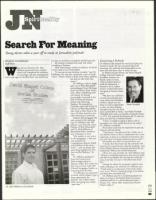
Dr. Alan Millman at his yeshivah.
he had to do before starting his medical practice.
He wanted to deepen his study and under-
standing of Judaism.
After researching a variety of yeshivot, he decid-
ed to study at one in Jerusalem.
"It was not an easy decision to make," says Dr.
Millman, 33, who just completed a year of study
there. "I had a desire to learn more about Judaism,
but had no idea whatthat
meant."
Dr. Millman, who is single,
grew up in West Bloomfield
and graduated from Michigan
State and Wayne State univer-
sities. After completing med-
ical school, he became
increasingly interested in his
faith and started keeping
kosher and observing
Shabbat. He attended an
Orthodox shul with friend P.J.
Cherrin of West Bloomfield,
who lived in New York at the
time. He then started to con-
sider learning at a yeshivah.
Judaism and synagogue life
were central to his upbring-
ing, Dr. Millman says. His
parents, now divorced, Anita
Naftaly of West Bloomfield
and Dr. Neil Millman of
Bloomfield Hills, instilled a
love of Judaism in him.
"My mother is very active
in the synagogue — she was
vice president of
Congregation Shaarey Zedek
and president of the sister-
hood — and we always did
something together for holi-
days and for Shabbos," he
says.
Dr. Millman graduated
from the Conservative
Hebrew high school at
Shaarey Zedek. But credits his
first trip to Israel, with USY
(United Synagogue Youth), as
a turning point for him.
"It really got me connected
to Israel, and it's where I got a
deep appreciation for
Judaism. But I didn't think
about becoming more obser-
vant then."
Discovering A Yeshivah
Dr. Millman did research for the kind of place he
wanted to study. He was concerned about the
stereotype of a yeshivah that brainwashes its stu-
dents and tells them what to think, he says.
At Yeshivat Darche Noam, the David Shapell
College of Jewish Studies in
Jerusalem, however, he
found a place, he says,
"where students learn to
think for themselves. I
wanted to be in a place
where I could decide how I
was going to become obser-
vant."
"We draw our staff from
a broad international spec-
trum within the Orthodox
world to expose our stu-
Rabbi Hirshfeld
dents to various approaches
so they can learn Judaism
and grow into the one that's
most comfortable to them," says Rabbi Yitzchak
Hirshfeld, dean and a co-founder of Darche Noam
in 1978. The yeshivah has between 60-75 male stu-
dents and also has a women's branch.
"I knew I needed to spend at least a year in
Jerusalem, but what would this do to my career,"
Dr. Millman wondered.
He decided study was too important to pass up.
Then he told his family.
"They knew I was observant for a while, but it
was hard for them at first to understand why it was
important to learn in a yeshivah environment. But
you can't learn to become observant once a week."
His mother says she's very proud of her son.
"I think what Alan learns [at the yeshivah] will
help him be a good doctor, ethically speaking," says
Anita Naftaly, director of special education for the
Federation's Alliance for Jewish Education.
Of his son's year of study, Dr. Neil Millman says,
"He had a wonderful experience that met his needs,
and this was probably the one time he could take
time to do this. I'm sure it will affect him all his
life."
Though he admits he missed his medical work
while studying at the yeshivah, Dr. Millman says,
"Torah study is as important, if not more impor-
tant, to me. There's a spiritual energy in Jerusalem
you don't have anywhere else."
Dr. Millman says he is considering aliyah but
plans to return to the United States to practice
medicine and live in a frum (observant) area —
Passaic, N.J., where other alumni from Darche
Noam reside. ❑
8/ 6
2004
49