

IMPACT
from page 20
"I felt so isolated and alone. When
you know someone who died, it tears
you apart. This really makes me feel like
I'm doing something," Rina Yaari said.
Esther Posner of Southfield had a
poignant reason for traveling to
Washington for the rally.
"I'm a Holocaust survivor. I came for
my children and grandchildren. I came
to be counted. I can't think of a more
empowering experience," she said.
Eva Lipton of West Bloomfield is a
child of Holocaust survivors. "Who
listened when they were marched into
the gas chambers? I wondered why no
one staged a march for those in the
Holocaust. I came to be one of the
voices," she said.
Buses bearing those from the Spirit
flight were dropped near the National
Gallery for a short walk to the West
Mall of the Capitol. There were no
Palestinian counter-demonstrators to
quash the mounting excitement as
Detroiters melded with Jews from
across the country. It became difficult
to stay together, but pockets of
Detroiters banded together and lis-
tened to rally speakers in the hot sun.
Michigan State University and
Wayne State University students, all
wearing bright blue "I stand with
Israel" T-shirts, were spotted in the
central section of the rally, closest to
the Capitol steps.
"I'm very happy I'm able to partici-
pate in making history by being part
of the largest pro-Israel gathering in
this country," said WSU student Sarah
Sawilowsky, 18, of West Bloomfield,
who is vice president of Detroit
Friends of Israel.
"I hope we showed the world that
Israel and America are partners against
the same enemy — terrorism. I hope
the government sees how we support
Israel and that they'll do the same.
This was an amazing trip that only
lasted a few hours, but it's an experi-
ence of a lifetime."
We Are One
During the rally, JAMD student
Jeremy Baruch used his video camera
to capture the spirit of the rally,
including mild clashes he saw between
Jews with differing political opinions.
"In the Talmud, it says you should
argue with your colleagues, but have
peace at the gates. That's what they
did," he said.
"It was so warm outside, but I had a
shivery feeling being amongst my peo-
ple. We are part of a greater communi-
MESSAGE
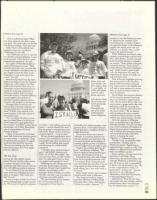
Above: Allen and
Amy Olender with
their children Max,
9, and Teddie, 12,
ofWest Bloomfield
made the rally a
family experience.
Left: Amelia Letvin,
20, of Detroit and
Sarah Sawiloivsky,
18, ofWest
Bloomfield were
part of the Hillel
of Metropolitan
Detroit delegation.
ty of Jews. I was walking around and
thirsty — people shared their water. I
lost my group, so someone lent me a
cell phone. These are Jews of all sorts
coming together — none are lost."
No one seemed apprehensive about
security. Two checkpoints were set up
and people's bags were searched thor-
oughly. Bomb-sniffing dogs quietly
moved among the crowd, mostly
unnoticed.
"I thought about security before I
came," said JAMD student Jacob
Kahn, 14, of West Bloomfield. "But
once you were there, you felt comfort-
able. I'm really glad I came to show
my support and strength for Israel."
Following the rally, things went very
smoothly, thanks largely to Rabbi
Buckman, Temple Israel's Rabbi Paul
Yedwab, vice president of the
Michigan Board of Rabbis, and Allen
Olender, who kept track of people by
cell phone and walkie-talkies.
The Spirit Airlines group stopped
for a kosher pizza dinner at
Congregation Tikvat Israel in
Rockville, Md., whose members were
gracious hosts. Their Rabbi Howard
Gorin had been a childhood friend of
Rabbi Buckman's.
The journey home was a time of
reflection. A consensus seemed to be
that the speakers were good, but what
was most powerful was the feeling of
standing together as Jews of all persua-
sions in support of Israel's right to exist.
"Israel is the unifying force for all
Jews," said Miriam Goldberg. "We
have to really be behind Israel to pro-
tect her. She belongs to all of us."
Hannah Korelitz, who took a break
from her first-grade homework, said,
"I care about Israel. Doing this mitz-
vah, the hardest part was that it was so
long and so hot and all those people
were talking, but it was really worth it
for Israel."
Many mused whether their presence
would actually make a difference.
"You hope you made an impact,"
said Doris Blechman of Bloomfield
Township after a long, satisfying day.
"At least you made a memory." ❑
from page 21
mission to rout the Palestinian terror-
ist infrastructure. Another major
stumbling point is whether Arafat is
the legitimate leader of the Palestinian
people who should meet with U.S.
officials, or a terrorist who is irrele-
vant to the political process.
While Wolfowitz was booed, other
speakers received huge ovations when
they called Arafat a terrorist and said
Israel should be allowed to complete
its mission. "Yasser Arafat is the quin-
tessential terrorist," former Israeli
Prime Minister Binyamin Netanyahu
said. "Arafat pursues a goal of poli-
cide, the destruction of a state, by
employing the means of suicide, sui-
cide and mass terror."
That dichotomy highlights growing
fear among some in the American
Jewish community that continued
U.S. intervention in the Middle East
will lead to more pressure for conces-
sions by Israel and more Israeli vic-
tims of terrorism.
David Harris, the executive director
of the American Jewish Committee
who was involved in organizing the
1987 rally for Soviet Jewry, said it was
much easier to gauge results after that
gathering, simply by counting the
number of emigrants allowed to leave
the Soviet Union. "We are dealing
with something far more complex,
multidimensional and does not lead
itself to easy measurements," he said.
As for the response to Wolfowitz,
some are downplaying its significance.
Malcolm Hoenlein, executive vice chair-
man of the Conference of Presidents of
Major American Jewish Organizations,
said he believed the booing was limited
and was predominantly a knee-jerk
reaction to hearing the words
"Palestine" or "Palestinian state."
"Frankly, it was not carefully crafted
to avoid that," Hoenlein said of
Wolfowitz's speech. "People have to
understand how to speak at a rally. That
address at a different forum would have
had a very different reaction."
Morris Amitay, a former head of the
American Israel Public Affairs
Committee, the pro-Israel lobby, said
although Wolfowitz is hawkish in sup-
port for Israel, he had a responsibility
to deliver the administration line. "He
is now a representative of the U.S.
government," Amitay said. "You pay
lip service to the sufferings of
Palestinians, which has become part
of the psychological lexicon."
Added Harris, "If, in the end, there
were people who were
re unhappy with the
administration, then it was important
for the administration to hear it." ❑
4/19
2002
23