

The Waiting Game
Misunderstood
Mitzvah
Time, as well as illness, beleaguers those needing transplants.
DAVID SACHS
Joy, Then Depression
Copy Editor
"They started to prep me," Sheldon said. "Then
they discovered the new kidney had a blood clot and
they couldn't use it."
"I had thought this was the miracle we were look-
ing for," said Diane, 63. "It was like God smiled on
us and then took it away.
"Shel was very upset and depressed for a few days.
It took me about four months to snap out of it.
Then we had to deal with the fact that someone
died," she added. "Even though we didn't know her,
her family was willing to donate her organs. I had
terrible pain for them, not even knowing them."
Before qualifying for a transplant, Sheldon, a
retired food broker, had to go through a series of
physicals and tests.
"The physical in January showed blood in my
stool, which proved to be a colon tumor. They cut
out about a quarter of my colon. They told me that
it would have turned malignant by summer.
"The physical was a godsend — I would have
never caught the tumor. I was much luckier than I
ever thought. They saved my life on that."
But now, the wait goes on.
"We don't go anywhere," said Diane. "He wears a
pager set for Michigan and Ohio. The timeframe to
get to the hospital is too short to go far.
"We can't take the chance in getting a flight back
in time. It's just not worth it.
"We've met so many lovely people in such dire
straits," she added. "And we've seen how healthy
they are after they get their transplants. It's totally
amazing.
"If our message jolts the community into thinking
of other people and getting past the thought of giv-
ing up an organ, it's well, well worth it," Diane said.
What has Sheldon learned this past year? "Get
physicals and definitely donate," he said. "It is
imperative to donate organs." ❑
T
he wait.
It can be an emotional roller-coaster
ride of medical calamities and false hopes.
And it also can be frustratingly
uneventful — like listening for a telephone call that
doesn't come.
Time not only passes for Sheldon Benis of West
Bloomfield as he waits for a kidney transplant — it
might someday run out.
"It's very scary," said Sheldon's wife, Diane. "We
live in terrible fear of him having to go on dialysis.
We've been hoping that he could get a transplant
before it happens.
"I offered Shel a kidney, but I was the wrong
blood type," she said. "Living like this is for the
birds. I love him and I want him healthy."
Sheldon's kidneys have been steadily deteriorating
over the past 10 years from diabetes. At age 67, and
on the verge of kidney failure, he is without a family
member or friend who can be a donor.
So he waits. Henry Ford Hospital doctors told
him in March that the wait in Detroit for a cadaver
kidney could be four to five years. In September, he
got on the waiting list at the Medical College of
Ohio in Toledo, where, in the Toledo-Dayton dis-
trict, the wait could be only a year.
But, in the rare occurrence that a perfect blood
and tissue match is found, Sheldon would get that
kidney, no matter where he was on the waiting list.
Sheldon appeared to have hit the transplant jack-
pot last June. After only three months on the Henry
Ford list, the Benises were called and told that a per-
fectly matched kidney from a 25-year-old woman
who died in an automobile accident in Connecticut
was available and that they should rush to Ford
Hospital for surgery.
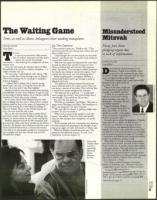
Diane and
Sheldon Benis
wait for a
potentially
lifesaving
kidney
donation
for him.
Many Jews shun
pledging organs due
to lack of information.
DAVID SACHS
Copy Editor
D
avid Techner, funeral director at Ira
Kaufman Chapel in Southfield, wasn't
surprised by the responses he got when
he asked a temple adult education class for their
views on organ donation upon death.
"Everybody thought that it wasn't permissible
because it was a desecration of
the body," he said
"Most of the time, people are
quite surprised to learn that its
actually a v.,onderful mitzvah."
"I think the perception starts
with the community's feeling
about autopsies, that there is a
desecration. Somehow the two
get linked together."
Organ harvesting, Techner
said, "is a surgical procedure. It's
done respectfully, its done as
quickly as possible, with empha-
David Techner
sis on the'need for everything to
be done in a proper way"
As myths persist about the propriety of Jewish
organ donation at death, the fact remains --
most Jews are reluctant to sign up as donors.
An Orthodox issue regarding the prevailing
ha/achic (Jewish law) view versus the modem med-
ical definition of death keeps many from donating
(see accompanying article on page 14), but most
Conservative and Reform _Jews, whose MOVements
present no restrictions: decline as wen.
Rabbi Elliot N. Dori, a Conservative propo-
nent of organ donation, says that in the United
States, 60 percent of people consent when asked
to be organ donors, but only about 5 percent of
Orthodox Jews do so, and the record of
Conservative and Reform Jews is not much bet--
ter." His book Matters of Lift and Death: A Jewish
Approach to Modern Medical Ethics notes the
same reluctance in Israel.
Dale Mintz, national director of women's
health for Hadassah, says, "We know that Jews
ta bialikely to give because of what the hospi-
"In Israel, -dkco mm un ities .
-
donated organs. In the tai4and people waiting for
.at's a lot of
people. If every person who pa-ssreaga.Th
able to give gave, there would be no waiting &as.
MITZVAH on page 12
12/29
2000
1l