

doctors in from all over the country"
"Part of the time," Jane said, "is making sure the
body is in shape and part of the time is coordinating
the doctors of the recipients. They only harvest all at
one time. They take the body to the operating room
and cut it open and all the recipients' doctors have
to be there to get the organs. They take everything
they need out. " •
A 46-year-old man with cirrhosis received Jennifer's
liver. A 38-year-old diabetic woman received her pan-
creas and left kidney after two years on a waiting list.
A 62-year-old father of four who had high blood
pressure for 20 years received her right kidney.
Advocates of transplants say the donor families
often take solace in the fact that parts of their loved
ones live on in others.
"Our daughter would have liked to do this," said
Jane. "It was a good thing to do. But I don't think it
makes us feel all that great. Our daughter is still
dead. It's nice to think that more people are alive
because of her, but selfishly, we would rather have
her back.
"It's a difficult decision," she said. "I think we
would do it over again. It's a good thing because
you're saving people's lives. It ' s a decision that's
important to make and it's a giving decision."
Letter Of Thanks
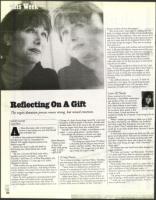
Reflecting On A Gift
The organ donation process rouses strong, but mixed emotions.
Chicago of a brain hemorrhage caused by a rare mal-
formation of blood vessels in the brain. Jennifer had
Copy Editor
decided earlier that if she were to die, she wanted to
share her organs with those who needed them.
s Dana Burnstein rode to the hospital to
"Jennifer was a giver, a helper, a contributor, a vol-
receive a new kidney, joy and relief should
unteer
— just a good person," said her father.
have overtaken her.
Even though the decision to donate was made
long beforehand, it was very painful
A sufferer from polycystic kidney disease,
process for the Polans.
her three-year wait on a transplant list
Dana Bu rnstein:
"The thing you expect from TV shows
behind 525 equally desperate patients was
"People j ust have
is
that they pull the plug or stop the res-
about to pay off.
to know that
pirator,"
said her mother. "But they don't
Instead, her mind could only dwell on
they're re ally giving ever do that. The oxygen has to be flow-
the young man whose kidney she would
a gift. It truly is
ing to keep the organs viable."
inherit.
DAVID SACHS
A
a gift of life.
"He was a 22-year-old black male with a
gunshot wound to the head — that's all I
was told," said Dana, 55, of West Bloomfield, who
received the kidney 2 1 /2 years ago at St. John's
Hospital in Detroit.
"I felt terrible that my good fortune was depend-
ent on somebody's misfortune. And being a mother
of two children who weren't that much older than he
was, I couldn't even begin to guess what his mother
was going through."
From the other perspective, grieving parents Jane
and Jesse Polan of Franklin know the emotional
trauma of organ donation all too well. Their 23-
year-old daughter, Jennifer, died suddenly June 2 in
A Long Process
"So it is kind of strange," said Jane Polan, "handing
over the person that you love, even though they're
dead — still breathing by means of equipment.
"I don't think we realized how extensive the
process is in prepping the body for donation. It was
a 12-hour or more process from when the person is
declared brain dead until the harvesting begins."
Added Jesse Polan, "They do all kinds of tests to
establish the ability of the organs to pass their crite-
ria for organ donation. It's a complex process that we
weren't really aware of before the fact. They flew
Dana, married to Dr. Gary
Burnstein, a Southfield cardiologist,
and mother of Ian, 31, and Lori,
28, reflected on the family of the
man whose kidney is now inside
her. "I do not know the people; I
Jennifer Polan
do not know their names. I did
write a letter. It took me about six
months to finally do it because I was trying to be so
profound.
"What I ended up writing to them was a little
bit about my family, my children, my husband
and what a gift they had given, not only to me,
but to them. That I wished there were more I
could do or say than thank them, because it seems
so inadequate.
"I wrote that they've given me back my life, and
given my husband his wife and my children their
mother. And that I was doing exceptionally well,
and that I hoped for them and prayed for them
that they were doing all right. And I thanked
them again."
The Polans have not heard from their daughter's
organ recipients.
"I've been very lucky," said Burnstein. "It's been
2 'I' years and I have had no rejection episodes at
all. I'm on minimal amounts of anti-rejection
medication. I went back to work six weeks after
the transplant."
Dana works three days a week as a sales clerk at
Scott Gregory boutique in Bloomfield Township
and is president of the Michigan region of
Women's American ORT. She does other volunteer
work as well.
"I'm going to be a grandmother in a few months
and I'm going to baby-sit for a grandchild!" she said.
wake up every morning and smile. And I'm
here to tell the tale."
12/29
2000
10
$
s